


Wrist-Worn Inertial Sensors for Technique Diagnostics and Injury Prevention in Hammer Throw – A Sports Medicine Perspective
Handgelenkgetragene Inertialsensoren zur Technikdiagnostik und Verletzungsprävention im Hammerwurf – eine sportmedizinische Perspektive
Graphical Abstract
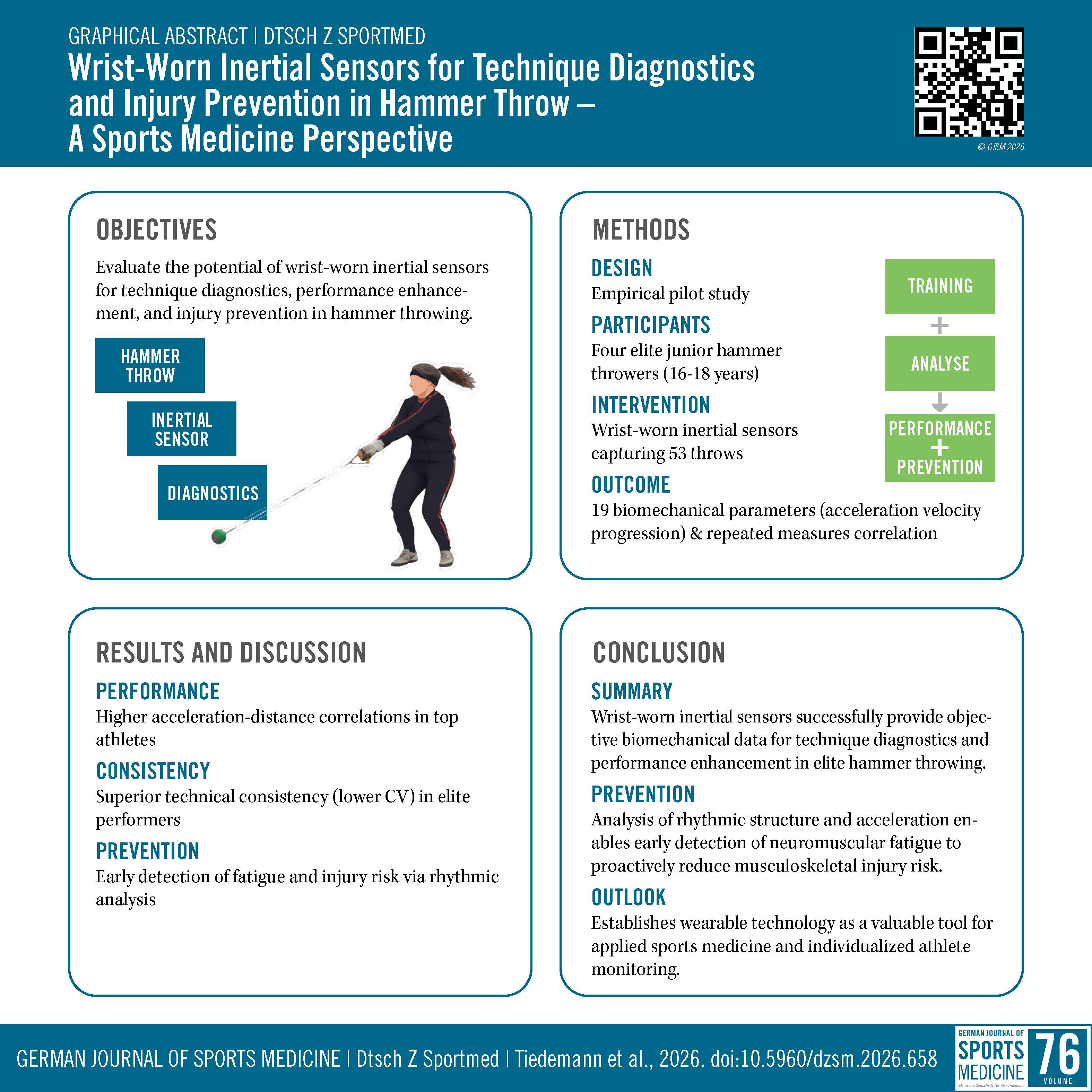
Summary
Aim: This pilot study successfully established a framework for IMU-based technique diagnostics in hammer throwing, demonstrating that a single wrist-worn sensor provides high-fidelity data for both performance analysis and injury prevention. By deriving 19 specific parameters based on a biomechanical rationale of progressive acceleration, the research bridge the gap between raw inertial data and elite coaching requirements.
Key Findings and Statistical Insights: The application of repeated measures correlation revealed that performance determinants are highly individualized. Advanced athletes (Athletes 1 and 2) exhibited a significantly higher number of parameters that correlated strongly with throwing distance, particularly regarding acceleration magnitudes in the final turns. Furthermore, technical proficiency was objectively quantified through the Coefficient of Variation (CV).
Technical Progression and Rhythmic Structure: The analysis of acceleration time courses confirmed that optimal technical execution is marked by a steep increase in acceleration during the power position of the final turn. The derived acceleration ratios (Qa) provided an objective measure of the rhythmic buildup, identifying whether an athlete maintained sufficient “acceleration reserve” for the final phase of the throw.
Clinical and Practical Implications: From a sports medicine perspective, this study highlights the potential of wearable technology for proactive injury prevention. By monitoring intra-individual variability in real-time, the sensor can detect early signs of neuromuscular fatigue. A sudden rise in the CV serves as a proxy for technical instability, which increases the risk of suboptimal joint loading and acute musculoskeletal strain under high centrifugal forces. Thus, IMU-based monitoring facilitates a biofeedback-driven approach to training load management.
Future Perspectives: In conclusion, the wrist-worn sensor appears to be a valid and practical tool for analyzing movement execution in elite junior athletes. Future research should expand this scope to a longitudinal outlook, investigating how alternating implement weights (overweight/underweight) impacts the rhythmic structure and long-term technical stability. Such data will be crucial for refining individualized training protocols and ensuring the long-term orthopedic health of developing elite throwers.
Key Words: Athletic Performance, Monitoring, Pilot Study, IMU-Technique, Movement Analyzation, Individualized Training Protocol
Introduction
 The hammer throw is a track and field event considered a form of heavy athletics. The objective is to throw the hammer as far as possible. This athletic discipline is characterized by its complex whole-body movement, multiple body rotations, dynamic balance maintenance, and immense force generation (17). While the primary goal is maximizing throwing distance, the unique demands of the sport also result in significant repetitive and asymmetrical loading, making the assessment of movement quality a critical task for applied sports medicine and injury prevention (11).
Like other throwing disciplines, the throwing distance depends on the release parameters, such as velocity, angle, and height (7, 9). Performance has largely plateaued since the 1986 world record held by Yuri Sedykh (86.74 meters), emphasizing the need for highly precise, individualized technique refinement to achieve marginal gains and, crucially, to maintain long-term athletic health.
From the biomechanical perspective, the hammer throw consists of three phases (5): 1) Preparation phase (winds), 2) Main phase (turns), and 3) Final phase (release of the hammer).
The most crucial phase is the main phase (three-five rotations) which generates the maximum release velocity (9). During this phase, the resulting linear velocity of the hammerhead varies, making individual turns distinguishable (3). The power position in the double support phase significantly impacts the development of increased velocity (8, 15) and is defined by the dissociation angle between the upper and lower body. Inconsistencies in achieving this power position, while detrimental to performance, are also recognized as potential mechanical risk factors leading to uneven joint loading and musculoskeletal stress (11, 19).
To monitor these critical parameters, the crucial phases of the hammer throw can be identified indirectly. Systems such as force sensors (4) or inertial sensors attached to the hammerhead (16) detect peak values in cable tension or acceleration, which – according to established technical models (8) – correspond to the ‘power position’ and the point of maximal velocity gain. However, these approaches often require aboratory settings, limiting their utility for long-term monitoring in routine training, which is essential for effective prevention and early detection of technical decay. An alternative approach is to use non-invasive, athlete-worn devices (e.g., smartwatches or specialized IMU). Unlike discrete measurement systems, these sensors provide a continuous temporal profile of the resulting wrist acceleration throughout the entire throw. Analyzing the reproducibility of these acceleration trajectories across multiple trials offers valuable insights into an athlete’s technique stability and movement variability (2, 6, 12). Such monitoring is crucial, as high variability in elite athletes can be an early indicator of fatigue or technical decay, thereby upporting both performance diagnostics and injury prevention.
Despite the established importance of objective biomechanical data, there remains a significant gap in practical, field-based measurement tools for hammer throwing. Current systems, such as cable force sensors (4) or hammerhead-mounted inertial measurement units (16), often require specialized setups or complex post-processing. This lack of portable technology prevents coaches and athletes from receiving immediate feedback during routine training sessions, which is essential for identifying technical decay early and preventing load-related injuries (11, 15).
This study aims to address this deficit by evaluating the utility of a non-invasive, wrist-worn inertial sensor for comprehensive technique diagnostics in a field-based setting. We specifically differentiate between parameters that can be derived immediately from the sensor to provide ‘quick feedback’ in training (e.g., peak resultant acceleration) and more complex parameters that require further post-hoc calculations, such as phase identification based on established technical models like Hinz (8).
Furthermore, we explore the potential of using continuous acceleration trajectories to assess movement variability. By analyzing the reproducibility of these patterns, we aim to provide a foundation for monitoring technique stability, which is a critical factor for long-term athletic health and performance (2, 6, 12, 14).

Materials and Methods
Subjects
Research was conducted during a regular training session for junior athletes of the German Athletics Federation (DLV). Four elite junior athletes (aged 16-18 years) participated, performing a total of 53 throws. Athletes 1-3 performed four turns, while Athlete 4 performed three turns (table 1). All participants provided informed consent, and the study was supervised by a certified coach. Figure 1 provides an overview of the study design and data collection structure.
 Experimental Procedure and Sensor Setup
The inertial sensor VmaxPro (sampling rate: 60 Hz, measuring range: 32g, company Enode, Germany) was attached to the athlete’s forearm just above the wrist using a non-slip wristband. Mounting the sensor required five to ten seconds and, according to the athletes, did not affect their performance. In this study, the term “wrist” is used synonymously for the mounting position on the forearm.
The classification of trials prioritized technical proficiency over absolute throwing distance. In elite junior training, a throw may achieve a significant distance despite suboptimal biomechanical patterns; however, such trials are categorized as technically ‘low-performance’ due to their lack of efficiency and potential for injury. Consequently, technical stability – assessed by the expert coach – served as the primary criterion. Throwing distance was nonetheless recorded to contextualize the data and to validate that the measured acceleration parameters correlate with the overall performance intensity.
The selection of parameters is based on the fundamental requirement of hammer throwing: the continuous and progressive buildup of velocity across all turns. Three core biomechanical principles guided the derivation of our metrics.
Acceleration Volume
Since the final release velocity is the result of the total impulse generated, we chose the integrated acceleration area as a proxy for the ‘work’ performed in each turn.
Rhythmic Progression
A technically throw requires a specific ratio between early and late turns. The Qa and QA ratios were derived to quantify whether the athlete maintains an ‘acceleration reserve’ for the final phase.
Temporal Consistency
Effective force application is highly dependent on timing. Therefore, temporal landmarks and CV values were selected to evaluate the stability of the rhythmic structure across multiple trials. By analyzing these parameters, we aim to describe the individual technical profile.
Data Processing
All derived parameters are based on the resulting acceleration (ares) calculated from the three acceleration axes. To attenuate high-frequency noise, the signal was filtered using a fourth-order Butterworth low-pass filter with a cut-off frequency of 5 Hz. This approach follows Murofushi et al. (13), with a slightly adjusted cut-off frequency to optimize the signal-to-noise ratio for this specific setup.
Determination and Calculation of Parameters
Temporal landmarks were derived from the raw sensor timestamps to form the basis for all duration and acceleration parameters (figure 2). Phase durations were determined via maximal acceleration peaks. To analyze velocity development, the acceleration curve for individual time intervals was integrated to obtain the mean velocities per turn, effectively filtering out short-term outliers. Furthermore, ratios of the maximum rotational acceleration in turns 1-3 relative to the final turn (Qa_maxT1-3) were determined to represent the acceleration progression (8). A similar procedure was applied to the integrated acceleration values (QA_T1-3). These parameters are detailed in table 2 and figure 2.
Analysis and Statistics
Pearson correlation analysis was used to determine significant relationships (p<0.05) between parameters and throwing distance (r>0.5 moderate; r>0.8 high). Additionally, repeated measures correlation was calculated to account for multiple throws per athlete (1). To assess technique stability, the mean coefficient of variation (CV) of the acceleration during the final turns was calculated.
Results
The correlation analysis reveals highly individual performance determinants across the four subjects (table 3). A clear distinction was observed based on the athletes’ performance levels: while the more advanced athletes (Athletes 1 and 2) exhibited multiple significant correlations, the less experienced subjects (Athletes 3 and 4) showed only one or no significant relationships between sensor parameters and throwing distance. For the higher-level athletes, performance was primarily associated with acceleration magnitudes and integrated velocity proxies, particularly during the final turns of the throw. This suggests that as performance level increases, the consistency and impact of specific kinematic parameters on the final outcome become more pronounced.
The time normalized courses of the resulting acceleration at the wrist of all throws for each athlete were analyzed to assess the forearm movement stability. Figure 3 shows all last turns of each athlete to illustrate the variability in execution.
For a comparison between the athletes, the mean time courses of the acceleration for each athlete from the figure 3 are presented in figure 4. It is noticeable that athletes 1 and 2 show higher accelerations and clear increases in temporal course of acceleration.
In addition, the results for the mean coefficient of variation for all last turns of each athlete are shown in table 4. All athletes have a mean coefficient of variation in the range of 0.107 - 0.134.
Discussion
This  pilot study successfully demonstrates the derivation of performance-relevant parameters in hammer throwing using a single sensor worn on the forearm. By establishing correlations between biomechanical parameters captured by this wrist sensor and the achieved throwing distances, this research presents the sensor’s efficiency in determining key performance quantities. Furthermore, it is possible to carry out a phase classification of the throw regarding the turns using local acceleration maxima. Additionally, the analysis of time courses of wrist acceleration of several throws can be used to assess the stability of movement of the forearm. Importantly, such sensor-driven stability analyses do not only provide athletes and coaches with objective information for performance enhancement, but also allow for early identification of atypical movement patterns that could indicate an elevated risk of injury. This makes the integration of wearable sensor technologies a valuable tool for proactive injury prevention in accordance with current sports medicine recommendations (11).
Using the wrist-worn sensor, 19 biomechanical parameters were derived based on literature and plausibility. Table 3 shows that the higher-performing athletes (1 and 2) exhibit more parameters with significant moderate correlations to throwing distance. In contrast, athletes 3 and 4 show few or none – possibly due to lower tangential velocities and thus a smaller contribution of radial acceleration. For athlete 1, maximum acceleration in each turn has strong influence, likely related to body size and throwing distance. Athlete 2 shows also strong correlations for the final turn (e.g., r=-0.60 for turn duration), aligning with literature. Acceleration ratios in turn 3 (QamaxT3, QAT3) also significantly affect throwing distance. Notably, athlete 2 is the only one showing a clear rise in resultant acceleration during the power position (black curve in figure 4).
The time course of the forearm acceleration curve can help identify turns and key events. Derived biomechanical parameters depend on the athletes performance level, with better athletes showing more significant and slightly stronger correlations. However, performance is defined by distance thrown and may not fully reflect technical execution, which remains difficult to quantify. Figure 3 shows acceleration curves of each athletes last turns, with mean CVs between 0.103 and 0.134. A CV of 0.1 indicates low variability, often seen as positive in performance contexts (10). However, in hammer throw, higher variability – e.g., due to direct implementation of coaching instruction s – may be desirable, as seen in athletes 3 and 4.
According to the trainer, athletes 1 and 2 show better technical execution than athletes 3 and 4, which is reflected in their lower CV values. Figure 3 illustrates this difference, particularly between athletes 2 and 4, with the latter displaying both higher variability and greater acceleration in the final turn. This aligns with prior correlation analyses and findings by Preatoni et al., indicating that lower variability often correlates with more stable and effective movement patterns. However, higher consistency does not always equate to superior performance. Notably, the analysis was limited to forearm acceleration, so conclusions about overall movement stability remain tentative. There are many factors that influence performance, and variability alone is not the only indicator of performance.
Figure 4 further illustrates that athlete 2 demonstrates a strong acceleration increase early in the final turn, aligning with the optimal technical model where a clear power position is established. In contrast, athlete 1 shows a more uniform curve, indicating untapped potential in force application. In the second half of the turn, a minimal acceleration increase is ideal to allow the hammer to overtake the hand and maintain velocity. Athlete 2 performs this phase most effectively, matching the technical requirements for an efficient release. These findings support the use of inertial sensor-based monitoring as a practical tool for both performance optimization and targeted injury prevention. Regarding future research, an interesting outlook would be to investigate the impact of different implement weights on these acceleration profiles. A longitudinal study could clarify how alternating between underweight and overweight hammers affects the rhythmic structure and technical stability, providing objective criteria for individualizing weight-specific training loads in daily sports medicine practice.

Practical Applications and Outlook
As a perspective for single-sensor use, the impact of different hammer masses on technique should be considered. Lighter hammers are commonly used in training and can typically be thrown about 15 m farther. It is therefore relevant to examine how reduced weight affects technique. In a pilot test, athlete 1 performed three throws each with a 6 kg and a 4 kg hammer. Figure 5 displays the corresponding acceleration curves. While averaging three throws is not statistically robust, a clear trend is observable. It can be assumed that the velocity of the hammer head is significantly higher when using the lighter hammer (4).
A clear difference in acceleration magnitudes between the two hammer weights is visible, with similar curve shapes but notable detail differences. This suggests again the correlation between velocity and wrist-measured acceleration, primarily due to radial acceleration (21). Monitoring multiple training sessions could help identify performance-related variabilities and correlations, potentially reflecting fatigue or power loss and enabling objective training decisions. Additionally, sensor data may assist coaches in grouping athletes by performance level. While parameters like peak acceleration or revolution times are measurable, the acceleration curve itself holds the greatest diagnostic potential – which, while difficult to quantify precisely, is increasingly valuable for both performance optimization and preventive sports medicine practice (11).
The wrist-worn sensor enables intuitive phase segmentation, allowing detailed analysis of key events. In hammer throw, the final turn is crucial for maximizing performance. Many athletes struggle with accurately perceiving their interaction with the hammer – especially after preseason strength training, which alters sensory feedback. The findings indicate that this technology can help bridge the gap between perception and actual execution. Moreover, inertial sensors offer a practical and accessible alternative to traditional analysis methods, supporting direct application by coaches and athletes. Importantly, with the technological progress in consumer devices, these sensor-based insights could also be integrated into widely available smartwatches, such as the Apple Watch, making daily technique diagnostics and injury prevention accessible to a broader population (11).
This enables not only improved performance analysis, but also early identification of technical inconsistencies that can serve as precursors for musculoskeletal overload or injury, making such systems valuable for ongoing injury prevention and sports medicine practice. Future studies are needed to investigate the potential of wrist sensors in monitoring of training load, injury prevention and rehabilitation.
Conflict of Interest
The authors have no conflict of interest.
Funding
This project (ZMVI4-070802/20-21) was funded with research funds from the Federal Institute for Sports Science based on a resolution of the German Bundestag (BISp). We would also like to express our thanks for the intensive talks and discussions with the national coach Helge Zöllkau and Steve Schneider as well as the athletes who made themselves available for the investigations.
Ethics Approval
The study was approved by the Ethics Committee of the Otto-von-Guericke University Magdeburg and was conducted in accordance with the Declaration of Helsinki. All participants provided written informed consent before participating in the study. The study was conducted in compliance with all relevant ethical guidelines and regulations.
Summary Box
What is already known?
- Traditional technique diagnostics are time-consuming and often restricted to laboratory settings
- Field-based methods to objectively quantify acceleration buildup are currently lacking
What this study adds?
- A wrist-worn IMU provides 19 parameters, creating a „biomechanical
fingerprint“ of the throw
- Advanced athletes demonstrate higher technical consistency and stronger correlations between acceleration and distance
- Radial acceleration peaks allow for precise phase detection and rhythmic analysis
Practical applications?
- Coaches can use real-time biofeedback to monitor technical stability and neuromuscular fatigue
- Monitoring movement variability (CV) enables proactive injury prevention by identifying technical breakdowns early
References
- Repeated measures correlation. FrontPsychol. 2017; 8: 456.
- Is movement variability importantfor sports biomechanists? Sports Biomech. 2007; 6: 224-243.
- Hammer throwing: problems and prospects. InV. M. Zatsiorsky (Ed.), Biomechanics in sport: Performanceenhancement and injury prevention. Blackwell Science Ltd.2008; 4: 458486.
- Developmentand validation of a method to directly measure the cable forceduring the hammer throw. Sports Biomech. 2008; 7: 274-287.
- Biomechanics of theHammer Throw: Narrative Review. Front Sports Act Living. 2022Mar 31; 4: 853536.
- A proposedframework to describe movement variability within sportingtasks: A scoping review. Sports Med Open. 2022; 8: 85.
- The pattern of hammer speed during a hammer throwand influence of gravity on its fluctuations. J Biomech. 1984; 17:553-559.
- Athletics, throwing and shot: Analyzes andrecommendations for the disciplines shot put, discus throwing,javelin throwing and hammer. SVB Sportverlag, Berlin, 1991.
- (2016, November). The relationshipbetween the duration time of turns and the throwing recordin the men‘s hammer throw. In ISBS-Conference ProceedingsArchive.
- How to Interpret Changes in an Athletic PerformanceTest. Sportscience. 2004; 8: 1-7.
- Track and field throwing sports: Injuriesand prevention. Curr Sports Med Rep. 2017; 16: 391-396.
- Movement variability: A perspective onsuccess in sports, health and life. Scand J Med Sci Sports. 2018;28: 758-759.
- Development of asystem to measure radius of curvature and speed of hammerhead during turns in hammer throw. Int J Sport Health Sci. 2005;3: 116-128.
- Movement variability andskills monitoring in sports. Sports Biomech. 2013; 12: 69-92.
- Art and science of hammer throwing.BookBaby, 2018.
- Wireless inertial sensor systemfor hammer throwing. Int J Comput Sci Sport. 2021; 21: 1-8.
- Hammer throw: A pilot study for a noveldigital-route for diagnosing and improving its throw quality.Appl Sci (Basel). 2020; 10: 1922.
- A wireless sensor system for abiofeedback training of hammer throwers. Springerplus. 2016; 5:1395.
- Is there a relationship between workloadand occurrence of back pain and back injuries in athletes? FrontPhysiol. 2020; 11: 894.
University Clinic Magdeburg
University Clinic for Cardiology
and Angiology, Leipziger Str. 44,
39120 Magdeburg, Germany
E-Mail: stefan.tiedemann@med.ovgu.de