


Cardiorespiratory Kinetics: Importance of Age, Physical Activity, and Exercise Mode
Kardiorespiratorische Kinetik: Bedeutung von Alter, körperlicher Aktivität und Ergometrie-Typ
Graphical Abstract
Summary
Objectives: Maximal cardiorespiratory capacity in terms of maximal oxygen uptake (V˙O2max) declines with age. Submaximal exercise parameters, such as the regulation of the cardiorespiratory system (kinetics) as an indicator of cardiorespiratory fitness, seem to be less influenced by age and are preserved by sufficient physical activity. However, kinetics parameters seem to be affected by the habitual type of locomotion in daily life. Hence, kinetics parameters are compared between younger and older adults with similar levels of physical activity for treadmill and cycle ergometry.
Methods: 16 younger (28±6 yrs) and 19 older (65±6 yrs) participants were tested on a cycle and treadmill ergometer, respectively. The protocols consisted of randomly changing moderate work rates. Kinetics parameters were assessed via time series analysis. Higher maxima at smaller lags indicate faster kinetics responses.
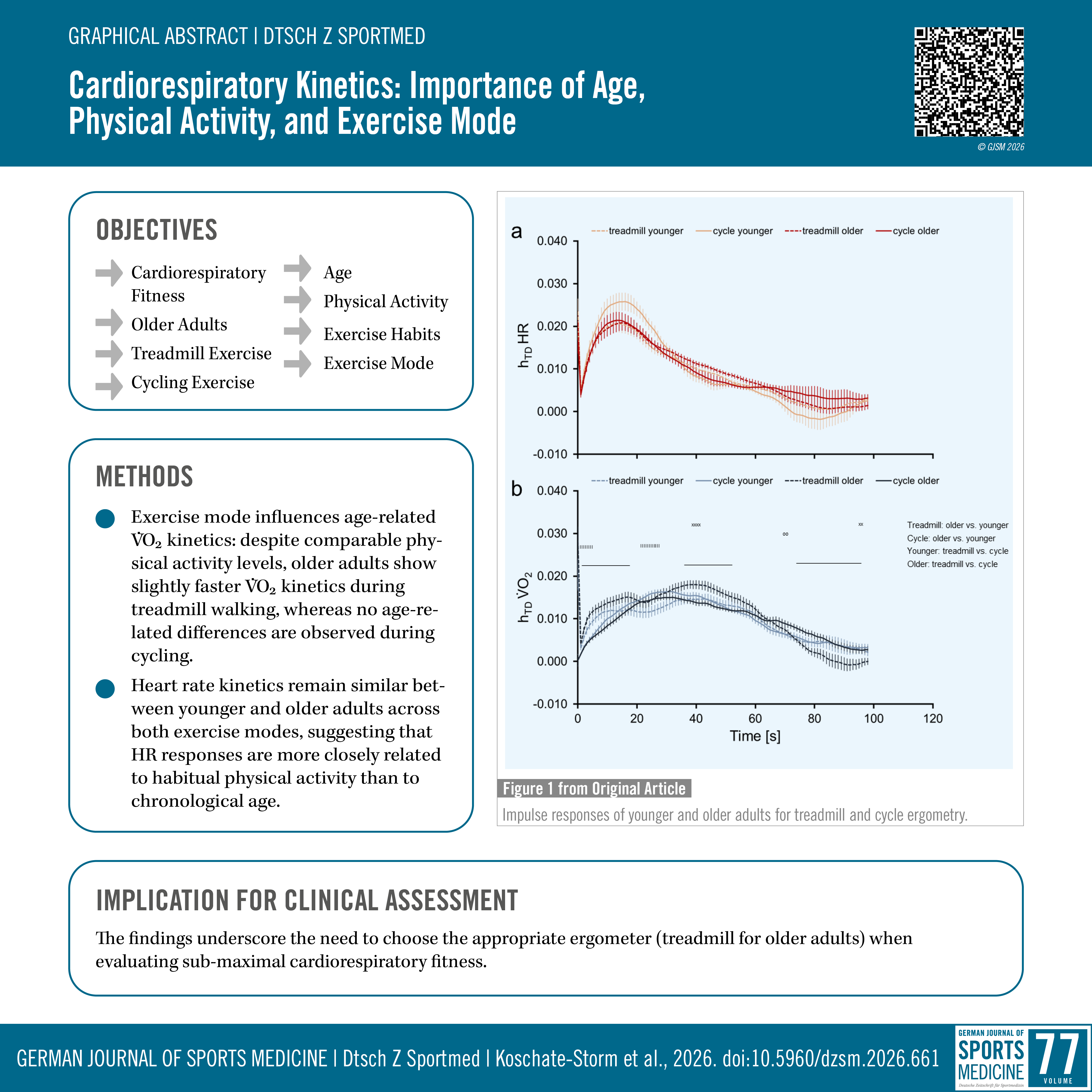
Key results: Time courses for HR kinetics were similar in younger and older adults with equal levels of physical activity (p=0.763), while V˙O2 kinetics were slightly faster for older adults during treadmill but not cycling exercise for several lags (p<0.05). For the older adults, V˙O2 kinetics, but not HR kinetics were faster during treadmill exercise, compared with cycling for several lags (p<0.05), while for the younger adults, faster V˙O2 kinetics were noticed for cycling compared with treadmill exercise for several lags (p<0.05).
Conclusion: The type of ergometry seems to be relevant to assess cardiorespiratory kinetics in younger and older adults. This should be considered in clinical practice, after the findings have been evaluated in a frailer group of participants.
Key Words:
Cardiorespiratory Fitness, Older Adults, Treadmill Exercise, Cycling Exercise
Introduction
Better cardiorespiratory fitness was found associated with a lower risk of all-cause mortality (5, 20, 23, 26). Hence, regular assessment of cardiorespiratory fitness may identify patients at risk of health deterioration and may help to initiate and evaluate adequate exercise interventions. The gold standard to assess cardiorespiratory fitness requires a maximal exercise test to measure maximal oxygen uptake (V˙O2max), verified by the identification of a plateau in V˙O2 (primary criterion), certain values of blood lactate concentration, respiratory exchange ratio, age-adjusted heart rate (HR), and eventually a supramaximal exercise test (10, 24, 33). For many populations, such as older adults or patient groups, this exhaustive exercise test seems to be not feasible, since in many cases criteria are not met and hence, V˙O2peak is reported (33). The concept of V˙O2 peak reporting has been criticized to be arbitrary and to influence the reporting of cut-off values (33). For these populations, the measurement of submaximal cardiorespiratory fitness, e.g. via cardiorespiratory kinetics may be more practical and relevant for daily life (1, 18).
Kinetics, e.g. of V˙O2, can be described by the time constant (τ) in a mono-exponential model, which defines the adaptation rate of oxidative phosphorylation via the pulmonary, cardiovascular, and muscular subsystems to changes in energy demand (13, 32) . Faster kinetics indicate better cardiorespiratory fitness. Similar to maximal values, cardiorespiratory kinetics seem to be influenced by physical activity and exercise mode: Chilibeck et al. (7) found faster V˙O2 kinetics in a small sample of older adults (n=5) during moderate treadmill ergometry, compared with bicycle ergometry. It was reported, that V˙O2 kinetics were faster in muscle groups used in daily life. However, V˙O2 kinetics were slower in older participants, compared with a younger control group in both exercise modes. In more recent studies, analysing heart rate (HR) and V˙O2 kinetics, broad ranges of overlap of τ for older and younger adults were reported (6, 8, 12, 14, 29). In the study of Chilibeck et al. (7), the participants’ physical activity levels were moderate for the younger adults and the older adults participated in a 3-day weekly walk-jog exercise program. For the younger adults a significantly higher V˙O2max was reported, compared with the older participants. Hence, it is largely unclear whether the two rather small populations are comparable regarding individual fitness levels. Therefore, cardiorespiratory kinetics should be compared between walking and cycling for younger and older adults with similar physical activity levels, to explore the effect of exercise mode and age in more detail, and in a larger sample.
The following hypotheses are tested:
(1) HR and V˙O2 kinetics are similar in younger and older adults with equal levels of physical activity.
(2) HR and V˙O2 kinetics of younger and older individuals differ between treadmill and cycle ergometry.
(3) The level of physical activity in daily life correlates with HR and V˙O2 kinetics in both age groups and exercise modes.

Methods
Participants
Overall, 35 volunteers were recruited via the newsletter of the German Sport University Cologne, personal communication, as well as signboards in fitness centres. To be eligible for inclusion in the experiments, all participants had to exercise at least two times per week on a regular basis. Individuals between 20 and 40 years of age were included in the group of younger adults, individuals of at least 60 years of age were allocated to the group of older adults. All eligible persons were then screened via an interview for cardiovascular, respiratory, metabolic, and orthopaedic diseases, that would preclude them from participation in the study (exclusion criteria). All participants had to have a medical certificate to be fit to participate in the study. Overall, n=16 younger (11 female, 5 male), and n=19 older adults (7 female, 12 male) were included in the study. Anthropometric and physical activity data of the included individuals are shown in table 1.
Experimental Procedures
The participants visited the laboratory twice. They were tested on a treadmill (h/p/cosmos Pulsar, h/p/cosmos medical, Nussdorf-Traunstein, Germany), and on a semi-recumbent cycle ergometer (Lode Angio, Groningen, The Netherlands [backrest: 45°, leg exercise device: 42° relative to ground level]) on separate days in random order. The cycle ergometer protocol consisted of 300 s of rest, 300 s at 30 W (low constant phase), two 300 s sequences of changing WRs of 30 W and 80 W (pseudo random binary sequences: PRBS 1 and PRBS2), 300 s of 80 W (high constant phase), followed by 60 s of 100 W with an increasing WR of 25 W every minute thereafter. The test was terminated, if the respiratory exchange ratio reached the value of 1 over at least 30 s.
 The treadmill protocol followed the same chronological order, but the velocities were set to 1.9 km∙h-1 and 5 km∙h-1. The inclination of the treadmill was adjusted to meet the same WR compared with the cycle ergometer test, using the following formula:
After the high constant phase, the inclination was increased every minute, to apply a similar WR compared to the ramp during the cycling exercise test.
For both exercise modes, gas exchange was measured using a Metalyzer 3B (Cortex Biophysik GmbH, Leipzig, Germany) and the Electrocardiogram (ECG) was obtained using eMotion Faros 360° with a sampling rate of 1000 Hz (BioSign GmbH, Ottenhofen, Germany). From the ECG recordings, the R-R intervals were determined, using the Tomkins algorithm in a Matlab procedure (Matlab 2019a). HR was calculated from the respective interbeat intervals.
Physical activity was assessed via semi-structured interviews and additionally, physical activity as well as HR, energy expenditure, distance and steps per day as well as floors climbed per day were assessed via a Fitbit charge 2 watch (Fitbit Inc. San Francisco, California, USA).
Data Analysis
Breath-by-breath gas exchange data were interpolated stepwise, and beat-to-beat HR data were linearly interpolated to 1 s intervals to obtain a homogenous sampling rate. Breath-by-breath and beat-to-beat data were then synchronized. Kinetics information were obtained, applying the method of Hoffmann et al. (16). Time series analysis was applied to auto-correlate the WR signal and cross-correlate the applied WR with the measured signals (e.g. HR or V˙O2). The applicability of this method for older adults during cycle ergometry (21), and treadmill exercise in younger physically active volunteers (22) was shown before. In this manuscript, impulse functions were calculated from the cross-correlation functions of HR and V˙O2 (hTDHR, hTDV˙O2). The impulse function characterizes the system’s temporal behavior in response to a single brief perturbation in work rate. This approach eliminates the need for repeated step tests and explicit model assumptions. Higher peaks of the impulse function (hTD) indicate faster responses of the respective parameter (16, 17).
Statistical Analysis
For anthropometric data, and self-reported physical activity, means and standard deviations are shown. Differences between the groups were calculated using a t-test for independent samples, for normally distributed data; otherwise, the Mann Whitney U-Test was applied. Statistically significant differences for the respective WR steps for HR and V˙O2 between the age groups and the exercise modes were calculated using ANOVA with the factors group (younger, older), ergometer (treadmill, cycle), and WR step (rest, low, PRBS1, PRBS2, high). Similarly, ANOVAs with the factors group (younger, older), ergometer (treadmill, cycle) and lag (0-100 s) were applied to show differences for the kinetic values of the impulse function for HR and V˙O2. Sphericity was tested, using Mauchly’s test. If sphericity could not be assumed (p≤0.100), the Huynh-Feldt correction was applied to calculate the within and between subject effects. Post hoc tests were computed according to Bonferroni. Explorative two-tailed correlation analyses were calculated using the Pearson-test for the normally distributed values. Otherwise, the Spearman-Rho-test was used. Level of significance was set to α≤5%. For statistical analyses SPSS 28 (IBM, Amonk, New York, USA) was used.
Results
Participants characteristics and data for physical activity of the two groups are shown in table 1. None of the participants took medication, potentially influencing HR.
Despite the significant age difference, no significant differences for resting HR, steps per day, distance walked per day, energy expenditure, or floors climbed per day were found. However, self-reported total hours of exercise were significantly lower in the older adults.
In table 2 and 3 the average values for HR and V˙O2 during the different WR steps are shown for younger and older adults.

 HR at VT1 was significantly lower in the older participants, and significantly higher in both groups during treadmill exercise. Independent of the age group, significantly higher V˙O2 at VT1 was observed for treadmill ergometry. The age groups did not differ for WR (cycle) or incline (treadmill) at VT1.
The impulse responses for HR and V˙O2 (hTDHR, hTDV˙O2) are shown in figure 1.
ANOVA showed no significant main effects for hTDHR regarding ergometer (p=0.763), ergometer*group (p=0.821), time*group (p=0.374), ergometer*time (p=0.081), ergometer*time*group (p=0.096) or group (p=0.198), but due to the time course of the hTDHR, a significant effect for time (p<0.001), was calculated (figure 1a).
Regarding the time course of hTDV˙O2, significant main effects for ergometer (p=0.008), group (p=0.048), ergometer*group (p=0.010), time (p<0.001), time*ergometer (p<0.001), ergometer*time*group (p=0.001) were found, but the time series of hTDV˙O2 did not show a different time course between the groups (time*group; p=0.370). Post hoc, significantly higher values for hTDV˙O2 for the time lags of 38-42 s and 95-96 s were found for the older adults (p<0.05) compared with the younger group during treadmill exercise. In contrast, for the cycle ergometer mode, significantly higher values were found for the younger adults compared with the older group for the time interval 69-72 s (p<0.05). Within the group of younger adults, significant differences between treadmill and cycle ergometer exercise were calculated for the periods from 1-8 s (higher for treadmill) and 21-33 s (lower for treadmill; p<0.05). For the older participants, significantly higher hTD(V˙O2) values were found for treadmill exercise compared with cycling exercise for the time spans of 1-18 s, 35-54 s, and lower values for 72-99 s (p<0.05), compared with cycling exercise (figure 1b).
Considering the explorative correlation analyses between kinetics values for exercise during treadmill and cycle ergometry, as well as parameters of physical activity within each group, no associations between the kinetics parameters during treadmill and cycling exercise were found. However, the peak of hTDHR during treadmill exercise correlated significantly with daily energy expenditure in the younger adults (rSP=0.594, p=0.015). This was not visible for the older adults or for hTDHR, assessed during cycling exercise in both age groups.
Discussion
The presented data show, that (1) HR kinetics were similar in younger and older adults with equal levels of physical activity, while V˙O2 kinetics were slightly faster for older adults during treadmill but not cycling exercise. (2) For the older adults, V˙O2 kinetics, but not HR kinetics were faster during treadmill exercise, compared with cycling. In contrast, for the younger adults, faster V˙O2 kinetics were noticed for cycling compared with treadmill exercise. (3) The level of physical activity in daily life correlated with HR kinetics in the younger adults, during treadmill exercise. This was not observed for older adults, or for cycling exercise in both groups.
The significantly faster V˙O2 kinetics for the older adults during treadmill ergometry, compared with cycling exercise are in line with the results of Chilibeck et al. (7), observed in a small sample of five older adults (69.6±4.3 years). However, Chilibeck et al. (7) reported slower V˙O2 kinetics in the older compared with a younger control group (24.4±3.1 yrs) for cycling and treadmill exercise. On the contrary, our results show faster V˙O2 kinetics for the older adults during treadmill exercise, while V˙O2 kinetics were slightly slower for the older adults during cycling in comparison to the younger adults. These differences may result from the inclusion of rather active older adults in this study. Younger and older adults of this study had similar V˙O2 values at VT1 and equal levels of physical activity, indicating a similar level of cardiorespiratory fitness. Chilibeck et al. (7) explain the significantly slower kinetics of the older adults for cycling and treadmill walking in their study by aging processes, but consider that the muscle mass, not involved in daily activities may be affected more by the slowing of the kinetics response during aging than those, accustomed to daily life activities. The influence of physical activity on the behaviour of kinetics parameters throughout the aging process was repeatedly emphasized (2, 4, 11, 12, 14, 27, 28). Since the age-related decrease in muscle mass is mainly driven by decreases in fast-twitch muscle fibres (30, 38), slow twitch muscle fibres, relevant for moderate endurance exercise, may be well preserved in this rather fit cohort of older adults. However, a correlation between daily life activity and kinetics parameters was only found for HR and daily energy expenditure in the younger adults of this study. Eventually, the variation in individual fitness level in the group of older adults might not have been large enough to show this association, since all participants were rather fit (19). The results of this study emphasize the need to consider activities during daily life, when selecting the testing protocol and type of ergometry for older adults.
The difference regarding HR at VT1 may be explained by age-related changes of maximal HR (formula: 208 – 0.7 x age), as outlined by Tanaka et al. (37).
Song et al. (36) expect the assessment of cardiorespiratory fitness via cardiopulmonary exercise tests to be further implemented in clinical studies, to assess functional ability of patients in the future. Cardiorespiratory kinetics have been assessed in different patient populations (25, 31), and deemed as very valuable to describe the cardiorespiratory system in more detail (15, 34), to identify different disease states of patients (3), and to predict post-surgery hospital stays (35).
According to the presented results, apparently, walking seems to be an important activity in the daily life of the tested older adults in this study. Regarding the choice of ergometry for exercise tests with older adults, on the one hand individual exercise habits should be considered to obtain representative knowledge about individual aerobic fitness. On the other hand, particularly for more frail older people, safety aspects, such as risk of falling and ECG monitoring with minimal artifacts should be considered, in which case cycle ergometry seems more feasible.
Limitations
For a more detailed analysis of daily life activities, a more sophisticated questionnaire, or physical activity trackers should be used. Especially the preferred or most used mode of locomotion in daily life should be assessed, since this seems to have an impact on exercise responses during different types of ergometry. This would help to identify the reasons for the different kinetics responses for cycling and treadmill exercise in older and young adults. It is suggested in the literature, that older adults’ daily life activities are closer to treadmill ergometry than cycle ergometry (7).
Moreover, it should be considered, that only a small number of rather fit individuals participated in the outlined experiments. Hence, the results should be confirmed in a larger group of participants, including more sedentary and / or frail older adults, to test the applicability in these individuals. Furthermore, differences between male and female participants should be analysed in a larger sample to provide a solid data base for more generalized recommendations. Furthermore, differences between male and female participants should be analysed in a larger sample to address distinctions, and to provide a solid database for more generalized recommendations.
The WR protocol was specifically designed for the study, to assess the cardiorespiratory kinetics (via the PRBS) in combination with the VT1 (during the ramp part). Length and intensity could be further reduced for more frail participants, i.e. by using only one PRBS and omitting the constant phase after the PRBS.
Conclusions
The presented data of a small sample suggest, that HR kinetics are similar in younger and older adults with equal levels of physical activity and independent of the exercise mode, while V˙O2 kinetics seem to be slightly faster for older adults during treadmill but not cycling exercise. This may be an indication that the metabolic demand of treadmill exercise is closer to everyday life in older adults, and hence muscle architecture and neuromuscular processes might be more adapted, compared with cycling ergometry.
Future studies should focus on the evaluation of cardiorespiratory kinetics in a larger sample, which should particularly include frailer older adults, which is the main group in focus for the need to identify low levels of aerobic fitness, in order to initiate adequate interventions to increase exercise tolerance in daily life.
Conflict of Interest
The authors have no conflict of interest.
Funding
The study was funded by the German Sport University Cologne in terms of an internal university research funding.
Ethical Approval
The study protocol was approved by the Ethics Committee of the German Sport University Cologne (reference number: 032-2018). All participants provided written informed consent prior to participation. The study was conducted in accordance with the principles of the Declaration of Helsinki, including its most recent amendment (2013).
Acknowledgement
The authors would like to thank the German Sport University Cologne for funding this project. Our special thank is to Sophia Poettinger for her efforts in conducting the tests and preparing the data for analyses. We thank all volunteers for their participation.
Summary Box
Exercise mode modulates age related V˙O2 kinetics: Even when younger and older participants have comparable physical activity levels, older adults exhibit slightly faster V˙O2 kinetics on a treadmill but not on a cycle ergometer, indicating that the type of locomotion (walking vs. cycling) influences kinetic responses
and may better reflect the muscle groups used in daily life.
Heart rate kinetics are age-independent when activity is matched: HR kinetic profiles did not differ between younger and older adults across both ergometers, suggesting that HR kinetics are less sensitive to aging per se and are primarily governed by overall physical activity level rather than chronological age.
Implications for clinical assessment: The findings underscore the need to choose the appropriate ergometer (treadmill for older adults) when evaluating sub-maximal cardiorespiratory fitness.
References
- Oxygen-uptake(VO2) kinetics and functional mobility performance in impairedolder adults. J Gerontol A Biol Sci Med Sci. 2003; 58: 734-739.
- Effects of aerobicendurance training on gas exchange kinetics of older men.Med Sci Sports Exerc. 1994; 26: 447-452.
- Oxygen Uptake RecoveryKinetics after the 6-Minute Walk Test in Patients with ChronicObstructive Pulmonary Disease. Respiration. 2016; 92: 371-379.
- Oxygen uptake kinetics and time toexhaustion in cycling and running: a comparison between trainedand untrained subjects. Arch Physiol Biochem. 2003; 111: 461-466.
- Prognostic comparison ofthe FRIEND and Wasserman/Hansen peak VO2 equationsapplied to a submaximal walking test in outpatients withcardiovascular disease. Eur J Prev Cardiol. 2021; 28: 287-292.
- The Influence ofAge and Cardiorespiratory Fitness on Kinetics of Oxygen Uptake.Can J Appl Physiol. 1996; 21: 185-196.
- Cardiorespiratory kinetics during exercise of different musclegroups and mass in old and young. J Appl Physiol. 1996; 81: 1388-1394.
- Effect of age on O(2) uptakekinetics and the adaptation of muscle deoxygenation at the onsetof moderate-intensity cycling exercise. J Appl Physiol. 2004; 97:165-172.
- A new submaximalcycle ergometer test for prediction of VO2max. Scand J Med SciSports. 2014; 24: 319-326.
- Exercise standards fortesting and training: a scientific statement from the AmericanHeart Association. Circulation. 2013; 128: 873-934.
- Early effects of exercise trainingon on- and off-kinetics in 50-year-old subjects. Eur J Appl Physiol.2002; 443: 690-697.
- FitnessLevel and Not Aging per se, Determines the Oxygen UptakeKinetics Response. Front Physiol. 2018; 9: 277.
- Oxygen uptake kinetics: Why are they so slow? And whatdo they tell us?. J Physiol Pharmacol. 2006; 57: 53-65.
- Effects of age and long-term endurance training on V’O2kinetics. Med Sci Sports Exerc. 2015; 47: 289-298.
- Impaired oxygenuptake kinetics in heart failure with preserved ejection fraction.Heart. 2019; 105: 1552-1558.
- Skeletalmuscle VO(2) kinetics from cardio-pulmonary measurements:assessing distortions through O(2) transport by means ofstochastic work-rate signals and circulatory modelling. Eur J ApplPhysiol. 2013; 113: 1745-1754.
- Cardiorespiratorykinetics in exercise physiology: estimates and predictions usingrandomized changes in work rate. Eur J Appl Physiol. 2022; 122:717-726.
- Submaximal oxygen uptakekinetics, functional mobility, and physical activity in older adultswith heart failure and reduced ejection fraction. J Geriatr Cardiol.2016; 13: 450-457.
- Association between V’O2 kineticsand V’O2max in groups differing in fitness status. Eur J ApplPhysiol. 2021; 121: 1921-1931.
- Cardiorespiratory fitness as aquantitative predictor of all-cause mortality and cardiovascularevents in healthy men and women: a meta-analysis. JAMA. 2009;301: 2024-2035.
- Muscular Oxygen UptakeKinetics in Aged Adults. Int J Sports Med. 2016; 37: 516-524.
- CardiorespiratoryKinetics Determined by Pseudo-Random Binary Sequences -Comparisons between Walking and Cycling. Int J Sports Med.2016; 37: 1110-1116.
- Oxygen uptake at aerobic thresholdis inversely associated with fatal cardiovascular and all-causemortality events. Ann Med. 2017; 49: 698-709.
- ACSM‘s guidelines forexercise testing and prescription. Eleventh edition. WoltersKluwer: Philadelphia; 2022.
- Oxygen uptake kineticsand chronotropic responses to exercise are impaired in survivorsof severe COVID-19. Am J Physiol Heart Circ Physiol. 2022; 323:H569-H576.
- Association ofCardiorespiratory Fitness With Long-term Mortality AmongAdults Undergoing Exercise Treadmill Testing. JAMA Netw Open.2018; 1: e183605.
- Speeding of VO2 kineticswith endurance training in old and young men is associatedwith improved matching of local O2 delivery to muscle O2utilization. J Appl Physiol. 2010; 108: 913-922.
- Time course and mechanismsof adaptations in cardiorespiratory fitness with endurancetraining in older and young men. J Appl Physiol. 2010; 108: 621-627.
- Slower VO(2) Kinetics in Older Individuals:Is It Inevitable?. Med Sci Sports Exerc. 2015; 47: 2308-2318.
- The decline in skeletal musclemass with aging is mainly attributed to a reduction in type IImuscle fiber size. Exp Gerontol. 2013; 48: 492-498.
- Cardiorespiratory mechanismsunderlying the impaired oxygen uptake kinetics at exercise onsetafter stroke. Ann Phys Rehabil Med. 2021; 64: 101465.
- Oxygen uptake kinetics. Compr Physiol. 2012; 2:933-996.
- Measurement of the maximum oxygen uptakeVo2max: Vo2peak is no longer acceptable. J Appl Physiol (1985).2017;122:997-1002.
- Oxygen uptake kineticsduring exercise reveal central and peripheral limitation inpatients with iliofemoral venous obstruction. J Vasc SurgVenous Lymphat Disord. 2022; 10: 697-704.e4.
- Oxygen uptake on-kineticsduring six-minute walk test predicts short-term outcomes afteroff-pump coronary artery bypass surgery. Disabil Rehabil. 2019;41: 534-540.
- Cardiopulmonary exercise test: A 20-year(2002-2021) bibliometric analysis. Front Cardiovasc Med. 2022; 9:982351.
- Age-predicted maximal heart raterevisited. J Am Coll Cardiol. 2001; 37: 153-156.
- The impact of life-long strengthversus endurance training on muscle fiber morphology andphenotype composition in older men. J Appl Physiol (1985). 2023;135: 1360-1371.
Carl von Ossietzky University Oldenburg
Geriatric Medicine
Ammerländer Heerstr. 140, 26129 Oldenburg,
Germany
Email: jessica.koschate-storm@
uni-oldenburg.de