


Graphical Abstract


Graphical Abstract
Effects of Longitudinal Whole-Body Electromyostimulation on Muscular Power and Endurance Parameters in Sportspeople and Athletes
Effekte von Ganzkörper-Elektromostimulation auf die Entwicklung von Schnellkraft und Ausdauergrößen bei Sportlern und Athleten
Graphical Abstract
Summary
Due to its time-efficient and joint-friendly character, whole-body electromyostimulation (WB-EMS) attracts sportspeople and athletes of different disciplines. Nevertheless, whilst some trials reported positive effects of WB-EMS on performance parameters, the study situation is very inconsistent.
Thus, the present meta-analysis aimed to summarize the effect of WB-EMS on maximum muscle power and endurance performance in sportspeople. Five electronic databases (Medline, CINAHL, CENTRAL, Web of Science, SportDiscus) were searched until 03/06/2025 according to the PRISMA scheme. Applying a random-effect model that includes the inverse heterogeneity model, effects sizes (SMD) and 95%-confidence intervals (95%-CI) were calculated. Subgroup-analyses focused on different modes of WB-EMS. The search identified 13 eligible trials with 14 WB-EMS and 13 control groups.
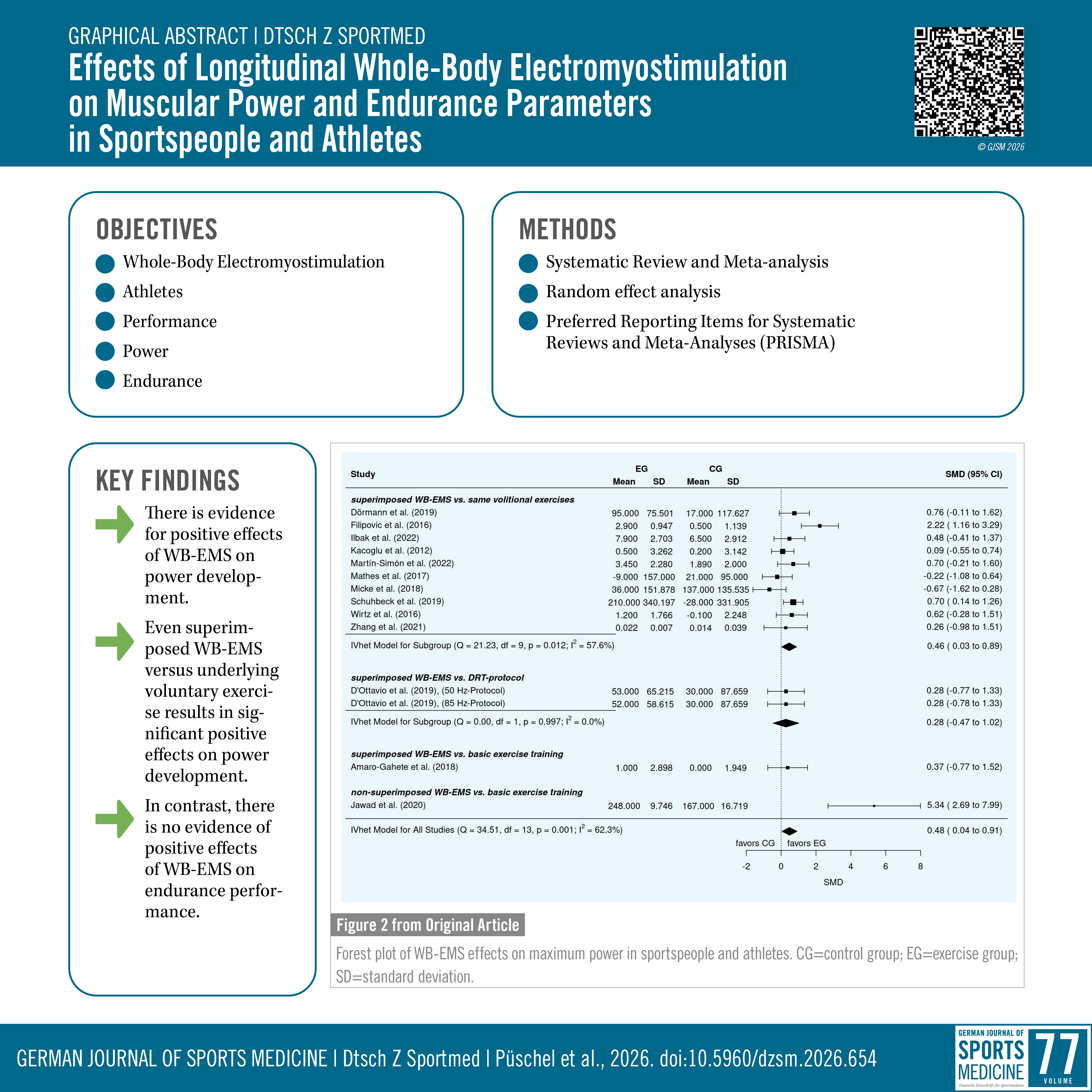
In summary, we observed positive effects of WB-EMS on maximum hip/lower extremity power (13 studies, SMD: 0.48, 95%-CI: 0.04 to 0.91). Subgroup analyses revealed positive effects of superimposed WB-EMS versus underlying voluntary exercise (10 studies, SMD: 0.46, 95%-CI: 0.03 to 0.89). Heterogeneity between the trial results was moderate to substantial in both cases (I2=58% and I2=62%). The few WB-EMS trials (n=3) that addressed endurance performance (i.e. V˙O2peak) reported inconclusive and, on average, non-significant results (SMD: 0.32, 95%-CI: -0.19 to 0.84).
The present study
provided considerable evidence for a favorable effect of superimposed WB-EMS on maximum power in already well-trained sportspeople and athletes. By contrast, positive evidence for the effects of WB-EMS on endurance performance is lacking, particularly due to the varying research issues of the studies and diverging exercise protocols.
Key Words:
Electrostimulation, Performance, Well-Trained People, Quantitative Analysis, Stystematic Review, Meta-Analysis
Introduction
Whole-body electromyostimulation (WB-EMS) can be considered as a joint friendly, time effective and highly customizable exercise technology - at least in the present commercial setting (22). These features might attract sportspeople and athletes of different disciplines to implement WB-EMS in their training routine. The reasons and aims for adding WB-EMS are diverse. While some athletes look to accelerate regeneration, others apply WB-EMS as a mean of injury prevention (36). However, the vast majority of studies with sportspeople and athletes focus on performance-related parameters (36). Considering that the conventional WB-EMS approach uses a resistance-type approach with low volume and short bouts of intermitted intense stimulation (4, 25), it is understandable that most studies with sportspeople and athletes focus on outcomes related to strength and power, while data on endurance performance on the other hand is rarely reported (36). Nevertheless, the net effect of WB-EMS, be it for power or endurance performance, has yet to be evaluated reliably. This relates in the main to two aspects: Firstly, all the systematic reviews that summarize and quantify the evidence in this area (16, 29) predominately included trials with locally applied EMS. Even more problematic, the majority of studies with sportspeople and athletes applied superimposed WB-EMS programs (36). Considering this combination of voluntary exercises superimposed by WB-EMS, it is clear that a considerable part of the effects can be attributed to voluntary exercise. One may argue that control groups that applied the identical voluntary exercise without WB-EMS (e.g. (11, 12) nevertheless might determine the proper WB-EMS effect. We agree. In spite of that, the approach of many studies of adding WB-EMS to high intensity voluntary exercise “as the cherry on the top”(22) requires high statistical power to address the limited, albeit potentially, relevant WB-EMS effects, which is usually not provided by studies involving sportspeople and athletes. A systematic review and meta-analysis that adequately considers the WB-EMS approach and its comparison with different control groups might be helpful to close this evidence gap. In order to address this question in a structured manner, we formulate the following hypotheses:
(a) Maximum power is affected significantly by WB-EMS in comparison to a non-specific control.
(b) Maximum power is affected significantly by superimposed WB-EMS in comparison to a control group that performed the underlying voluntary exercise.
(c) Endurance performance is not affected significantly by present WB-EMS programs.

Materials and Methods
Briefly, the present work is based on a comprehensive systematic review and the evidence map of Reinhardt et al. (36). The project followed the Preferred Reporting Items for Systematic Reviews and Meta-Analyses (PRISMA) Statement and was registered under PROSPERO ID CRD420250646327.
Eligibility Criteria
We applied a two-stage approach. During the first step a comprehensive search according to the PICOS criteria below was conducted (36). Based on this comprehensive systematic review, additional eligibility criteria that emphasize “study outcomes” were applied for the present contribution.
Population: We included professional and semiprofessional “athletes” (3), advanced sportspeople and recreational/hobby sportspeople. Advanced sportspeople included competitive sportspeople and physical education/sport students, while cohorts of studies exercising at least twice weekly during the last 2 years (without competitions) were considered “hobby/recreational sportspeople”.
Intervention: Only WB-EMS interventions according to the present definition (23) were included.
Comparators: Studies that compared WB-EMS with one or more active or non-training control group were eligible. In contrast, studies that compared two WB-EMS protocols (e.g. (1, 35)) without another control group were not considered.
Outcomes: The present study included only studies that reported outcomes related to lower extremity muscular power (including jumping) and endurance performance as determined from baseline to immediately post-intervention.
Study design: Longitudinal controlled trials (randomized or not) were included.
Information Sources
In summary, five electronic databases (CINAHL (via Ebsco) Host, CENTRAL, Medline (PubMed), SPORTDiscus (via Ebsco Host), Web of Science (via Clarivate)) were searched for publications from their initiation up to 6th March 2025 without language restrictions.
Literature Search
A standard protocol was developed and a controlled vocabulary (MeSH term for MEDLINE, CINAHL® Subject Headings for CINAHL) was applied. Keywords and their synonyms were used in the following queries: WB-EMS OR “whole body electro myo stimulation” OR electromyostimulation OR “electrical muscle stimulation” OR electro-myo-stimulation OR electrostimulation OR “integral electrical stimulation” OR “whole-body electrical muscle stimulation”) AND (athletic OR athlete OR sport OR performance OR trained). Additionally, reference lists of eligible articles were screened (figure 1).
Selection Process
Titles, abstracts and full texts were independently screened against the eligibility criteria (PICOS) by three reviewers (SR, MP, WK). Disagreements were resolved by discussion. In cases of unclear or missing eligibility criteria, the corresponding authors were contacted by email three times in four weeks to provide missing, incomplete or unclear data.
Data Management
Endnote (Clarivate, Philadelphia, US) was used to download search results and to conduct title, abstract and full-text screening. Duplicates were identified and excluded using the approach suggested by Bramer et al. (5) .
Data Extraction
Data from eligible studies were extracted by two reviewers (WK, MP) using a Microsoft Excel table. Disagreements between the reviewers were resolved by discussion.
Risk of Bias in Individual Studies
Using the Physiotherapy Evidence Database (PEDro) Scale Risk of Bias Tool (26) two reviewers (FH and WK) assessed studies for risk of bias. Disagreements were resolved by discussion. Methodological quality of the studies was classified <5 score points: low, 5-7 score points: moderate and >7 score points: high (37).
Data Synthesis
Missing standard deviations (SD) were converted into standard errors (SE) and confidence interval (CI) (6) or (in cases of
missing variations of changes) by imputing using the correlations between baseline and final values from the other studies (6). In cases of more than one power outcome, maximum hip/low extremity power as determined by squatting or leg press exercises was preferably included in the analysis. When multiple maximum jumps tests were performed, preferably counter movement jump were included in the analysis (table 3).
Statistical Analysis
Random-effects meta-analyses (43) were calculated applying the robust inverse heterogeneity (IVhet) model (8) as the primary analyses. Continuous outcome data were synthesized using standardized mean differences (SMDs) with 95% confidence intervals (95% CI). Cochran Q test and the I² statistic were used to determine heterogeneity between the trials results (I2 0-40% = low, 30-60% = moderate, 50-90% = substantial, 75-100% = considerable heterogeneity (17)). We applied funnel plots with trim and fill analysis (10), regression and rank correlations, Doi plots and the Luis Furuya-Kanamori index (LFK index ±1 to ±2: minor asymmetry; > ±2: major asymmetry) (14) to check asymmetry and corresponding small study/publication bias. The subgroup analyses focused on different scenarios when comparing WB-EMS and control groups.

Results
In summary, the search identified 13 trials (2, 7, 9, 13, 18, 19, 20, 27, 28, 30, 38, 42, 43) with 14 WB-EMS (145 participants) and 13 control groups (141 participants) that focused on maximum hip/lower extremity power and which were included and considered for the analysis (figure 1). In parallel only three WB-EMS projects (2, 11, 28, 41) with three WB-EMS (27 participants) and four control groups (36 participants) were found that focused on endurance parameters. Of note, two of the three studies reported power and endurance exercise.
Summary of Study and Publication Characteristics
All but one (19) of the WB-EMS trials were randomized controlled studies (table 1). Apart from two studies that implemented either two control (11) or two WB-EMS (7) groups, all the studies compared a single WB-EMS with a single control group.
Summary of Participant Characteristics
Table 1 shows the participant characteristics of the studies. Two studies included hobby sportspeople, eight studies focused on advanced sportspeople (including sport students) and four trials included semi-professional/professional athletes (11). In most cases the cohorts can be considered as “allrounders”, five studies focused on sport games, and one each addressed hobby runners and resistance exercisers. All the studies focused on healthy male participants. Participants were on average 20-30 years old and of normal weight (table 1).
Summary of Exercise and WB-EMS Characteristics
Thirteen of 14 studies applied superimposed WB-EMS protocols (table 2), i.e. added WB-EMS to exercise with high voluntary muscle activation. Underlying types of exercise included isometric and dynamic RT, power/ jumping exercises, interval running and cycling (table 2). with 4 to 14 weeks, study duration was mostly short (table 2). Weekly exercise volume in the WB-EMS groups ranged considerably between 1x 12-20 min (2) to 3.5x 60 min/week (28). All the studies applied bipolar low frequency impulse protocols. Impulse breadth was scheduled 350 µs and 400 µs. All but one study (19) applied an intermitted impulse protocol with 4s-30s of impulse and 1s-30s of impulse break. Although not always clear whether only WB-EMS per se or the combined superimposed approach was implied, impulse intensity as scheduled by rate of received exertion range was high to maximum tolerable (table 2).
Outcome Characteristics
Table 3 shows the outcomes addressed by the 14 studies. Briefly, of the 13 studies that reported data on maximum power performance, six reported jumping performance only as jumping height in cm. As stated, we preferably included power as assessed by leg-press and squatting in the analyses. The three studies on endurance performance (2, 12, 41) all applied incremental step tests (ergometer or treadmill) to a voluntary maximum. The one study (28) that considered aerobic and anerobic capacity as the core outcome also determined a 20 min time trial and a 30 s sprint test on a bicycle ergometer. While all the studies reported data on V˙O2peak, other endurance performance parameters of the tests were not consistently reported (2, 11, 41) (table 3).
Methodologic Study Quality
Methodologic quality according to PEDro (26) of the studies ranges between 4 and 6 score-points (table 1). The main reasons for this low-to-moderate result relate to the aspects of “allocation concealment”, “blinding of participants” and/or “blinding of therapists”, with the latter two being hardly applicable in exercise studies.
Adverse Effects
None of the studies reported adverse effects. Nevertheless high CK values compared to voluntary exercise control were observed in the superimposed WB-EMS studies of Filipovic et al. (13) and Mathes et al. (28), which normalized by the end of the intervention however (22).


Meta-Analysis Results
WB-EMS Effects on Maximum Power
Figure 2 shows the significant effects of WB-EMS compared to control for maximum power performance in sportspeople and athletes (SMD: 0.48; 95%-CI: 0.04 to 0.91). More specifically, the subgroup analysis that focused on the effects of superimposed WB-EMS versus underlying voluntary exercise (upper graph) resulted in similar positive results (10 studies, SMD=0.46; 95%-CI: 0.03 to 0.89). Heterogeneity between study results was moderate (full data set) or substantial (specified analysis). Unfortunately, for the other comparisons only one study each (with 1-2 comparisons) was available. Nevertheless the findings clearly confirmed hypotheses (a) and (b) that expected a superiority of (superimposed) WB-EMS vs. control.
EMS Effects on Endurance Performance
The present analysis focuses on changes in relative V˙O2peak as a strong predictor for endurance performance and the only parameter that was consistently reported by all studies. In summary, the number of studies (or comparisons) was too low to generate a reliable analysis even when ignoring the
WB-EMS approach and corresponding control. Nevertheless, we provided the corresponding results in figure 3 to graphically present the results of the single studies. Briefly, superimposed WB-EMS did result in positive effects independently of whether compared with the underlying voluntary exercise(I2=0%) or (less expected) with the usual training routine (I2=69%) without newly added interventions. Thus we accepted our hypothesis (c) of missing effects of WB-EMS on endurance parameters.
Small Study/Publication Bias, Asymmetries
For the analyses of small study/publication bias and asymmetries for maximum power, we used the full data set. In summary, no studies had to be imputed in the funnel plot with trim and fill (figure 4), further regression (p=.15) and rank correlation test (p=.59) did not indicate funnel plot asymmetry. In addition, the LFK index (0.93) revealed no relevant asymmetry. Due to the low numbers of WB-EMS studies that focus on endurance performance, we did not calculate any funnel plot, regression or rank correlation tests or the LFK index.

Discussion
In contrast to WB-EMS application in the fitness and health domain (4, 25), the majority of studies with sportspeople and athletes understood WB-EMS much more as a vehicle for increasing the effect of intense voluntary exercise (36). This concept of superimposed WB-EMS (33) makes the reliable validation of WB-EMS effects by means of systematic reviews and meta-analyses a daunting task – largely independently of the outcome. Considering the large number of potential protocols when combining various types of exercise and exercise/stimulation parameters, no two exercise/WB-EMS protocols are exactly alike – an aspect that frequently leads to an apples-and-oranges problem in meta-analyses (15, 21). Although the studies included in the present analysis all applied a superimposed WB-EMS approach with similar impulse parameters (table 2), large differences exist for the type of exercise to be superimposed (i.e. strength/power/HIIT vs. squat jumps vs. cycling) and weekly training volume (1x 12-15 min vs. 2x 9 min, 3.5x 60 min). These flaws might still be tolerable; however the main limitation of the present meta-analysis is the comparators of the WB-EMS approach. Considering the superimposed WB-EMS application, the most reliable option for determining the (largely) isolated effect of WB-EMS will be the comparison with a control group that conducted the identical exercise protocol but without WB-EMS. However, even common sense suggests that differences between WB-EMS superimposed vs. non-superimposed exercise protocols will be much more discreet compared with superimposed exercise protocols versus ongoing training routines. It might be the most striking results of the present (subgroup-) analyses (table 2) that we observed a significant albeit low effect (10 studies; SMD: 0.46) of superimposed WB-EMS versus the underlying voluntary exercise that is predominately applied with near-maximum to maximum intensity (e.g. (1, 9, 11, 13)) on maximum power performance. Unfortunately, evidence for the other comparison (figure 2) is limited. While the result of D’Ottavio et al. (7) who compared superimposed WB-EMS versus traditional DRT (comparable effects) sounds reasonable, the result of the trial of Amaro-Gahete et al. (2) on power (figure 2) and relative V˙O2peak (figure 3) is more challenging. In detail the authors (2) replaced one of two sessions of running routine by one 12-20 min session WB-EMS superimposed on HIT-endurance, DRT and power training. Surprisingly, the authors reported no significant effects of WB-EMS on maximum power (figure 2), but on rel. V˙O2peak (figure 3). One may argue that rel. V˙O2peak might not be the most reliable predictor of endurance performance development in this context, nevertheless other performance parameters (e.g. maximum speed) confirmed these results. Lastly, the study of Jawad et al. (19) reported very high but nonetheless plausible effects on maximum power (figure 2), when considering that the trial addresses injured athletes during their rehabilitation program with and without adding (non-superimposed) WB-EMS.
 Due to diverging research issues, corresponding heterogeneity between the protocols (table 2) and the paucity of studies, results on endurance performance are also difficult to interpret. When switching to an individual study level, two comparisons (11, 28) focused on a superimposed WB-EMS approach vs. underlying voluntary exercise, while two other projects (2, 11) compared their superimposed WB-EMS with control groups with ongoing training routine (running, soccer). Indisputably, the latter approach also makes perfect sense when considering superimposed WB-EMS as a whole, intended to partially replace (2) or time-efficiently complete (11) the previous training regime. As already reported, Amaro-Gahete et al. (2), who adopted this superimposed strategy, reported significant effects on endurance performance. In contrast, Filipovic et al. (11), who compared maximum jumping exercise superimposed by WB-EMS, i.e. a rather unspecific protocol for running endurance with habitual training routine, observed no favorable effects. Lastly, Mathes et al. (28), who applied a traditional high volume cycling endurance protocol (3-4x 60 min/w.), superimposed by WB-EMS or not, reported negligible effects on endurance performance in non-specifically trained sports students. A present network meta-analysis on local and whole-body EMS in athletes, Micke et al. (29) confirmed the non-significant WB-EMS effects on aerobic capacity compared to “active control”.
Apart from the study limitations listed above a few other flaws and biases aggravate a reliable conclusion of WB-EMS effects on endurance performance. (a) In general, the limited number of eligible studies and their low sample sizes complicate a meaningful meta-analysis on the effect of WB-EMS, particularly for the issue of endurance performance. (b) Unfortunately, the studies were not consistently reported in adequate details. Although most authors responded to our queries, not all issues could be resolved, which might have resulted in inadequate categorization. (c) Methodological quality was rated by the PEDro (26), which is not perfectly applicable for randomized cross-over trials and in particular non-randomized trials (table 1). (d) The application of WB-EMS in sportspeople and athletes does not necessarily have to focus on performance. Apart from general injury prevention, WB-EMS is a validated method for time-efficiently addressing of low back pain (24, 31), a performance reducing complaint quite prevalent in sportspeople and athletes (39, 40). (e) The degree to which the present research findings can be generalized to other populations (e.g. non-athletic cohorts) is unclear. Most importantly, superimposed WB-EMS based on intense volitional exercise is less popular in scientific or traditional WB-EMS protocols for the general population (4, 22), thus our findings that is predominately based on superimposed WB-EMS trials cannot reliably be transferred to this cohort.
In conclusion, there is considerable evidence that even in well-trained sportspeople, maximum power performance can be increased by WB-EMS protocols. In contrast, there is limited evidence for WB-EMS effects on endurance performance. Nevertheless, even small absolute changes in performance can be highly relevant for well-trained athletes. Thus, future WB-EMS studies with an adequate sample size and comprehensible methodology should address the question of endurance performance in more depth. This includes addressing different types of endurance (e.g. general/local, short/moderate/long-term) more distinctly.
Conflict of Interest
All authors have completed the ICMJE Uniform Disclosure Form at www.icmje.org/coi_disclosure.pdf and declare: no support from any organization for the submitted work; no financial relationships with organizations that may have an interest in the submitted work in the past three years; no other relationships or activities that may have influenced the submitted work.
Funding
no funding
Ethical Approval
Approved by the ethics committee of the German Sport University Cologne (032-2018). Written informed consent was obtained from all participants in accordance with the Declaration of Helsinki (2013).
Data Sharing
n.a.
Acknowledgement
We thank all the authors who provided missing data. The present study was performed in (partial) fulfillment of the requirements for Michael Püschel obtaining the degree Dr. med. dent.
Summary Box
The present work provides considerable evidence for the favorable effect of WB-EMS on maximum power in already trained cohorts. Notably, even superimposed WB-EMS protocol produced superior results when compared with the underlying, usually near-maximum to maximum voluntary exercise. In contrast the results of the few studies focusing on endurance performance vary widely and indicate on average non-significant effects.
References
- FunctionalExercise Training and Undulating Periodization Enhancesthe Effect of Whole-Body Electromyostimulation Training onRunning Performance. Front Physiol. 2018; 9: 720.
- Whole-Body Electromyostimulation Improves Performance-RelatedParameters in Runners. Front Physiol. 2018; 9: 1576.
- Athlete: a working definition for medicaland health sciences research. Scand J Med Sci Sports. 2016; 26:4-7.
- Non-athletic cohorts enrolledin longitudinal whole-body electromyostimulation trials - Anevidence map. Sensors (Basel). 2024; 24: 972.
- De-duplication of databasesearch results for systematic reviews in EndNote. J Med LibrAssoc. 2016; 104: 240-243.
- Cochrane Handbook for Systematic Reviews ofInterventions: The Cochrane Collaboration; 2016.
- Effects of Two Modalitiesof Whole-body Electrostimulation Programs and ResistanceCircuit Training on Strength and Power. Int J Sports Med. 2019;40: 831-841.
- Advances in the metaanalysisof heterogeneous clinical trials I: The inverse varianceheterogeneity model. Contemp Clin Trials. 2015; 45: 130-138.
- The Effects of SuperimposedWhole-Body Electromyostimulation During Short-TermStrength Training on Physical Fitness in Physically ActiveFemales: A Randomized Controlled Trial. Front Physiol. 2019; 10:728.
- A nonparametric “trim and fill” method ofaccounting for publication bias in meta-analysis. JASA. 2000; 95:89-98.
- Influence of Whole-BodyElectrostimulation on the Deformability of Density-SeparatedRed Blood Cells in Soccer Players. Front Physiol. 2019; 10: 548.
- Superimposed Whole-BodyElectrostimulation Augments Strength Adaptations and Type IIMyofiber Growth in Soccer Players During a Competitive Season.Front Physiol. 2019; 10: 1187.
- Effects of a Whole-BodyElectrostimulation Program on Strength, Sprinting, Jumping,and Kicking Capacity in Elite Soccer Players. J Sports Sci Med.2016; 15: 639-648.
- A new improvedgraphical and quantitative method for detecting bias in metaanalysis.Int J Evid-Based Healthc. 2018; 16: 195-203.
- Is There Any Practical Applicationof Meta-Analytical Results in Strength Training? Front Physiol.2017; 8: 1.
- Neuromuscular Electrical StimulationTraining vs. Conventional Strength Training: A SystematicReview and Meta-Analysis of the Effect on StrengthDevelopment. J Strength Cond Res. 2022; 36: 3527-3540.
- Cochrane Handbook forSystematic Reviews of Interventions version 6.2 (updatedFebruary 2021). Cochrane, 2021 [Internet]. [15.11.2025.]
- The effect of plyometric training combined withelectrical muscle stimulation on sports performance parametersin basketball players. Spor ve Performans Arastırmaları Dergisi.2022; 13: 189-200.
- The Effect of RehabilitationExercises and Electric Muscle Stimulation (X Body)on Optimizing Leg Connective Muscles Strength andBiomechanical variables for Injured Athletes. Int J PsychosocRehabil. 2020; 24: 216-223.
- Effects of lower-body electromyostimulationtraining and detraining on anthropometric parameters andmuscular performance. VIREF Revista de Educación Física.2021; 10: 156-176.
- Meta-analysis and exercise related sports medicine[Meta-Analysen im trainingswissenschaftlichen undsportmedizinischen Spannungsfeld]. Dtsch Z Sportmed. 2013;64: 96-98.
- Whole-BodyElectromyostimulation. Effects, Limitations, Perspectives of anInnovative Training Method. Cham, Switzerland: Springer; 2024.
- Editorial: Whole-BodyElectromyostimulation: A Training Technology to ImproveHealth and Performance in Humans? Front Physiol. 2020; 11: 523.
- The effects of wholebodyelectromyostimulation (WB-EMS) in comparison to amultimodal treatment concept in patients with non-specificchronic back pain—A prospective clinical intervention study.PLoS One. 2020; 15: e0236780.
- Outcomes addressed by longitudinalwhole-body electromyostimulation trials in middle agedolderadults - An evidence map. Japan J Med Sci. 2024: 2: 01-22.
- Reliability of the PEDroscale for rating quality of randomized controlled trials. PhysTher. 2003; 83: 713-721.
- Effects of simultaneouslycombined whole-body electrostimulation and plyometrictraining on vertical jump performance, 20 m sprint-time andhandgrip strength. Pol J Sport Tour. 2022; 29: 30-35.
- Chronic effects of superimposedelectromyostimulation during cycling on aerobic and anaerobiccapacity. Eur J Appl Physiol. 2017; 117: 881-892.
- Effects of electromyostimulationon performance parameters in sportive and trained athletes: Asystematic review and network meta-analysis. Eur J Sport Sci.2023; 23: 1570-1580.
- Effects of an Eight-Week Superimposed Submaximal Dynamic Whole-BodyElectromyostimulation Training on Strength and PowerParameters of the Leg Muscles: A Randomized ControlledIntervention Study. Front Physiol. 2018; 9: 1719.
- Similar Pain IntensityReductions and Trunk Strength Improvements FollowingWhole-Body Electromyostimulation vs. Whole-Body Vibrationvs. Conventional Back-Strengthening Training in Chronic NonspecificLow Back Pain Patients: A Three-Armed RandomizedControlled Trial. Front Physiol. 2021; 12: 664991.
- The PRISMA 2020statement: an updated guideline for reporting systematicreviews. BMJ. 2021; 372: n71.
- Electrical stimulationsuperimposed onto voluntary muscular contraction. SportsMed. 2005; 35: 951-966.
- R: A Language and Environmentfor Statistical Computing. Vienna, Austria. R Foundation forStatistical Computing Vienna. 2025.
- Effects of four weeks ofstatic vs. dynamic bodyweight exercises with whole-bodyelectromyostimulation on jump and strength performance: atwo-armed, randomized, controlled trial. J Sports Sci Med. 2023;22: 226.
- Outcomes addressed by wholebodyelectromyostimulation trials in sportspeople and athletes- An evidence map. Sports (Basel). 2025; 13: 302.
- Functional Outcomes and Quality of Life After Ankle FractureSurgically Treated: A Systematic Review. J Sport Rehabil. 2018;27: 274-283.
- The Influenceof WB-EMS-Training on the Performance of Ice Hockey Playersof Different Competitive Status. Front Physiol. 2019; 10: 1136.
- Prevalence of Back Painin Elite Athletes. German Journal of Sports Medicine. Dtsch ZSportmed. 2018; 69: 240-246.
- Prevalence of Back Pain in Sports: ASystematic Review of the Literature. Sports Med. 2017; 47: 1183-1207.
- Seven Weeks of Jump Trainingwith Superimposed Whole-Body ElectromyostimulationDoes Not Affect the Physiological and Cellular Parametersof Endurance Performance in Amateur Soccer Players. Int JEnviron Res Public Health. 2020; 17.
- Acute metabolic, hormonal, andpsychological responses to strength training with superimposedEMS at the beginning and the end of a 6 week training period. JMusculoskelet Neuronal Interact. 2015; 15: 325-332.
- Effects of Whole BodyElectromyostimulation Training on Maximum and ExplosiveStrength of Trained Female. A Pilot Study. Kronos: revistauniversitaria de la actividad física y el deporte. 2021; 20: 1579-5225.