

Nuclear Magnetic Resonance Therapy as Part of Combination Therapy in Professional Football – 1-Year-Results, a Case Series
Kernspinresonanz-Therapie als Bestandteil einer Kombinationstherapie im Profifußball – Einjahresergebnisse, eine Fallserie
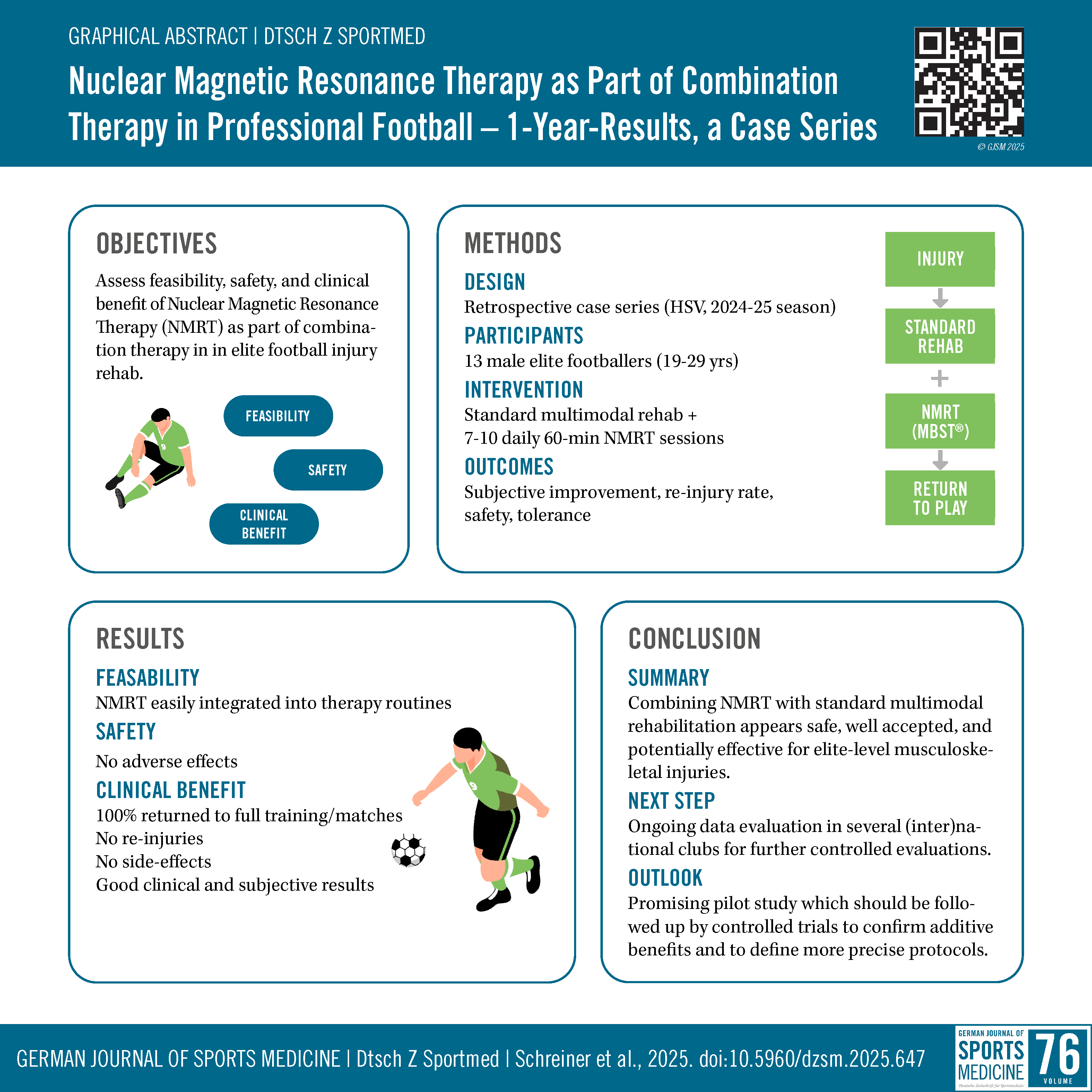
Graphical Abstract
Summary
Objectives: To assess the feasibility, safety, and preliminary subjective and clinical benefit of integrating Nuclear Magnetic Resonance Therapy (NMRT; MBST®) into a multimodal treatment and rehabilitation protocol in musculoskeletal injuries in elite-level football players.
Methods: A retrospective extended case series was conducted at Hamburger Sport-Verein (HSV) during the 2024-25 season. Thirteen male first-team footballers (aged 19–29) sustaining various acute/chronic muscle, tendon, ligament, and bone injuries were treated in addition to standard-of-care rehabilitation (combination therapy) with daily 60-minute NMRT sessions (7-10 x). Subjective and overall clinical results, re-injury occurrence, safety profile and adverse events were collected over 12 months. Injury prevalence and incidence in elite European football were contextualized using established data sources.
Key Results: In the HSV case series, all 13 players achieved timely and sustained return to full training and matches, with zero re-injuries and no reported side effects. NMRT was well tolerated and easily integrated into existing physiotherapy and recovery routines.
Conclusions: Combination therapy is the cornerstone of treating elite athletes, who require a multifaceted approach to treatment that addresses their unique needs and ensures they receive the best possible care. Combining NMRT with standard multimodal therapy appears to be a safe, well-accepted, and potentially effective adjunct in sustainable rehabilitation of typical elite football injuries. While promising in this single-club case reports, controlled trials are essential to quantify NMRT’s additive benefit and establish standardized treatment protocols in sports medicine.
Key Words: Multimodal Therapy, Regeneration, Recovery, Therapeutic Nuclear Magnetic Resonance, Return-To-Sport
Introduction
Professional football has evolved into a high-performance arena where physical demands and injury risks are ever-present: In the 2023-24 season, European football leagues reported a record 4.123 injuries, leading to an estimated €732 million in player salary losses due to downtime (689101119). The Bundesliga in Germany was notably the most affected, with the highest injury rate among Europe’s top five leagues (6, 10, 11).
In professional football, injuries are an inherent risk due to the sport’s high-intensity nature. Epidemiological studies have consistently identified muscle and tendon injuries, ankle sprains as well as knee and groin injuries as the most prevalent among players (4, 5, 6, 8, 9,10, 11, 19, 31).
Understanding the prevalence and nature of these injuries is crucial for developing effective prevention and rehabilitation strategies in professional football (21). Ongoing research and advancements in sports medicine continue to play a vital role in enhancing player safety and performance.
In professional sports, the complexity and severity of injuries often necessitate a multifaceted approach to rehabilitation. Combination therapy, which integrates various therapeutic modalities, has become a cornerstone in modern sports medicine. This approach aims to address the multifactorial nature of sports injuries by targeting different aspects of the healing process simultaneously.
Research indicates that combining therapies such as manual therapy, exercise, and physical therapies such as extracorporal shockwave therapy (ESWT), electrotherapy, and others can lead to superior outcomes compared to single-modality treatments (2, 3, 17). For instance, a systematic review found that manual therapy combined with multimodal physiotherapy significantly improved shoulder function and reduced pain in patients with rotator cuff injuries (18). Further modalities comprise the usage of orthobiologics (12).
The synergistic effects of combination therapy shall and do not only expedite recovery but also enhance the overall performance and longevity of athletes. By tailoring treatment plans to the specific needs of the athlete and the nature of the injury, combination therapy offers a comprehensive solution that addresses both the physical and psychological aspects of recovery. Incorporating combination therapy into the rehabilitation protocols of professional football teams can potentially reduce downtime, minimize the risk of re-injury, and facilitate a quicker return to peak performance. Yet, scientific data and studies are still limited, the combination of applications is often based on experience and assumptions, also because causal relationships are difficult to differentiate. But as the field of sports medicine continues to evolve, embracing integrative and personalized treatment strategies will be crucial in optimizing athlete health and performance.
In this context, Nuclear Magnetic Resonance Therapy (NMRT, also tNMR = therapeutic nuclear magnetic resonance; MBST®, MedTec Medizintechnik Gmbh, Gießen, Germany) has emerged as a non-invasive treatment modality aiming at accelerating recovery and enhancing tissue repair. NMRT utilizes magnetic resonance fields to stimulate cellular regeneration, offering a promising alternative to or support of traditional rehabilitation methods. While its application in professional sports is gaining attention, comprehensive evaluations of its efficacy and integration into clinical practice are still limited. First data and clinical experience so far suggests that integrating MBST® with high-energy laser therapy, ESWT, and early athletic training might be beneficial as another pillar in combination therapy and has shown promising results in accelerating recovery from muscle, tendon, and ligament injuries (14, 16, 22, 25, 32).
This paper examines the prevalent injury challenges in professional football based on cases of a single club and explores the potential role of combination therapy with a new physical therapy modality (NMRT) in addressing these issues. We aim to assess its viability as a therapeutic option for athletes. Furthermore, we discuss the implications of adopting this modality within sports medicine frameworks and its potential impact on player health and performance.
Methods
This retrospective extended case report was conducted over a 12-month period from January 2024 to January 2025 at the Hamburger Sport Verein (HSV), a professional football club in Germany which has played during the above-mentioned time in the second league.
Thirteen male players aged 19–29 years (mean 24.4 years), all of whom had sustained a musculoskeletal injury within the previous 12 months and were treated with NMRT in addition to the club’s standard of care (SOC), were enrolled. Exclusion criteria included systemic illnesses, neurological disorders, or contraindications to NMRT (MBST®) which are similar to MRI diagnostics. Diagnoses and follow-up were made based on / embedded in all available and the club’s SOC clinical assessments including physical examination with specific functional tests depending on the injuries as well as MRI in all cases for diagnosis and in parts for follow-up. No special assessments like scores were included in this analysis but the players’ subjective well-being.
All athletes received the standardized HSV rehabilitation program (combination therapy) comprising:
Physiotherapy / Athletic Training
Intensive physiotherapy and osteopathy, daily training therapy with mobilisation of pelvis/hips/trunk, specific warm-up, regenerative measures, as well as incorporated strength training, proprioception exercises, and sport-specific drills, tailored to each player’s injury and recovery stage including treadmill analysis and insole adaption.
Physical Therapy
Physical therapy, to manage pain and inflammation and support regenerative processes:
- ESWT (radial and focussed): to enhance collagen synthesis, release growth factors, and stimulate the body’s healing process to improve pain
- Laser Therapy / deep heat application: to reduce pain and support tissue healing
- Electrotherapy (interferential / micro current therapy): to reduce pain and stimulate muscle tissue
- Cryotherapy: applied post-exercise to reduce muscle soreness and swelling
- IHHT (intermittent hyper-/hypoxia training): to support mitochondrial function and performance qualities.
Nutritional Supplements
Provided guidance on protein intake and anti-inflammatory diets to support tissue repair including Vitamin D3, Omega 3, Curcuma/Boswellia, collagen, intestinal build-up, and detoxification procedures.
Dental Co-Treatment
Dental co-treatment with splint care to address oral symptoms and help with general alignment. PRP-injections to support healing and regeneration.
Orthobiologics
PRP-injections to support healing and regeneration.
NMRT (Nuclear Magnetic Resonance Therapy)
In addition, those 13 patients were treated with NMRT (MBST®). Administered using the MBST® device ARTHRO·SPIN·FLEX 2 with at least 7 sessions per athlete (depending on the specific treatment card) with each session lasting for 60 minutes, 1 session a day, taking place daily in a row if possible and with a top-up treatment in single cases if demanded by the athlete. Usually, 2 cards with different target tissues were applied (e.g. bone, cartilage, postop) stepwise / not alternating (see also results, table 1 and figure 1 (supplememtal material online)).
Nuclear Magnetic Resonance Therapy (NMRT) is a non-invasive medical treatment modality that leverages the principles of magnetic resonance imaging (MRI) to stimulate cellular regeneration and repair in damaged tissues (16, 20, 27, 32). Unlike MRI, which is primarily used for diagnostic imaging, NMRT utilizes specific magnetic resonance sequences to target and activate the metabolism of damaged cells, promoting healing processes (16, 20, 26, 28, 29, 30).
The NMRT devices (MBST®, MedTec Medizintechnik GmbH, Gießen, Germany) operate by generating low-strength magnetic fields and radiofrequency pulses that induce resonance in hydrogen protons within the targeted tissue. This shall enhance cellular metabolism, potentially triggering anti-inflammatory and pain-relieving effects, and accelerating tissue repair processes. The therapy is designed to be tissue-specific (16, 22). More importantly, basis science in-vitro data shows that therapeutic nuclear magnetic resonance can support cell regeneration in different tissues, reduce catabolic processes, modulate inflammation and, according to recent findings, can influence hypoxic signalling pathways, the circadian clock and other factors which have been described in association with osteoarthritis, bone health and other (MSK) conditions also on a quantum biological level (1, 7, 20, 26, 27, 28, 29, 30, 32).
NMRT (MBST®) has been utilized in the treatment of a range of musculoskeletal conditions, including ocartilage degeneration / osteoarthritis, osteoporosis and bone metabolic disorders, intervertebral disc herniations, muscle, tendon, and ligament injuries and (post-surgical) rehabilitation (14, 15, 16, 22, 24, 25, 32). The therapy is particularly beneficial in addressing degenerative changes and chronic injuries, where traditional treatments may be less effective. Yet, it is also known to address acute injures as well and based on clinical experience faster compared to a regular healing process (14, 15, 16, 24, 32).
MBST® is considered safe, with no known side effects reported in the literature (16, 32). It is a non-invasive procedure that does not require injections, surgery, or medication. The treatment is typically well-tolerated, with sessions lasting 60 minutes, and is administered multiple times per week in a row depending on the clinical indication ranging from 7-10 sessions per treatment in total. Clinical studies and patient reports suggest that MBST® can lead to significant improvements in pain reduction, mobility, and overall quality of life (14, 15, 16, 22, 24, 32).
It represents a promising therapeutic option and - due to its potential to stimulate physiological healing processes - makes it an attractive alternative and/or adjunct to traditional treatment methods. However, further clinical research is warranted to fully establish its efficacy and optimal application protocols.
Combination therapy aims to enhance the healing process through synergistic effects. We evaluated the new use of NMRT based on 13 case reports in the light of this as a new element to see whether it can improve the players’ subjective well-being and general outcome and asses its applicability and safety within the club’s current SOC protocol.
The case series data evaluation complies with the Declaration of Helsinki. The ethical approval for this retrospective data collection has been granted as by the Hamburg Ethics Committee. No registration number is required, as there is no regular application for retrospective data collection, but the necessity to report this. All players gave their written informed consent. The study was conducted according to the CARE guidelines.
Results
All 13 players treated as described above were evaluated. There was no drop-out or lack of follow-up. All diagnoses, anatomical sites and further treatment aspects like the tissue specific cards selected for the individual indications/tissues are displayed in table 1.
In summary, combination therapy including NMRT (MBST®) in those 13 cases contributed to good clinical effects based on clinical examination and imaging as well as subjective well-being of the players. It enabled a sustainable return-to-sports, play and -competition which happened reasonably quickly. In chronic cases with no drop-out or down-time, the addition of NMRT seemed to support recovery subjectively as well as based on clinical findings and development. According to player 1 NMRT was the best therapy for him, as other therapies didn’t work well for him.
Furthermore, all 13 players did not suffer from any re-injury. There were no side effects or adverse events reported associated with NMRT.
We could show that it is safe to incorporate MBST® as another tool in the algorithm of the established combination therapy. It was well tolerated by the players, easy to apply and to incorporate in the existing structures.
Discussion
The most important finding after 12 months of experience with nuclear magnetic resonance therapy (NMRT, MBST®) in the context of supporting a professional football team is, that this form of therapy has proven to be a useful addition to a multimodal treatment spectrum. All forms of therapy and modalities must complement each other sensibly with the aim of accelerating tissue regeneration.
While we couldn’t show in this first analysis that magnetic resonance therapy can help to achieve a time advantage in the healing process for acute injuries, we could demonstrate that it is a useful addition to the therapeutic procedure for chronic processes (cartilage damage / osteoarthritis, inflammation of the pubic bone / tendon attachment tendinopathies) and bone marrow oedema, which are often difficult to treat and represent a certain treatment gap. So, players as well as therapists are eager to add new promising elements to their regular combination therapy.
The NMRT device has been accepted well as part of team care. The 60-minute therapy time is very well tolerated by the athletes and can also be used not only for regeneration time in general but parallel treatments, e.g. micro¬current or ionising oxygen therapy. This therapy is planned and scheduled by the physiotherapists in consultation with the team doctors. All athletes reported no side-effects and felt better after the treatment (some quickly, others with a certain delay/in the course or after the full treatment), so they subjectively describe it as a relevant add-on to their known therapy. This could also mean a better quality of life. More importantly, those 13 players did not suffer any re-injury to date and profited from combination therapy including NMRT also in chronic cases after having tried different treatment approaches before.
One advantage of NMRT is, that in comparison to other comparable devices, it is supposed to address tissues’ specific properties with its specific software programs on the chip cards. It is pain-free and especially in acute and painful injuries better tolerated than ESWT or other magnet field therapies, for example. The latter comprise a broad range of different kinds of magnetic fields (static, pulsating, high-/low frequency) while NMRT is the only device that combines two magnetic fields and radiofrequencies which create magnet resonance conditions within the targeted tissues and has got a tissue specific approach. Besides, the one-hour treatment and lying on the bed can be used for other regenerative therapeutic elements, mindfulness or breathing exercises or parallel treatments or even to overbridge waiting times.
Disadvantages of the therapy is the long treatment duration of 60 minutes per session for 7-10 days which requires compliance. Furthermore, players don’t feel much while the treatment is going on like a tingling or hear some kind of noise. In acute injuries warmth can be perceived and the impression of an ongoing general process which requires adequate water intake. The dependence on treatment cards is another technical challenge because the specific tissue program cannot be chosen within the device or so and require some kind of compliance.
This report’s limitations include the small patient number and the lack of a control group as well as the heterogeneity of the reported injury types, various follow-up times for the players, and reliance on retrospective chart notes. The combined algorithm makes attributions to any single component or treatment (e.g. NMRT vs. ESWT) impossible. More data collection is needed and already ongoing in other professional football and rugby clubs as well (Charlton Athletic, Wrexham AFC, Bath Rugby) so outcome for injured players can be optimized stepwise as well as to specify certain NMRT algorithms. Despite these constraints, the case reports highlight the real world translational potential of NMRT as part of combination therapy in professional sport settings and strengthen its (pre)clinical evidence available so far (14, 15, 16, 20, 24, 26, 7, 32).
Evidence and evidence-based-medicine is a necessary cornerstone in medical therapy, of course, yet therapy and medicine in elite sports and even more so in football is complex and depends on multiple parameters which is often not reproducible within the scope of a study, but developable on the basis of experience and case reports like ours. There is a strong need - also for the above-described socio-economic reasons - to constantly optimize treatment protocols accepting the fact that it will not always be possible to deduct each and any causal inference (23). Players and patients deserve the best treatment possible with as little side effects and pain as possible. That is why this group evaluated NMRT as a further add-on in combination therapy. Furthermore, we think that physical therapies will represent a growing aspect in combination therapy as well as conservative orthopaedic treatment in general. Even though studies about combination therapy are still limited, the evidence available already shows promising results for the combination of ESWT, exercise, manual/massage techniques and orthobiologics in rotator cuff issues, muscle injures and tendinopathies (2, 3, 12, 17, 18). This is aligned with our clinical experience in elite sports. The reported injuries and injury rates correspond to those reported in the literature (4, 5, 6, 8, 9, 10, 11, 13,19, 21) while we could present good subjective and clinical outcomes.
Conflict of Interest
The authors have no conflict of interest.
Funding
This study and publication itself were not funded by external sources. The last author and club was provided with the MBST® device and treatment cards for free by MedTec Medizintechnik GmbH, Germany. Neither the authors nor HSV club received any financial expenses for this study and publication.
Ethical Approval
This retrospective case series complied with the local Ethics Committee and the Declaration of Helsinki (2013).
All players provided written informed consent for the use of anonymized data. Data were pseudonymized, securely stored, and accessed only by authorized researchers in accordance with GDPR.
NMRT (MBST®) was applied as part of standard rehabilitation care; all adverse events were monitored.
As a retrospective analysis of clinical data, formal trial registration was not required.
Summary Box
This case report series explored the integration of Nuclear Magnetic Resonance Therapy (NMRT) into the rehabilitation protocol of elite football players with various musculoskeletal injuries in a professional football club. All 13 players returned to full training and competition without re-injury, and NMRT was well tolerated, had no side effects and easily incorporated into standard care. The findings suggest NMRT may be a promising and safe addition to multimodal rehab protocols, though controlled trials are needed to confirm its effectiveness.
References
- HIF signaling: A new propellant in boneregeneration. Biomater Adv. 2022; 138: 212874.
- Combined extracorporeal shockwave therapy and exercise for the treatment of tendinopathy: A narrative review. Sports Med Health Sci. 2021; 4: 8-17.
- Radial ESWT combined with a specific rehabilitation program (rESWT+RP) is more effective than sham rESWT+RP for acute hamstring muscle complex injury type 3b: a randomized, controlled trial. Br Med Bull. 2025; 155: ldaf009.
- Epidemiology of muscle injuries in professional football (soccer). Am J Sports Med. 2011; 39: 1226-1232.
- Time-loss and recurrence of lateral ligament ankle sprains in male elite football: A systematic review and meta-analysis. Scand J Med Sci Sports. 2022; 32: 1690-1709.
- Epidemiology of Football Injuries of the German Bundesliga: A Media-Based, Prospective Analysis over 7 Consecutive Seasons. Sports Med Open. 2023; 9: 20.
- Focusing on the hypoxia-inducible factor pathway: role, regulation, and therapy for osteoarthritis. Eur J Med Res. 2022; 27: 288.
- Epidemiology of Injuries in Professional and Amateur Football Men (Part II). J Clin Med. 2023; 12: 6293.
- Epidemiology of Injuries in Men‘s Professional and Amateur Football (Part I). J Clin Med. 2023; 12: 5569.
- Mens European Football Injury Index 2023/24. [Accessed August 4, 2025].
- Injuries cost top leagues 732 million euros last season, Bundesliga worst hit. Reuters, 2024. [Accessed August 4, 2025].
- A comparative analysis of platelet-rich plasma alone versus combined with extracorporeal shockwave therapy in athletes with patellar tendinopathy and knee pain: a randomized controlled trial. Knee Surg Relat Res. 2024; 36: 47.
- Injury burden differs considerably between single teams from German professional male football (soccer): surveillance of three consecutive seasons. Knee Surg Sports Traumatol Arthrosc. 2020; 28: 1656-1664.
- One-year-survey with multicenter data of more than 4,500 patients with degenerative rheumatic diseases treated with therapeutic nuclear magnetic resonance. J Back Musculoskelet Rehabil. 2013; 26: 93-104.
- Nuclear magnetic resonance therapy (MBST) in the treatment of osteoporosis. Case report study. Clin Cases Miner Bone Metab. 2017; 14: 235-238.
- Regeneration of Bone and Cartilage Tissue - New Treatment and Rehabilitation Strategy. Ortop Traumatol Rehabil. 2024; 26: 225-232.
- Efficacy of manual therapy on shoulder pain and function in patients with rotator cuff injury: A systematic review and meta analysis. Biomed Rep. 2024; 20: 89.
- Comparative Effectiveness of Combination Versus Single-Modality Physiotherapy for Rotator Cuff-Related Shoulder Pain: A Systematic Review and Network Meta-Analysis. J Clin Med. 2025; 14: 4765.
- Epidemiology of injuries in professional football: a systematic review and meta-analysis. Br J Sports Med. 2020; 54: 711-718.
- Nuclear Magnetic Resonance Treatment Accelerates the Regeneration of Dorsal Root Ganglion Neurons in vitro. Front Cell Neurosci. 2022; 16: 859545.
- Injuries in professional football: current concepts. Curr Sports Med Rep. 2013; 12: 381-390.
- Clinical Evaluation Report (CE-TPL-01) in accordance with Medical Device Regulation (EU) 2017/745 and MEDDEV 2.7/1 Rev. 4, 2022; 2.0, 180, 167.
- Injury Burden in Professional European Football (Soccer): Systematic Review, Meta-Analysis, and Economic Considerations. Clin J Sport Med. 2023; 33: 450-457.
- Nuclear magnetic resonance therapy in lumbar disc herniation with lumbar radicular syndrome: effects of the intervention on pain intensity, health-related quality of life, disease-related disability, consumption of pain medication, duration of sick leave and MRI analysis. Eur Spine J. 2015; 24: 1296-1308.
- Health starts in the cell. Sportärztezeitung. 3/2025; 28-28.
- Nuclear Magnetic Resonance Therapy Modulates the miRNA Profile in Human Primary OA Chondrocytes and Antagonizes Inflammation in Tc28/2a Cells. Int J Mol Sci. 2021; 22: 5959.
- NMR in vitro effects on proliferation, apoptosis, and viability of human chondrocytes and osteoblasts. Methods Find Exp Clin Pharmacol. 2005; 27: 391-4.
- Therapeutic nuclear magnetic resonance and intermittent hypoxia trigger time dependent on/off effects in circadian clocks and confirm a central role of superoxide in cellular magnetic field effects. Redox Biol. 2024; 72: 103152.
- Quantum based effects of therapeutic nuclear magnetic resonance persistently reduce glycolysis. iScience. 2022; 25: 105536.
- Therapeutic Nuclear Magnetic Resonance affects the core clock mechanism and associated Hypoxia-inducible factor-1. Chronobiol Int. 2021; 38: 1120-1134.
- Does Playing Football (Soccer) Really Increase the Risk of Knee Osteoarthritis? A Systematic Review and Meta-analysis. J Orthop Sports Phys Ther. 2024; 54: 328-339.
- Potential of molecular biophysical stimulation therapy in chronic musculoskeletal disorders: a narrative review. Eur J Transl Myol. 2023; 33: 11894.