


Determination of the Boundary between Heavy to Severe Exercise Intensity Domain in Recreational Triathletes and Cyclists
Bestimmung des Intensitätsübergangs zwischen der „Heavy-" und der „Severe-Domain“ bei Freizeit-Triathleten und -Radfahrern
Graphical Abstract
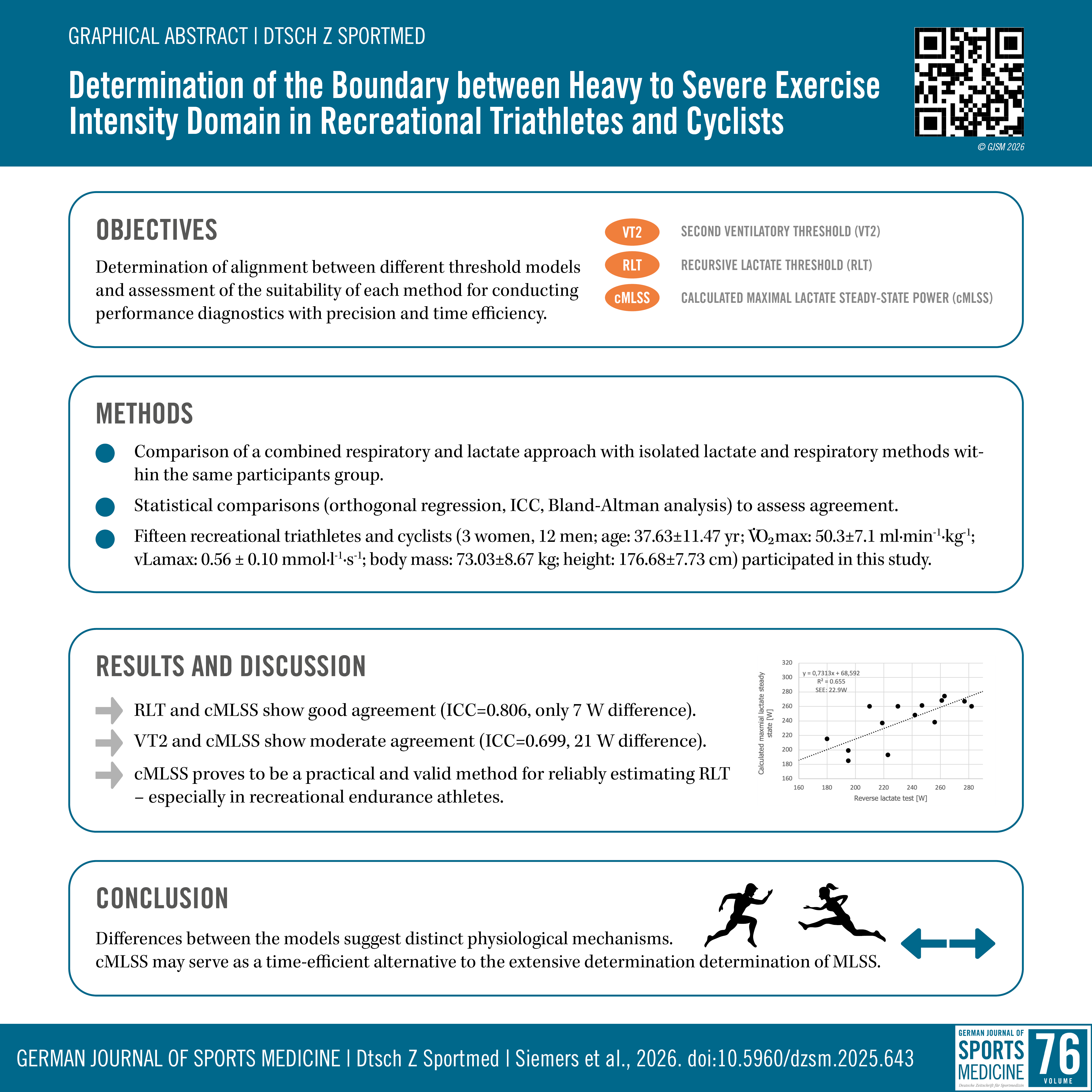
Summary
Objective: Studies have proven the potential of the calculated maximal lactate steady-state (cMLSS) as a practical and time-efficient way to determine MLSS. Purpose of this study was to compare traditional approaches to distinguish the heavy from the severe exercise intensity domain with the cMLSS to evaluate its potential for physiological threshold determination.
Methods: Fifteen triathletes (3 women, 12 men; age: 37.63±11.47yr, bodyweight: 77.1±8.9kg, height: 178.5±8.1cm, maximum oxygen consumption [V˙O2MAX]: 52.6±5.9ml·min-1·kg-1) performed an isokinetic sprint of 15s to determine maximal glycolytic rate (vLaMAX) followed by an incremental test with assessment of gas exchange to determine V˙O2MAX and second ventilatory threshold (VT2). The calculation of cMLSS was conducted using V˙O2MAX and vLaMAX. Reverse lactate test (RLT) was performed on a separate day and the protocol (priming stages, one stage at estimated 105% of MLSS and reverse segments) was accompanied by blood lactate samples. Power at experimental thresholds (VT2, RLT) and cMLSS was compared using statistical methods for assessing agreement.
Results: Cycling power ±SD for RLT, cMLSS and VT2 was assessed at 236±34W, 229±38W and 250±36W. Intraclass correlation coefficients (ICC3,1) ranged from good (RLT vs. cMLSS: ICC3,1=0.806) to moderate (VT2 vs. cMLSS: ICC3,1=0.699). However, there were significant differences for VT2 vs. cMLSS (p=0.012, d=0.740), but not for RLT vs. cMLSS (p=0.268, d=0.310).
Conclusion: The results accord to published comparisons of threshold concepts, also showing large individual differences. The observed deviations could originate from the methodological procedure, but are most likely attributable to divergent underlying physiological mechanisms of respiratory and metabolic responses during exercise. The cMLSS includes more information about the interaction of endurance performance determinants (V˙O2MAX, vLaMAX) and could give more goal-oriented training recommendations.
Key Words: Threshold Concepts, Performance Determinants, Calculated Maximal Lactate Steady-State (cMLSS), V˙O2MAX, vLaMAX
Introduction
Over the past 50 years, there has been considerable debate about the most appropriate method to distinguish the heavy from the severe exercise intensity domain (26). This transition is commonly referred to as the lactate threshold 2 (LT2) and can be defined through various concepts, including the second anaerobic threshold (AT2), the individual anaerobic threshold (IAT), critical power (CP), maximal lactate steady state (MLSS), lactate turnpoint, or respiratory compensation point (RCP) (38). All of these common threshold estimates possess their own strengths and limitations, making the selection of the best-suited approach a complex endeavor (38).
Threshold concepts based on lactate (LT) and ventilatory (VT) parameters require laboratory-based performance testing, typically using graded exercise tests (GXT) (23, 36). For VT estimation the oxygen uptake (V˙O2) as one of the most important noninvasive physiological quantities is used (36). Deflection and inflection points (e.g., carbon dioxide (V˙CO2), end-tidal carbon dioxide concentration (PetCO2) and minute ventilation (V˙E)) of ramp protocols lasting 8 to 12 minutes can be used as submaximal anchors and therefore have practical utility for VT2 estimation (15).
LT models like onset of blood lactate (OBLA) (39), point on a regression curve that yields the maximal distance of the line emerging by the two endpoints of the curve (DMAX) (10) and the reverse lactate test (RLT) (13) are based on the lactate production, transport, diffusion and elimination (20). Currently, more than 25 different lactate threshold concepts based on different test protocols are described (24, 38). In that regard, Jamnick et al. (26) showed an impressive example with a wide range of work rates at LT due to different methodological approaches.
Another concept describes the usage of Critical Speed (CS) and Critical Power (CP) as external load-based methods to approximate the transition from the heavy to the severe exercise intensity domain through various short all-out tests, such as 3-, 8-, and 20-minute tests (36, 73). Hill initially described a hyperbolic relationship between external load (i.e., power) and time, thereby creating a threshold estimate-model for the evaluation of tests with different durations (21). In general, all the metabolic threshold concepts suffer from the limitation of focusing solely on a subsystem within the body and failing to capture a systemic picture of global organismic demands (18, 26). Moreover, the relationship between subsystem-based approaches like the VT and LT concepts are still debated between supporters and non-supporters (2, 9, 17, 31, 35).
In that regard, MLSS is considered one of the gold standards estimating the boundary between heavy and severe exercise intensity domain (6) and is defined as the highest workload where lactate production and elimination are in an equilibrium and is, together with the maximal oxygen uptake (V˙O2MAX) and the fractional usage of V˙O2MAX one of the most important indicators for endurance performance (4, 16, 28). The gold standard for the detection of MLSS is time consuming and costly, as constant load tests often cannot be performed within one day according to the conditions described by Beneke (7). MLSS detection is performed as a series of 30-minute tests, where the rise of blood lactate concentration is <1.0 mmol·L-1 in the last 20 minutes of the test (6). Therefore, for the practical application of single day testing fixed lactate values or deflection points for the estimation of the MLSS based on threshold concepts are used. However, different concepts do not necessarily yield identical workloads at MLSS (5). This reveals errors due to missing validity, accuracy and reliability of the methodological procedures used (26, 42). These problems and the lack of a practicable application elucidate the need for a valid one-day protocol for determining threshold for exercise and training prescription purposes (26).
In that regard, studies (20, 32) evaluated a combined concept of metabolic and ventilatory threshold estimation approaches – the calculated maximal lactate steady state (cMLSS) – which showed a practical and time-efficient way to estimate MLSS with mainly the simulation of intercellular processes to account for lactate accumulation and elimination (20). Mader and Heck (32) presented this mathematical simulation of the activation of glycolysis (vLass) and oxidative phosphorylation (V˙O2ss) for the calculation of cMLSS. Into this matter, a 15s isokinetic sprint is used to calculate maximal glycolytic rate (vLaMAX) and therefore the activation of glycolysis (lactate production system).
Furthermore, V˙O2MAX is measured to calculate V˙O2 at steady state (V˙O2ss) (27). The cMLSS is defined as the point at which the lactate accumulation rate (vLass) exactly equals the maximal lactate elimination rate (vLaoxmax) (20). This elimination rate can be described as a linear function of lactate oxidation per unit of oxygen consumed (20). A detailed kinetic explanation is provided by Mader and Heck (32). Key physiological constants have been introduced to describe the kinetics of lactate production and elimination. Constants such as 50% activation rate constant of oxidative Phosphorylation related to V˙O2MAX (Ks1) and 50% activation rate constant of glycolysis (Ks2) can reflect the activation dynamics of oxidative phosphorylation and glycolysis, which are influenced by intracellular concentrations of adenosine diphosphate (ADP) (20, 32).

Another important constant is the individual power-oxygen relationship of 11.7ml·min-1·W-1 (Ks4), which describes the relationship between oxygen uptake to external work rate and plays a central role in accurately estimating cMLSS (32). Wahl et al. (41) demonstrated a strong correlation (r=0.96) between cMLSS and the gold standard MLSS, with a mean difference of 1W and limits of agreement ranging from -28 to 29W.
To the best of our knowledge there is no evidence for studies that examined the relationship between the mathematical simulation of Mader and Heck (32) and a ventilatory- and lactate-based threshold concept within the same population. Therefore, the present study aims to compare traditional approaches to distinguish the heavy from the severe exercise intensity domain like VT2 and RLT with the cMLSS to further evaluate interrelations and potential for threshold determination.
Methods
Participants
An a priori power analysis was conducted using G*Power (Version 3.1, University of Düsseldorf) to determine the required sample size for detecting a medium effect size (d=0.5) with a power of 0.70 and an alpha level of 0.05 in a one-tailed dependent t-test. The analysis indicated a required sample size of 20 participants. Initially, 20 participants were recruited for the present study. However, five participants were excluded from the final analysis due to incomplete data. Fifteen recreational triathletes and cyclists (3 women, 12 men; age: 37.63±11.47yr, bodyweight: 77.1±8.9kg, height: 178.5±8.1cm, maximum oxygen consumption [V˙O2MAX]: 52.6±5.9ml·min-1·kg-1) participated in this study. Everyone was informed about the aims and risks of this study and signed an informed-consent form. Ethical approval for the study was obtained by the local ethics committee of MSH Medical School Hamburg (reference no.: MSH-2022/188).
Data Recording
All tests were carried out in a sports medicine laboratory at a constant room temperature of 20°C and a humidity of 40%. All tests were performed with a SRM ergometer (SRM, Jülich, Germany). The ergometer was controlled via the SRM-Ergometer-Software (version 1.2.1). Ergometer calibration was performed once a day in accordance with the manufacturer recommendations. Pulmonary gas exchanges were recorded using a metabolic analyzer (Quark CPET, module A-670-100-005, COSMED Deutschland GmbH, Fridolfing, Germany; desktop software: Omnia version 1.65) and a mixing chamber. Before each measurement gas calibration with a 15.1% O2 and 5.06% CO2 gas mixture and a 3L syringe for the volume transducer was performed as described by the manufacturer. All blood lactate samples collected at the earlobe were measured with the Biosen C-Line device (EKF-diagnostic GmbH, Barleben, Germany).
Testing Procedure
 Test of Maximal Glycolytic Rate
The test protocol commenced with a 10-minute warm-up at 100W, during which two blood lactate samples were collected immediately post warm-up in a resting position. The average of these two samples was then utilized for blood lactate values before the start of the exercise (RLa). Thereafter, a 15s isokinetic sprint in a seated position and cadence being limited to 130rpm was conducted. Immediately, blood lactate samples were taken every minute for 10 minutes to determine maximal lactate concentration after the exercise (maxAELa). The vLaMAX was calculated with the method described by Mader and Heck (31).
Test of Maximum Oxygen Consumption
After a 10-minute passive rest due to the blood lactate measurements post exercise a V˙O2MAX test started with another 10 minutes at 100W. The wattage was increased every 60s with an increment of 20W. The participants had to ride as long as possible in a seated position and cadence above 65rpm. The V˙O2MAX was equated at the highest measured value for 30s. The exhaustion criteria were selected according to the recommendations of Whipp et al. (40): Plateau of V˙O2, Respiratory ratio (RQ)>1.1 and maximal lactate (LaMAX) >8mmol·L-1. A schematic overview of study design can be found in figure 1.
Calculation of Maximal Lactate Steady State (cMLSS)
To ascertain cMLSS, the oxidative and glycolytic energy production tied to exercise intensity needs prior understanding, typically expressed as V˙O2ss and vLass (32). Therefore, it is possible to calculate the activity of the glycolysis as a function of V˙O2ss and vLass. Additionally, the function of vLaoxmax, lactate distribution volume and V˙O2ss must be calculated. The model contains constants for the calculation of V˙O2ss, vLass and vLaoxmax that result from biochemical primary literature (32). Consequently, it is possible to calculate cMLSS as a function of vLass and vLaoxmax. The theoretic background and a detailed calculation are described in previous publications (20, 32).
Reverse Lactate Test
Three to five days after the vLaMAX and V˙O2MAX- test, the RLT was conducted. For the intensity description of the RLT protocol, the mean of cMLSS and VT2 was used. After a warm-up of 5 minutes at 50% of cMLSS and VT2, the RLT started with a priming stage performing five stages of 3 minutes each in order to slightly exceed the cMLSS and VT2. For example, assuming a cMLSS of 300W, the stages might be structured as follows: 210W, 240W, 270W, 300W, and 105% of MLSS at 315W. This was followed by a reverse segment in which the power output is reduced by 10W per stage (13). A representative progression for the reverse segment would be: 305W, 295W, 285W, 275W, 265W, and 255W. By deliberately lowering the power output below threshold level, the lactate concentration diminishes correspondingly. The threshold is described as the apex of the lactate curve which correlates with the highest workload in a steady state (13).
Determination of Second Ventilatory Threshold
According to the approach of Binder et al. (3), oxygen uptake (V˙O2MAX), V˙CO2, PetCO2 and VE have been used for VT2 determination. V˙E, V˙CO2 and PetCO2 were plotted over time to identify the corresponding power and V˙O2 values at deflection and inflection points. Two trained researchers used the concepts and visualized the deflection point of PetCO2 (3). Additionally, the inflection points of V˙E vs. V˙CO2 (respiratory compensation point) for VT2 detection was used (3).

Statistics
All statistical data was analyzed with the Software SPSS Version 27 (Chicago, IL, USA) and Microsoft Excel (Microsoft 365, Microsoft Corporation, Redmond, USA). Standard statistical methods were used for the calculation of means and standard deviations (SD). Normal distribution of data was verified by using the Shapiro-Wilk test. The agreement of the three methods was assessed using intra-class correlation coefficient (ICC3,1) and Bland-Altman plots with limits of agreement (LoA) (8). In addition, the mean absolute error (MAE) was calculated as the sum of absolute errors divided by the number of available data pairs of the tested conditions to add a quantification of the mean random scattering around the systematic bias (mean difference) and to account for different directions of this difference. The ICC was calculated based on a single-measure-two-way mixed-effects model. The degree of agreement was interpreted as follows: <0.50=poor, 0.50-0.75=moderate, 0.75-0.90=good, and >0.90=excellent (30). Additionally, the effect size of Cohen´s d was used for interpretation as follows: <0.2=no effect, <0.5=small effect, ≥0.5=moderate effect, >0.8=large effect (11). Furthermore, for relationship between the variables orthogonal regression with coefficient of determination (R2) and standard error of estimate (SEE) was used.
Results
V˙O2MAX and vLaMAX were detected at 52.6±5.9ml·min-1·kg-1 and 0.56±0.13mmol·L-1·s-1, respectively. Cycling power for VT2, RLT and cMLSS was assessed at 250±36W, 236±34W, and 229±38W. Descriptive values of all participants for bodyweight, height, vLaMAX, V˙O2MAX, VT2, cMLSS, and RLT are presented in table 1.
Intra-class correlation and Bland-Altman analysis for RLT and cMLSS showed an ICC₃,₁ value of 0.806 and a mean difference of 7±22W (MAE: 19W, LoA: 51 to -37W). For VT2 and cMLSS an ICC₃,₁ of 0.699 with a mean difference of 21±29W (MAE: 27W, LoA: 78 to -35W) could be determined. In addition, for the comparison of VT2 and RLT an ICC₃,₁ of 0.890 with a mean difference of 14±17W (MAE: 17W, LoA: 47 to -18W) could be shown (see figure 2 and 3). There were significant differences between VT2 and cMLSS (p=0.012, d=0.740) and between VT2 and RLT (p=0.009, d=0.857) with moderate effect sizes, but not for RLT and cMLSS (p=0.268, d=0.310).
Discussion
It was the purpose of this study to compare traditional approaches for detecting the boundary between heavy and severe exercise intensity domains, such as VT2 and the RLT, with the cMLSS to further evaluate interrelations and potential for threshold determination. The results of this study contribute to the ongoing debate about the optimal methodological procedure for determining this boundary, which is critical for exercise and training prescription (37).
The present findings indicate that cMLSS with a mean of 229±38W shows large individual differences compared with both RLT (236±34W) and VT2 (250±36W) in the investigated population of recreational triathletes and cyclists. Hauser et al. (20) showed a significant high correlation (r=0.92) with a mean difference of 12±20W for cMLSS and MLSS comparisons, and therefore an overestimation of MLSS through cMLSS. In addition, Wahl et al. (41) could also show a significant high correlation (r=0.98) for the comparison of cMLSS and MLSS with a mean difference of 1±14W. Pallares et al. (35) showed that VT2 overestimated MLSS (r=0.85) with a mean difference of 49±28W. These findings align with previous research, such as that by Jamnick et al. (26), who reported a wide range of work rates at this boundary depending on the method applied. To best of our knowledge there is no evidence that examined the relationship between a blood lactate-based, ventilatory-based and a combined approach in one population.
Ventilatory and lactate thresholds describe similar physiological states, although they are measured using different methods (38).
Research showed that blood lactate-based and ventilatory-based concepts could show a difference of 14 to 25W in endurance athletes (15). Our data elucidate the same range of differences. While the ventilatory threshold estimate reflects the respiratory response to increasing metabolic load, the blood lactate threshold estimates depict the direct rise in blood lactate levels (15). As suggested by Jamnick et al. (26) a combined approach of both methodological procedures could result in a systemic picture of global organismic demands and internal load situation.
Differences between the combined models and ventilatory- and lactate-based approaches for threshold determination could be caused through different methodological challenges in the determination of V˙O2MAX and vLaMAX (20). These findings could be based on day-to-day variability due to the athlete, environmental factors, or the cardiopulmonary exercise testing (CPET) systems. Van Hooren et al. (40) showed a difference of 0.6±1.18% for V˙O2 values with different measurement devices and systems. Additionally, a day-to-day variation for V˙O2MAX of 2.0±1.0ml·min-1·kg-1 could cause an underestimation (29). In the present analysis, athlete 9 showed a difference of 50W between RLT and cMLSS with a V˙O2MAX of 49.3ml·min-1·kg-1. An increase in V˙O2MAX of 3ml·min-1·kg-1 would result in a cMLSS of 232W and a difference of 28W between cMLSS and RLT. So therefore, differences in calculation variables through underestimation of CPET testing could result in over- or underestimation of cMLSS.
Furthermore, research showed that different protocols for vLaMAX determination could result in different values. Harnish et al. (19) and Yang et al. (43) showed large differences between different durations of the isokinetic sprint test. A reduction to 13s would lead to a higher vLaMAX of 8% and therefore a reduction of cMLSS (20). In our study talak was assessed at 3.5s as fictional time of no lactate production according to Heck et al. (25). There is still a debate on the determination of talak. A reduction of 0.5s of talak would result in a lower vLaMAX and therefore a higher cMLSS. Additionally, blood lactate values can vary due to measurement errors, non-compliance with nutritional guidelines or general dietary habits (14, 6). Blood lactate levels show a coefficient of variation of 4.2% (6), this variation would result in a difference of ±0.02mmol·L-1·s-1 for vLaMAX values. V˙O2MAX and vLaMAX values are the main influences for the calculation of cMLSS and therefore methodical errors could result into large over- or underestimation of cMLSS. It needs to be mentioned that due to mathematic laws, V˙O2MAX has a bigger influence for the calculation of cMLSS than vLaMAX.
The calculation of cMLSS using constants such as Ks1 and Ks2 for the activation of respiration and glycolysis, is grounded in empirical data (12, 32). Ks1, the 50% activity-constant of 0.063mmol·kg-1 ADP depends on the activation of the phosphorylation by the free ADP concentration (32). The activity rate constant of vLass (Ks2) resulting from phosphofructokinase activity at an ADP concentration of 1.1mmol·kg-1 and translates to a Ks2 value of 1.33mmol·kg-1 (32). However, as Nolte et al. (34) described, these constants can lead to discrepancies between measured data and simulation results. A key constant, Ks4, valued at 11.7ml·min-1·W-1 (25), significantly influences the cMLSS calculation and thus affects the accuracy of threshold estimation (20). Ks4 cannot accurately represent individual power-oxygen relationships, especially in ramp tests with varying protocols, such as 20W or 25W increment per minute (28).

Future research should continue to explore the integration of different threshold concepts and refine the cMLSS model to enhance its accuracy and applicability across diverse athletic populations. In this context, the mathematical model of Mader and Heck (32) should be adapted to individualize the constants used for calculations. Additionally, future research should focus on exploring how these individual differences influence training adaptations and performance outcomes, aiming to refine and personalize training protocols.
Conclusion
The present study compared various threshold concepts to estimate the boundary between heavy to severe exercise intensity domains and revealed significant individual differences. These deviations could stem from the methodological procedures but are most likely due to differing underlying physiological mechanisms. The cMLSS incorporates more comprehensive information about the interaction of endurance performance determinants, such as V˙O2MAX and vLaMAX, hypothetically providing more targeted training recommendations with minimal additional effort. However, mathematical assumptions, accuracy, and applicability of cMLSS across diverse athletic populations should be further evaluated.
Conflict of Interest
The authors declare that the research was performed without any commercial or financial relationships that could be construed asa potential conflict of interest.
Ethics Approval
Ethical approval for the study was obtained from the local ethics committee of MSH Medical School Hamburg (reference no.: MSH2022/188). Informed consent was obtained from all participants prior to their inclusion in the study.
Author Contribution Statement
PS conceived, designed the study, and wrote the first draft of the manuscript. TG supervised the project. TG and MS helped improving the manuscript. All authors provided critical commentson the manuscript, read, and approved the final version of the manuscript.
Acknowledgements
We thank all participants for their time taking part in this study.
Summary Box
This study addresses the methodological uncertainty in distinguishing the heavy from the severe exercise intensity domain by comparing traditional threshold concepts (VT2, RLT) with the mathematically calculated
maximal lactate steady state (cMLSS).
For the first time, cMLSS is directly compared with ventilatory and lactate-based thresholds within the same population.
Using a comprehensive multi-method protocol (VT2, RLT, cMLSS) and integrating V˙O2MAX and vLaMAX for cMLSS calculation, the study enables a time-efficient cross-validation of system- and subsystem-based threshold models. Agreement between methods was assessed using orthogonal regression, ICC, and Bland–Altman analyses.
The results show good agreement between RLT and cMLSS (ICC=0.806; mean difference=7 W), whereas VT2 demonstrated only moderate agreement with cMLSS (ICC=0.699; mean difference=21W). These findings support the cMLSS as a practical and valid estimator of RLT in recreational endurance athletes, while also ighlighting notable individual variability likely driven by differing physiological mechanisms.
References
- Predictive validity of ventilatory andlactate thresholds for cycling time trial performance. Scand J MedSci Sports. 2006; 16: 27-34.
- Relationship between blood lactateand excess CO2 in elite cyclists. J Sports Sci. 1991; 9: 173-181.
- Methodological approach to thefirst and second lactate threshold in incremental cardiopulmonaryexercise testing. Eur J Cardiovasc Prev Rehabil. 2008; 15: 726-734.
- The concept ofmaximal lactate steady state. Sports Med. 2003; 33: 407-426.
- Laktatmessung in derSportmedizin—drei Geräte im Vergleich. Dtsch Z Sportmed. 1994;45: 60-69.
- Anaerobic threshold, individual anaerobic threshold, andmaximal lactate steady state in rowing. Med Sci Sports Exerc. 1995;27: 863-867.
- Methodological aspects of maximal lactate steady state—implications for performance testing. Eur J Appl Physiol. 2003; 89:95-99.
- Measuring agreement in methodcomparison studies. Stat Methods Med Res. 1999; 8: 135-160.
- The relationship between lactate and ventilatory thresholds inrunners: validity and reliability of exercise test performanceparameters. Front Physiol. 2018; 9: 1320.
- A new approach for the determination of ventilatory andlactate thresholds. Int J Sports Med. 1992; 13: 518-522.
- Statistical power analysis for the behavioral sciences.Comput Environ Urban Syst. 1990; 14: 71.
- Defining hypoxia: asystems view of VO2, glycolysis, energetics, and intracellular PO2. JAppl Physiol. 1990; 68: 833-842.
- Reverse lactate threshold: a novel single-session approachto reliable high-resolution estimation of the anaerobic threshold. IntJ Sports Physiol Perform. 2012; 7: 141-151.
- The validity and accuracyof blood lactate measurements for prediction of maximalendurance running capacity. Int J Sports Med. 1994; 15: 89-95.
- Validity and reliability ofcombining three methods to determine ventilatory threshold.Med Sci Sports Exerc. 2001; 33: 1841-1848.
- Lactate profile changes in relation to trainingcharacteristics in junior elite cyclists. Int J Sports Physiol Perform.2010; 5: 316-327.
- Gas exchange andlactate anaerobic thresholds: inter- and intraevaluator agreement. JAppl Physiol. 1985; 58: 2082-2089.
- Fractal correlation properties of heartrate variability: a new biomarker for intensity distribution inendurance exercise and training prescription? Front Physiol. 2020;11: 550572.
- Reliability of the 15-s maximal lactateaccumulation rate (VLamax) test for cycling. Physiologia. 2023; 3:542-551.
- Comparison of calculated andexperimental power in maximal lactate-steady state during cycling.Theor Biol Med Model. 2014; 11: 25.
- The critical power concept: a review. Sports Med. 1993; 16:237-254.
- Laktat. In: Springer eBooks. 2022.
- 30 Years of lactate thresholds – what remains to bedone? Dtsch Z Sportmed. 2008; 59: 297-302.
- Justification of the 4-mmol/llactate threshold. Int J Sports Med. 1985; 6: 117-130.
- Diagnostics of anaerobicpower and capacity. Eur J Sport Sci. 2003; 3: 1-23.
- An examinationand critique of current methods to determine exercise intensity.Sports Med. 2020; 50: 1729-1756.
- Slow component of VO2kinetics. Med Sci Sports Exerc. 2011; 43: 2046-2062.
- Endurance exercise performance: thephysiology of champions. J Physiol. 2008; 586: 35-44.
- Inathletes, the diurnal variations in maximum oxygen uptake aremore than twice as large as the day-to-day variations. Front Physiol.2019; 10: 219.
- A guideline of selecting and reporting intraclasscorrelation coefficients for reliability research. J Chiropr Med. 2016;15: 155-163.
- Relationship between the lactate and ventilatorythresholds during prolonged exercise. Sports Med. 1993; 15: 104-115.
- A theory of the metabolic origin of“anaerobic threshold”. Int J Sports Med. 1986; 7: S45-S65.
- Glycolysis and oxidative phosphorylation as a function ofcytosolic phosphorylation state and power output of the muscle cell.Eur J Appl Physiol. 2003; 88: 317-338.
- Simulation of steady-state energymetabolism in cycling and running. SportRxiv. o. D.
- Validity and reliability of ventilatory and blood lactatethresholds in well-trained cyclists. PLoS One. 2016; 11: e0163389.
- Criticalpower: an important fatigue threshold in exercise physiology.Med Sci Sports Exerc. 2016; 48: 2320-2334.
- Critical power: a paradigm-shift forbenchmarking exercise testing and prescription. Exp Physiol. 2023;108: 539-540.
- The anaerobic threshold: 50+years of controversy. J Physiol. 2021; 599: 737-767.
- Onset of blood lactate accumulation andmarathon running performance. Int J Sports Med. 1981; 2: 23-26.
- Accuracy of respiratory gasvariables, substrate, and energy use from 15 CPET systems duringsimulated and human exercise. Scand J Med Sci Sports. 2024; 34:e14490.
- Accuracy of a modified lactateminimum test and reverse lactate threshold test to determinemaximal lactate steady state. J Strength Cond Res. 2017; 31: 3489-3496.
- A test to determineparameters of aerobic function during exercise. J Appl Physiol. 1981;50: 217-221.
- Uncertainty in determining the optimaltest duration for maximal rate of lactate accumulation during alloutsprint cycle ergometry. Eur J Appl Physiol. 2024; 124: 3147-3148.
MSH Medical School Hamburg
Institute of Interdisciplinary Exercise
Science and Sports Medicine
Am Kaiserkai 1, 20457 Hamburg, Germany
E-Mail: paul.siemers@student.medicalschool-hamburg.de