

High Frequency Saliva-Based Targeted Multi-Omics as Screening Tool in Professional Soccer – The Practice Perspective
Hochfrequente, speichelbasierte, zielgerichtete Multi-Omics als Screening‑Instrument im Profifußball – Die Perspektive der Praktiker
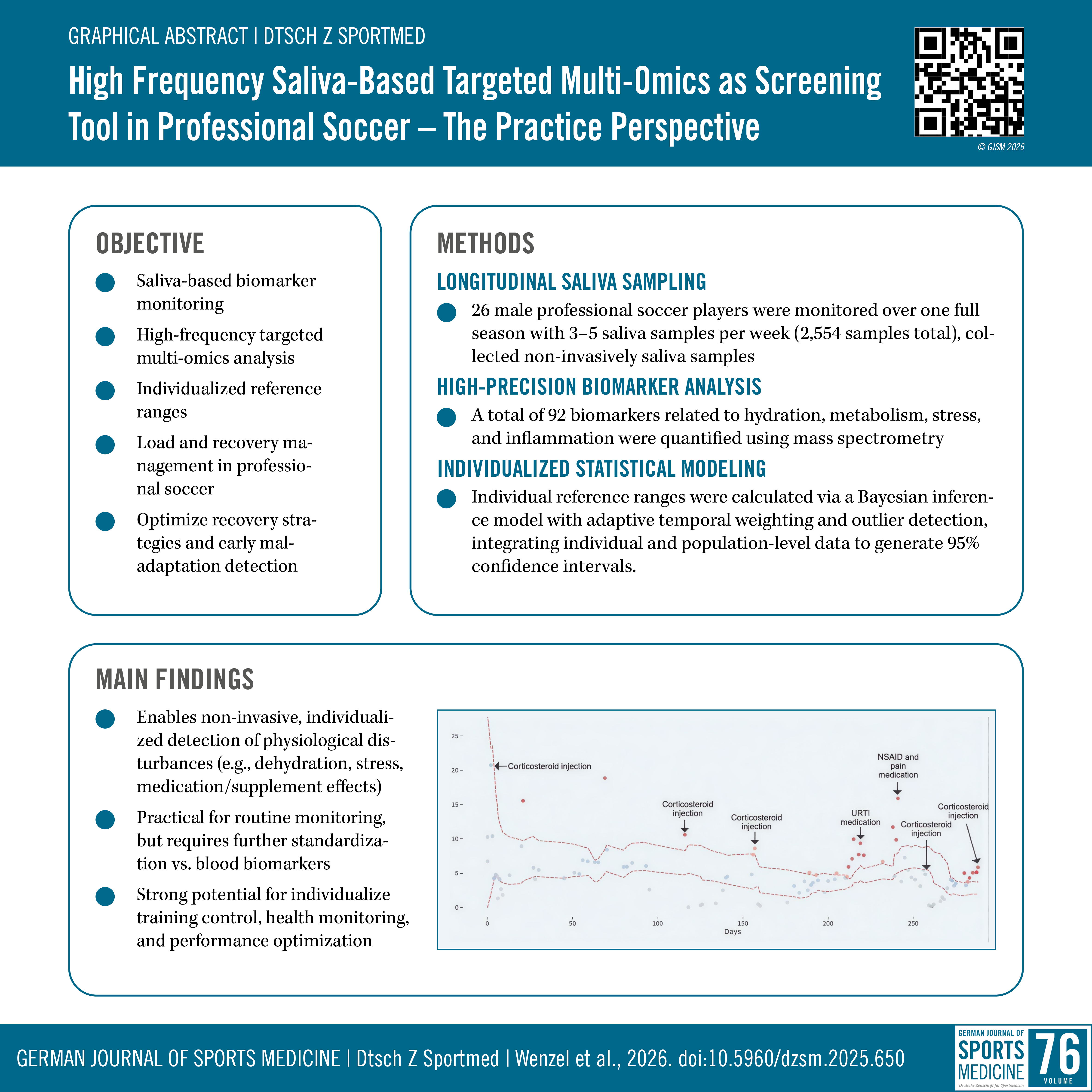
Graphical Abstract
Summary
Background: In professional soccer, the use of external measures such as GPS data and functional performance screenings to control load, recovery and injury prevention is well established. However, internal biomarkers have so far only been used to a limited extent, as their collection is usually invasive, cost-intensive and difficult to implement at high-frequency. This work aims to present a first practical approach for high-frequency, saliva-based multi-omics biomarker monitoring in professional soccer and explores potential applications.
Methods: Twenty-six male first-team players were monitored over an entire season, providing 3-5 saliva samples per week, resulting in 2,554 samples analyzed for 92 biomarkers. Samples were collected using Salivette® Cortisol swabs and analyzed via liquid chromatography-tandem mass spectrometry (intra-assay CV <5%). Individual reference ranges were calculated using a Bayesian inference model with adaptive temporal weighting and outlier detection, combining individual and population data to derive 95% confidence intervals. The analyses focused on selected biomarkers related to hydration, metabolism, stress, and inflammation.
Results: Four representative cases showed marked deviations from their individual 95% reference ranges, each linked to distinct physiological conditions: temporary dehydration (total protein: team average 0.49±0.38 mg/ml; individual range 0.33-2.27 mg/mL), incorrect use of dietary supplements (melatonin: 0.28±5.17 ng/mL; 0.001-123.016 ng/mL), elevated stress (cortisol: 3.76±3.39 ng/mL; 0.004-41.836 ng/ml) and medication influences (cortisone: 9.53±5.82 ng/ml; 0.002-10.737 ng/ml).
Conclusion: This study represents a first promising attempt to implement saliva-based biomarker assessment in professional soccer, which can support medical staff, nutritionists, and coaches in identifying early signs of maladaptation, optimizing recovery strategies, and enabling timely, individualized interventions throughout the season. Further research is needed to validate these findings and investigate their scalability to other sports.
Key Words: Internal Load, Biomarker, Training, Nutrition
Introduction
Individualized load and recovery management are crucial for athletes’ performance, health, and success. In training science, definitions of external and internal load markers are limited to measures used for individual training control and assessable during exercise (15). In this regard, markers that monitor recovery after training, and that may be used for injury prediction modelling do not fall under this narrow definition. However, training load, recovery management, and injury risk are closely related to each other. Independent of definitions, the use of predominantly external measures is common practice in professional soccer. These measures primarily include GPS-derived load metrics and biomechanical and neuromuscular screening tests (18), which are often integrated into non-contact muscle injury risk prediction models in soccer due to their relevance for player fitness and team success (10, 16, 18).
Despite their potential for load and recovery management as well as for injury prediction, the use of internal biomarkers is largely limited to non-invasive assessments of cardiovascular and metabolic functions. These include measures such as oxygen uptake, heart rate, and heart rate variability. Beyond lactate, saliva- or capillary blood-based biomarkers are rarely utilized, even though they best reflect the current physiological status of an organism and its organ systems. Common examples such as creatine kinase (CK) (12) and C-reactive protein (CRP) (11) indicate muscle damage and inflammation, but their use in load and recovery management remains controversial and requires individual reference values (14, 25). Some professional soccer clubs have also attempted to integrate regular assessments of global saliva-based stress markers, such as cortisol and testosterone. So far, these attempts have failed due to long processing times (ranging from days to weeks), low assessment frequencies, short observation periods and relatively high costs per marker when sent to external laboratories. Consequently, there is a clear need for practical, non-invasive, and high-frequency biomarker approaches that can complement existing external load metrics and provide deeper insights into the physiological status and recovery dynamics of athletes. To address this gap, this study aims to present a first practical approach for implementing a high-frequency, saliva-based, targeted multi-omics biomarker assessment in professional soccer under resting conditions. By determining individual reference values for well-established analytes and identifying potential fields of application, it contributes to the future integration of such methods into athlete monitoring.

Methods
Study Cohort and Illustrative Cases
Within the study, we recruited soccer professionals as well as players of the youth academy down to the age of 13 years starting in the preseason 2024. All players and their parents (in case of study participants below the age of 18) were informed about the study and provided their written consent. Our investigation was approved by the local ethics committee at TU Dortmund University. All player data were anonymized prior to analysis, and confidentiality was maintained through secure data storage and restricted access.
For this analysis, we included resting data (pre-training or pre-match) from n=26 players of the first male team to ensure a clinically relevant and homogeneous cohort, in which training load, medical care, and routine monitoring were standardized. Participant characteristics are listed in table 1. All samples were collected in the morning (between 7:30 and 11:30 a.m.). Within one season (08/24 to 05/25), we collected 2,445 saliva samples from the first team, each containing 92 analytes analyzed using mass spectrometry (MS)-based proteomic, metabolomic, and lipidomic pipelines.
Four players were selected from this cohort as illustrative cases (Player A-D). These players were chosen based on the complete availability of data and representative variation patterns, clearly illustrating the individual reference value approach. The selection was not intended to test specific hypotheses, but rather to illustrate the methodology and its interpretation in practice. Table 1 summarizes the analytes relevant to this study for both the team-level analysis and the individual case examples.
Saliva Sampling
Salivette® Cortisol (Sarstedt) tubes were used for saliva sampling according to the manufacturer’s instructions. The players were instructed to rinse their mouths with water 10 minutes before sample collection. After that, no further food or liquid intake was permitted. Each player removed the swab from the Salivette® and placed it in their mouth against the cheek, where it remained for one minute without being chewed. The swab was then returned directly from the mouth to the Salivette® without contact with external surfaces. It was securely closed, and the samples collected from the players were prepared for analysis.
Mass Spec
Liquid chromatography-tandem mass spectrometry (LC-MS/MS) measurements were carried out in-house at the Biolyz Biomarker Platform. Small molecules were extracted by protein precipitation, dilute-and-shoot, or solid-phase extraction as appropriate, then separated either on hydrophilic-interaction (HILIC) or reversed-phase C18 columns operated under analytical- or micro-flow conditions; detection used different triple-quadrupole instruments in scheduled multiple-reaction-monitoring mode. For targeted proteomics, proteins were reduced, alkylated, and digested with trypsin (bottom-up proteomics approach), and the resulting surrogate peptides were resolved on micro-flow C18 LC and quantified by MRM with isotopically labelled internal standards. Across the combined panels, the platform delivered a linear dynamic range spanning four orders of magnitude, with limits of detection extending into the low-picogram mL-1 range. System suitability was confirmed daily with calibrants and pooled-matrix quality controls, resulting in average intra-run and inter-day coefficients of variation of ≤5 % and ≤9 %, respectively.
Statistical Analysis
The participants’ characteristics and the analytes were presented at the team level as mean values, standard deviations (SD), and minimum and maximum values. For the four illustrative cases, the corresponding analytes are also shown with their individual values, allowing a direct comparison with the reference range at the team level (table 1). Data visualization was performed using the Biolyz dashboard (figures 1-4).
Individual reference ranges were calculated using an empirical Bayesian approach implemented through scipy.stats.bayes_mvs, using standard non-informative (Jeffreys’) priors for the mean and variance parameters. This approach allows the observed data to be used primarily for the posterior distributions while maintaining mathematical accuracy through the Bayesian framework.
The model used a 30-day rolling window with adaptive functions, including temporal weighting (current measurements are weighted between 0.2 and 1.0 depending on their recency), dynamic window expansion when there were insufficient data points (a minimum of 20 measurements required), and a two-step process that first identifies outliers using multi-threshold detection before calculating 95% confidence intervals. The final reference ranges combined individual statistics with population-level data using adaptive weights that decrease as the number of individual measurements increases, ensuring robust estimates even during initial sampling periods.
Reference range boundaries were established using 95% Bayesian credible intervals (26). Several statistical criteria were used to detect outliers, including thresholds for extreme deviations (>20× window mean), global Z-scores (>3.5 SD), and boundaries based on interquartile range adjusted for data availability. When Bayesian calculations were not possible due to limited data, a fallback approach using mean ±2 SD was applied to ensure continuous monitoring.
The reference ranges underwent internal validation, which included biomarker-specific adjustments for known markers with high variability, detection algorithms for users with consistently low baseline values, and comprehensive error handling with fallback strategies to ensure the robustness of the calculations. Although no external validation using certified reference materials or cross-laboratory comparisons was performed in this implementation, the adaptive combination of population statistics (derived from the entire user cohort) with individual data provides an internal quality control mechanism.
The analyses were primarily exploratory and descriptive, aiming to demonstrate the application of individualized Bayesian reference intervals for monitoring players.
Results
To illustrate the practical implementation of high-frequency monitoring of saliva-based biomarkers in professional soccer, four illustrative cases (Examples 1-4) are presented. These examples demonstrate different physiological patterns observed across the cohort that are more pronounced than is typically the case for most players. They clearly show how individual reference ranges can be used and interpreted, and how repeated, high-frequency sampling of selected biomarkers in saliva can reveal meaningful patterns related to hydration, circadian rhythm, metabolic balance, and stress response.
Table 1 summarizes the descriptive statistics for team characteristics and for a subset of salivary analytes relevant to the four illustrative cases (Players A-D), including total protein concentration in saliva, melatonin, trigonelline, cortisone, and cortisol. An overview of the physiological ranges, biological functions, and interpretations of these markers can be found in the supplementary table S1 online).
Example 1: Chronic Dehydration (Player A)
Dehydration has a significant impact on athletic performance and is widely recognized among players, nutritionists, and coaches as a factor that increases the risk of injury (23). Total saliva protein levels serve as an indirect measure of hydration status (9, 28, 29). In this case, concentrations were above the individual reference range for several days in a row. All samples were taken under resting conditions, i.e., before training or before the game, although it is assumed that previous training or game activities during the season contributed to the basic hydration status. Remarkably, player A indicated significantly higher baseline boundaries compared to his teammates, highlighting the need for individual reference values. After being informed by medical staff about the potential dehydration issues, player A acknowledged that he had previously had problems maintaining adequate hydration and responded immediately, as reflected in figure 1. 
Example 2: Over-Supplementation of Melatonin (Player B)
The use of supplements is common practice in professional sports. While evidence for the substitution of many supplements is rather limited, other benefits and risks have been described. Melatonin is a well-established supplement which improves sleep quality (2) and reduces systemic inflammation. It is widely substituted to counteract jet lags or support sleep in specific working conditions, such as shift work (4). Recommended dosages typically range from 0.5 to 5.0 mg per day (21). However, excessive intake or misuse can lead to abnormal fatigue or tiredness, hypotension, and reduced attention (27). In this case, a gradual increase in melatonin supplementation led to significantly increased saliva concentrations at rest (range from 0.001 to 123.016 ng/ml). The increasing substitution of melatonin was associated with a decreased physical and mental performance of player B. The data also indicate a compensatory increase in caffeine intake, which was reflected in rising trigonelline concentrations. After the medical staff recognized the overdose, they informed the player, who subsequently stopped or significantly reduced the supplementation of melatonin, leading to a rapid normalization of biomarker levels and a complete restoration of well-being and performance (figure 2).
Example 3: Pain Detection and Screening of Medical Intervention (Player C)
Pain which derived from injuries or degenerative alterations within the musculoskeletal system is frequently observed in professional sports (1). From a health perspective, it makes sense to relieve pain through medical measures such as the application of non-steroidal anti-inflammatory drugs (NSAID) or corticosteroid injections when these are combined with recovery measures and further non-pharmaceutic interventions (e.g. physiotherapy).
This is certainly not always the case in professional sports, where these kinds of actions are also taken to enable athletes to participate in competitions. Due to the high psychological pressure and the desire to play, some athletes tend to report pain only if it is severe, and sometimes with a delay. In this case, salivary cortisone levels above individual reference values of player C were directly associated with pain. After medical interventions (corticosteroid injection perineural, epidural out of competition with clear medical indication in August, November, January, April, May and NSAID in March), saliva cortisone concentrations decreased below individual reference levels, as was to be expected based on the well-documented pharmacokinetics of this medication (22). This sustainable decrease was observed for several days up to weeks before reaching reference boundaries again. Notably player C did not report any pain during the initial observation phase. However, the cortisone concentration in saliva subsequently increased, coinciding with the onset of pain symptoms. This pattern was observed repeatedly over time, as shown in figure 3. Although these results cannot yet be generalized, the cortisone level in saliva appeared to serve as an objective and sensitive indicator for the early detection of pain in this player, especially in conjunction with subjective pain reports and medication use. This information can help to adjust the load during match or training and optimize recovery management in order to prevent more severe health issues.

Example 4: Cortisol as Unspecific Marker of Stress (Player D)
Cortisol is an established, albeit nonspecific, biomarker that reflects physiological and psychological stress. Because of its distinct circadian rhythm and high inter- and intraindividual variability, meaningful interpretation requires standardized assessments and the use of individual reference values. Player D repeatedly showed pronounced cortisol increases on three different times during the season (figure 4). The first increase preceded a viral infection, while the second coincided with a period of high psychological stress for the whole team following the announcement of a head coach change. The third increase was associated with bad sleep caused by family reasons (child). This example illustrates that elevated cortisol levels may occur for various stressors but can still serve as an early signal for medical staff, enabling targeted interventions and more efficient use of team resources.
Discussion
Overall, our findings indicate that high-frequency saliva-based targeted multi-omics biomarker assessment in professional soccer can identify individual physiological deviations with potential impact on athletes’ and teams’ performance and health. The four illustrative cases demonstrate how individual reference ranges can reveal temporary dehydration, oversupply, increased stress, or the influence of medication. These deviations were communicated to medical staff and players, resulting in corrective measures and normalization of analytical values.
It must be emphasized that these are exploratory cases and therefore require further validation. Nevertheless, these cases illustrate the potential of the method applied. In order to fully utilize these markers and develop practical countermeasures, a broad spectrum of expertise and resources is required.
High acceptance among coaches and players are essential for reliable implementation. Educational sessions with coaches and the medical staff ensure understanding of objectives, methods, potential of assessment, and limitations. Additionally, it should be clearly communicated that immediate, reliable scientific results are not to be expected, but rather that the aim is to achieve long-term improvements in performance and health.
All players and, in the case of participants under the age of 18, their parents should be fully informed about the study procedures by both the coaches and the scientific staff. Participation must be voluntary, and a high level of acceptance of the methodology should be observed from the outset. Sample collection and quality require continuous monitoring to minimize missing data. Ethical considerations, including transparency and trust, are paramount. Data visualization tools, such as dashboards and integrative indicators for hydration, sleep, and fatigue, facilitate interpretation of complex datasets and emphasize longitudinal trends over individual outliers.
Finally, the results need to be communicated to the medical staff and subsequently to the players and, potentially, the coaches. This process is challenging, as complex and comprehensive information must be condensed. To facilitate this, a dashboard is used to indicate when a player falls outside of individual reference ranges for each analyte, primarily focusing on well-established markers. The information is further simplified by combining markers into integrative indicators such as sleep, fatigue, or pain. Individual abnormal readings are not highlighted; instead, trends across consecutive measurements are considered. If several consecutive samples indicate abnormal levels (outside individual references) or trends, the findings should be discussed with the medical staff. Issues such as malnutrition, over-supplementation, or dehydration need to be directly communicated to the players by the medical staff, leading to immediate success, as evidenced by the normalization of respective analytes and an improvement in performance. Effective communication requires empathy and trust from both sides. Assessments are designed to improve performance and maintain health, not to control individuals.
From an analytical perspective, it is crucial to balance depth (number of analytes) and speed of analysis. Achieving this balance with current MS techniques limits the competitiveness of existing point-of-care tools or standard laboratory procedures, such as enzyme-linked immunosorbent assays (ELISA). Moreover, MS is highly adaptable and can be used to quantify a wide range of molecules. In addition to the rapid availability of results, high-frequency measurements are necessary for two reasons: firstly, to provide medical staff with information on an almost daily basis, and secondly, to define individual reference ranges. It should be noted that untargeted approaches are more suitable for identifying new targets, whereas targeted approaches are necessary for defining individual and interpretable reference limits. Previous research on CK and CRP has demonstrated that both, resting levels and responses to acute exercise exhibit significant interindividual variability, highlighting the need for individual reference values (3, 5, 25). A limitation of this analytical approach is that it is only effective when customized and integrated into specific environments (here, soccer). Additionally, it requires strong methodological and biological expertise as well as financial resources.
Saliva sampling offers both advantages and limitations as a biological sample for high-frequency biomarker monitoring. However, different sampling techniques such as passive drooling, spitting, absorption, and suction have varying implications depending on the analysis’s objective (8). Factors like salivation rate and protein content must be considered, necessitating adjustments and standardized sampling procedures (7, 8). A major disadvantage is that associations with blood levels need to be established for direct knowledge transfer (e.g. correlations to pathologies events). For certain markers, such as cortisol (24) or testosterone (6, 19), these associations have already been demonstrated (13), while evidence for other analytes remains limited or inconsistent due to methodological heterogeneity and small sample sizes. To improve analytical robustness, saliva measurements are supplemented by venous and capillary blood sampling and, in some cases, muscle biopsies under standardized conditions. Recent studies examining parallel plasma, urine, and saliva proteomics have shown that protein abundance in body fluids correlates at rest and that these correlations increase during acute exercise. Notably, 191 proteins showed significant correlations between plasma and saliva, compared to only seven between plasma and urine (17). Of the 1,943 proteins detected in saliva, 601 showed significant changes after acute exercise, with some remaining elevated for over 24 hours. Several of these proteins are directly related to muscle integrity and extracellular matrix remodeling, underscoring the potential of saliva as a source of biomarkers in professional sports and beyond.
In a recent study by Lindsey et al., new biomarkers were identified in saliva that predict objectively assessed physical fatigue and readiness for warfighters (20). These markers, measured using MS-based untargeted proteomics, were superior to measurements such as cortisol, testosterone, IL6, uric acid, IgA, and alpha amylase. Nevertheless, many analytes within the applied panel are rather unspecific. For example, elevated cortisol levels may indicate sleep disorders, psychological stress, infections, or pain. However, deviations from individual reference values provide an objective tool for alerting medical staff to potentially critical conditions in individual players.
Notably, high-frequency saliva-based biomarker assessment may represent a valuable add-on to wearable technologies that are increasingly used in professional sports to continuously monitor external load, heart rate, or movement patterns. While these tools provide important information about movement (patterns) and physiological responses of the cardiorespiratory system, they do not capture direct biochemical changes. The evaluation of saliva-based multi-omics biomarkers complements wearables by providing molecular insights into hydration, stress, inflammation, and metabolic status, enabling the detection of subtle individual differences. Integrating biomarker measurements with wearable data represents a promising approach to comprehensive athlete monitoring and enables personalized interventions that combine internal physiological signals with external stress and performance metrics.
This study is descriptive and exploratory. No control group or standardized performance outcomes were included, and cross-validation with blood or clinical endpoints is pending. The specificity of the markers may be limited (e.g., cortisol increases due to multiple factors), and the cohort consists of a single professional team, restricting generalizability.
Repeated high-frequency measurements on larger cohorts, combined with external load metrics and psychological assessments, could improve predictive models for injuries and performance. Ultimately, these data can support data-driven monitoring and personalized interventions but require larger samples and repeated measurements to improve accuracy and generalizability.
However, these initial experiences demonstrate the feasibility and potential benefits of high-frequency, saliva-based multi-omics measurements in professional soccer and provide a foundation for future validation studies and practical integration into athlete monitoring programs.
Conflict of Interest
CW is funded by a research project between Borussia Dortmund GmbH & Co. KGaA and TU Dortmund University. PZ acts as consultant for both, Borussia Dortmund GmbH & Co. KGaA and Biolyz FlexCo. MM is CEO of Biolyz FlexCo. KK, AI and OW are employed by Biolyz FlexCo. Analyzes were conducted on site by Biolyz FlexCo. The authors affiliated with Biolyz FlexCo were not involved in data interpretation. MB acts as consultant for Biolyz FlexCo.
Funding
This study was funded by Borussia Dortmund GmbH & Co.
Ethical Approval and Informed Consent
The study was approved by ethical committee at TU Dortmund University (approval number: GEKTUDO_2024-33). Informed consent was collected from all participants before data collection commenced.
Data Availability Statement
Due to the sensitivity of the data and the risk of identifying individual players, the data set underlying this study is not publicly available.
Author Contribution
CW: Investigation, Project administration, Visualization, Writing – original draft, Writing – review & editing; MK: Investigation, Project administration, Resources, Writing – review & editing; LL: Investigation, Resources, Writing – review & editing; PL: Investigation, Writing – review & editing; MM: Conceptualization, Methodology, Resources, Validation, Writing – review & editing; KK: Data curation, Methodology, Investigation, Project administration, Validation, Writing – review & editing; AI: Data curation, Investigation, Methodology, Writing – review & editing; OW: Data curation, Formal analysis, Software, Visualization, Writing – review & editing; MB: Conceptualization, Investigation, Resources, Writing – review & editing; PZ: Conceptualization, Funding acquisition, Resources, Supervision, Validation, Writing – original draft, Writing – review & editing
Summary Box
High-frequency multi-omics analyses based on saliva enable non-invasive monitoring of athletes and can reveal individual problems such as malnutrition, pain, or stress that affect performance.
Saliva sampling offers practical advantages but also presents methodological challenges that require tandardization and validation compared to blood measurements.
Despite these limitations, initial results underscore the potential of saliva-based multi-omics to support individualized training, health monitoring, and performance optimization in professional soccer.
References
- Overuse injuries in sport: acomprehensive overview. J Orthop Surg Res. 2018; 13: 309.
- The Effectsof Melatonin Supplementation on Professional Soccer PlayerPerformance: A Systematic Review. Nutrients. 2023; 15: 4467.
- Individualized Monitoring ofMuscle Recovery in Professional Badminton. Front Physiol. 2019;10: 778.
- Melatonin asa Chronobiotic with Sleep-promoting Properties. CurrNeuropharmacol. 2023; 21: 951-987.
- Early warning system forplayer recovery? A series of case studies illustrating theapplication of individualised adaptive reference ranges in thelongitudinal blood monitoring of English Premier League soccerplayers. Biomarkers. 2025; 30: 232-245.
- Estimation of injurycosts: financial damage of English Premier League teams’underachievement due to injuries. BMJ Open Sport Exerc Med.2020; 6: e000675.
- Serum and SalivaConcentrations of Biochemical Parameters in Men with ProstateCancer and Benign Prostate Hyperplasia. Lab Med. 2020; 51: 243-251.
- Saliva as a diagnostic toolin soccer: a scoping review. PeerJ. 2024; 12: e18032.
- Saliva Collection Methods AmongChildren and Adolescents: A Scoping Review. Mol Diagn Ther.2024; 28: 15-26.
- Assessment of exerciseinduceddehydration in underhydrated athletes: Which methodshows the most promise? Clin Nutr. 2024; 43: 2139-2148.
- Predicting noncontactinjuries of professional soccer players using machine learning.PLoS One. 2025; 20: e0315481.
- Acute-Phase Proteins and Other SystemicResponses to Inflammation. N Engl J Med. 1999; 340: 448-454.
- Acute leucocyte, muscledamage, and stress marker responses to high-intensityfunctional training. PLoS One. 2020; 15: e0243276.
- Blood-Based Biomarkersfor Managing Workload in Athletes: Considerations andRecommendations for Evidence-Based Use of EstablishedBiomarkers. Sports Med. 2023; 53: 1315-1333.
- Associationbetween salivary and blood hormone concentrations using anautomated electrochemiluminescence immunoassay technique:Challenges and pitfalls. Exp Physiol. 2025; 110: 1795-1801.
- Blood-Borne Markersof Fatigue in Competitive Athletes – Results from SimulatedTraining Camps. PLoS One. 2016; 11: e0148810.
- Internal and ExternalTraining Load: 15 Years On. Int J Sports Physiol Perform. 2019; 14:270-273.
- Predictive modeling of lowerextremity injury risk in male professional youth soccer playersusing least absolute shrinkage and selection operator regression.Scand J Med Sci Sports. 2023; 33: 1021-1033.
- Body FluidProteomic Landscape of Acute Exercise. bioRxiv. 2025.
- Machinelearning approaches to injury risk prediction in sport: a scopingreview with evidence synthesis. Br J Sports Med. 2025; 59: 491-500.
- The Usefulness of Testosteronein Saliva Tests to Detect Testosterone Deficiency in Men withAdvanced Chronic Kidney Disease: A Single-Center Study. J ClinMed. 2025; 14: 2818.
- Preliminary insights intosalivary proteomic versus targeted biomarker profilesassociated with acute physical fatigue. bioRxiv. 2025.
- Safety of higherdoses of melatonin in adults: A systematic review and metaanalysis.J Pineal Res. 2022; 72: e12782.
- Glucocorticoid Therapy and Adrenal Suppression. In: FeingoldKR, Ahmed SF, Anawalt B, Blackman MR, Boyce A, Chrousos G,et al., editors. Endotext. South Dartmouth (MA): MDText.com,Inc.; 2000. [Accessed January 19, 2026].
- Perceptions ofProfessional Young Male Soccer Players Regarding Injury RiskFactors and Prevention Strategies. J Sport Rehabil. 2025; 1: 1-6.
- Advantage of salivary cortisolmeasurements in the diagnosis of glucocorticoid relateddisorders. Clin Biochem. 2008; 41: 688-692.
- Individualised reference rangesfor markers of muscle recovery assessment in soccer. Eur J SportSci. 2023; 23: 1829-1837.
- Bayesian detection of abnormalvalues in longitudinal biomarkers with an application to T/Eratio. Biostatistics. 2007; 8: 285-296.
- Case report on melatonin overdose:Cause and concern. Sleep Med X. 2024; 7: 100116.
- Saliva parameters as potentialindices of hydration status during acute dehydration.Med Sci Sports Exerc. 2004; 36: 1535-1542.
- Saliva flow rate, totalprotein concentration and osmolality as potential markersof whole body hydration status during progressive acutedehydration in humans. Arch Oral Biol. 2004; 49: 149-154.