

Comparing Recent Multinational Consensus Guidelines with the Latest Consensus from the European Working Group on Sarcopenia in Older People
Vergleich aktueller multinationaler Konsensleitlinien mit dem jüngsten Konsens der European Working Group on Sarcopenia in Older People (EWGSOP)
Graphical Abstract
Summary
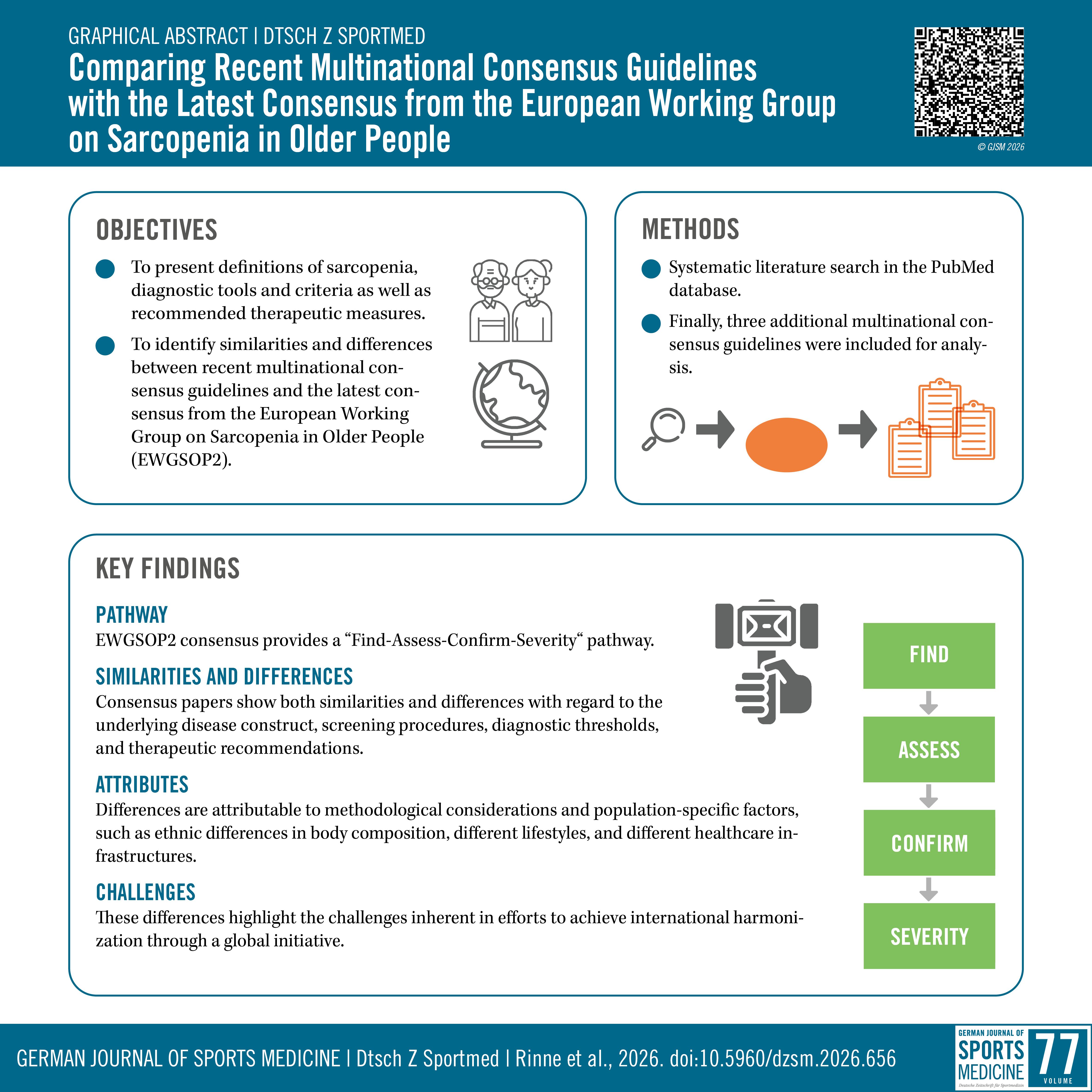
This clinical review presents definitions of sarcopenia, diagnostic tools and criteria, as well as recommended therapeutic measures. Current consensus papers and guidelines were systematically identified, and their key statements were compared with the latest recommendations from the European Working Group on Sarcopenia in Older People.
Finally, three consensus papers were included for comparison. The consensus papers revealed both similarities and differences with regard to the underlying disease construct, screening procedures, diagnostic thresholds, and therapeutic recommendations. Some of the observed differences can be explained by population-specific factors, such as ethnic differences in body composition, different lifestyles, and different healthcare infrastructures.
Nevertheless, this review provides a valuable point of orientation and a foundation for clinical decision-making.
Key Words:
Muscle, Aging, Exercise, Nutrition, Therapeutic Recommendations, Lifestyle, Health Care
Introduction
Sarcopenia is most commonly defined as a disorder of skeletal muscle characterized by a significant loss of muscle mass and strength, which increases the risk of functional impairments and adverse events (8). The term ‘sarcopenia’ (‘sarx’=flesh, and ‘penia’=loss) was first introduced by Rosenberg in 1989 to describe age-related loss of muscle mass (12). The clinical and economic relevance of sarcopenia derives less from its isolated occurrence than from its consequences and adverse health outcomes. It is consistently reported that sarcopenia is linked to an increased risk of falls and fractures, reduced health-related quality of life, and higher mortality (2). These associations highlight sarcopenia’s significance as a public health concern.
Sarcopenia can manifest, for example, in a decrease in motor units, negative changes in neuromuscular junctions and efficiency of neuromuscular transmission (nerve signal to muscle activation), predominant atrophy of type 2 fibers, and increasing ectopic fat accumulation in skeletal muscle (4, 13). A reduction in anabolic stimuli caused by a decrease in anabolic hormones and physical inactivity, as well as nutritional
deficiencies, can significantly influence disease progression (14). Chronic diseases associated with systemic inflammation and medications such as statins, muscle relaxants, or glucocorticoids, further contribute to its pathogenesis (13). This indicates that the physiological processes underlying sarcopenia are complex and extend beyond age-related processes alone (15).
This rapid review presents definitions of sarcopenia, diagnostic tools and criteria, as well as recommended therapeutic measures. To this end, current consensus papers and guidelines were systematically identified, and their key statements on definition, diagnosis, and therapy were compared with the latest recommendations from the European Working Group on Sarcopenia in Older People (EWGSOP2) (5, 6).
Literature Selection

Systematic Literature Search
A systematic literature search was conducted in the PubMed database, focusing on current consensus and guideline documents on sarcopenia. The following search string was used:
(“sarcopenia” [Title]) AND (“consensus” [Title] OR “guideline“ [Title] OR “recommendation” [Title] OR “statement” [Title]). The search was limited to publications from the past three years (1/2023 to 1/2026), and was last updated on 17 January 2026.
Inclusion and Exclusion Criteria
Only English-language, multinational consensus and guideline documents providing explicit statements on the definition, diagnosis, and/or treatment of sarcopenia were included. Consensus and guideline documents on sarcopenia focusing on specific groups with additional comorbidities, on patients with sarcopenic obesity, or addressing only specific aspects (e.g. selected diagnostic methods) were excluded. Primary studies and other (systematic) reviews were also excluded.
Selection Process
The identified publications underwent a two-stage screening process. First, titles and abstracts were screened, followed by a full-text review of potentially relevant documents. Selection was performed independently by KR and CB according to the predefined inclusion and exclusion criteria. In cases of discrepancy, consensus was reached through discussion.
After applying the search strategy and completing the two-stage screening, three papers were ultimately included (see figure 1).
The publications included were multinational consensus documents providing normative standards for the definition, screening/diagnosis, and/or treatment of sarcopenia. The latest recommendations from the EWGSOP were added to these.
An overview of the characteristics of the included publications is presented in table 1.
Definition of Sarcopenia
EWGSOP2: Sarcopenia is defined as a skeletal muscle disorder affecting older adults, but that can also occur earlier in life and is associated with an increased risk of adverse outcomes. ‘Probable sarcopenia’ is identified by low muscle strength, and sarcopenia is confirmed when low muscle quantity or quality is documented. If low physical performance is also evident, sarcopenia is considered severe. When no other specific cause is evident, sarcopenia is classified as ‘primary’ (age-related), otherwise it is ‘secondary’ (e.g. due to an inflammatory disease). Sarcopenia of less than 6 months is defined as acute sarcopenia, while sarcopenia lasting ≥6 months is considered chronic.

 Similarities and important deviations in the latest consensus papers: Members of the ANZSSFR task force reached consensus to adopt the EWGSOP2 sarcopenia definition. The GLIS conceptual definition of sarcopenia differs from the EWGSOP2 definition regarding relevant diagnostic criteria. According to GLIS guidelines, sarcopenia is defined by reduced muscle strength, decreased muscle mass and muscle-specific strength (muscle strength/muscle size). Impaired physical performance is considered an outcome rather than a diagnostic criterion. Muscle quality is not included in the definition and morphological characteristics of muscle tissue, such as muscle fat infiltration, are not part of the conceptual definition. Furthermore, levels of disease severity are not included in the definition (with no distinction made between sarcopenia and severe sarcopenia). The AWGS’s working group definition defines sarcopenia as age-related loss of skeletal muscle mass accompanied by low muscle strength. ‘Possible sarcopenia’ is identified by low muscle strength and sarcopenia is confirmed when low muscle quantity is documented. Similar to the GLIS definition, the AWGS’s does not grade sarcopenia severity. What is particularly noteworthy is the conceptual framework, which adopts a lifelong approach to muscle health, emphasizing muscle-organ crosstalk.
Screening and Diagnosis
EWGSOP2: The group recommends the FIND-ASSESS-CONFIRM-SEVERITY (F-A-C-S) pathway for use in clinical practice (figure 2).
The aim of this approach is to identify individuals with early signs of muscle weakness and functional decline and to guide further diagnostic evaluations. The SARC-F is a 5-item questionnaire to assess patients’ limitations in strength, walking ability, rising from a chair, stair climbing and experiences with falls (6, 9). Grip strength and chair stand test are recommended for measuring muscle strength. Muscle quantity and/or quality should be assessed using dual-energy X-ray absorptiometry (DXA) or bioelectrical impedance analysis (BIA) in routine clinical care, while alternative methods (e.g. MRI or CT) are useful for extended diagnostic evaluation or research. Deficits in physical performance can be detected using gait speed, short physical performance battery, timed-up-and-go test or 400 m walk test.
Similarities and important deviations in the latest consensus papers: The ANZSSFR has adopted the EWGSOP2 F-A-C-S framework, with minor modifications. Step 3 ‘Confirm’ is considered optional and may be constrained in terms of limited access to the necessary resources. Furthermore, topic experts agree that not only reduced muscle strength but also slowness indicates ’probable’ sarcopenia. Therefore, gait speed is recommended as an additional measure of physical performance in Step 2 ‘Assess’. The GLIS consensus does not provide an operational definition of sarcopenia, and currently does not specify diagnostic tools and cut-off values. The AWGS presents a conceptual framework that integrates the promotion of muscle health into the World Health Organization’s Integrated Care for Older People (ICOPE) approach. To facilitate case-finding, individuals presenting any of the following should be assessed for sarcopenia: functional decline, unintended weight loss, depressed mood, cognitive impairment, repeated falls, malnutrition, heart failure, chronic obstructive pulmonary disease, diabetes mellitus, chronic kidney disease, etc. In addition, the AWGS encourages all older adults to perform self-assessments, including SARC-F, measuring calf circumference (SARC-CalF) or the Yubi-wakka test (placing a ring around the calf using the thumbs and index fingers and assessing whether the calf is smaller than (possible indication of sarcopenia), equal to, or larger than the ring). In depth-assessment begins with the measurement of handgrip strength. Low handgrip strength indicates ‘possible sarcopenia’. To confirm the sarcopenia diagnosis, appendicular skeletal muscle should be quantified by DXA or BIA. The AWGS consensus endorses the assessment of clinical and functional outcomes, including physical performance. However, physical performance tests are not part of the sarcopenia diagnosis process but serve to assess limitations in daily functioning. The cut-off values proposed by the EWGSOP2 consensus differ and are available for men and women aged 50-64 years and ≥65 years based on research in Asian populations.
Therapeutic Measures
Only the ANZSSFR task force and the AWGS present recommendations for the management of sarcopenia. Within the ANZSSFR task force, there is consensus that healthcare professionals should provide information and support to promote engagement in self-determined health behaviors. Patients with sarcopenia should be offered resistance training delivered by accredited healthcare professionals. A total protein intake of 1-1.5 g/kg/day should be considered for individuals with sarcopenia, except for those with severe kidney disease (stage IV). To optimize energy and protein intake, consultations with a qualified dietitian is recommended. The AWGS recommends that an integrated care plan should be developed, that also considers muscle-organ crosstalk, comorbid conditions as well as the individual’s social environment. The AWGS consensus formally endorses multimodal exercise interventions (combined resistance and endurance training) coupled with nutritional optimization (in particular, adequate protein intake with supplementation of branched-chain amino acids or ß-hydroxy-ß-methylbutyrate (HMB), when needed) (figure 3). In its explanations, the consensus refers to a meta-analysis demonstrating that combined exercise is the superior intervention for increasing muscle mass in individuals with sarcopenia (10). Reference is also made to a meta-study suggesting that a protein intake of ≥1.6 g/kg body weight/day may be beneficial for maximizing the effects of resistance training in older adults (11). Furthermore, a recent meta-analysis on HMB supplementation (2.4-3 g/day) is cited, reporting beneficial effects on muscle mass and strength in patients with sarcopenia, but also pointing out that the results must be interpreted with caution due to the limited data available (7). Other interventions with potential efficacy (e.g. omega-3 long-chain polyunsaturated fatty acid or probiotic supplementation) are discussed but are not included in the formal AWGS recommendations.
Currently, no pharmaceutical drugs are approved for the treatment of sarcopenia. Only the AWGS provides more detailed information on the challenges of drug development (among others, the complexity of clinical phenotypes). Several agents are under investigation, including testosterone, Insulin-like Growth Factor-1 (IGF-1), Growth Hormone (GH), selective androgen receptor modulators (SARMs), Angiotensin Converting Enzyme Inhibitors (ACEi), Angiotensin Receptor Blockers (ARBs) or drugs inhibiting the myostatin/activin-ActRIIB pathway. Although some drugs may be effective in improving skeletal muscle mass, they are not necessarily effective in improving physical performance.
Conclusions and Perspectives
Overall, the consensus papers revealed both similarities and differences with regard to the underlying disease construct, screening procedures, diagnostic thresholds, and therapeutic recommendations. These differences are attributable to methodological considerations and population-specific factors, such as ethnic differences in body composition, different lifestyles, and different healthcare infrastructures (1). Differences in the consensus papers highlight the challenges inherent in efforts to achieve international harmonization through a global initiative. Future research should focus on the early identification of individuals at high risk of sarcopenia and the development of innovative therapeutic strategies to promote muscle health and, consequently, overall health.
Conflict of Interest
The authors have no conflict of interest. CB received fees/grants from Abbott, Diabetes Care, Eli Lilly, and Novo Nordisk.
Ethical Approval
This paper is a clinical review and did not involve any new research on human participants or animals.
Summary Box
Sarcopenia is most commonly defined as reduced muscle strength and mass. For screening, older adults should be encouraged to do self-assessments, such as the SARC-F questionnaire. Grip strength and the chair stand test are recommended for measuring muscle strength. Muscle quantity can be assessed using DXA or BIA in routine clinical care. Cut-off values vary across populations. Therapeutic measures should include multimodal exercise interventions and nutritional optimization.
Literatur
- Position statement: Evidence-BasedExercise Guidelines for Sarcopenia in Older Adults: Insights fromthe Korean Working Group on Sarcopenia. Ann Geriatr Med Res.2025; 29: 278-94.
- Health outcomes ofsarcopenia: a consensus report by the outcome working group ofthe Global Leadership Initiative in Sarcopenia (GLIS). Aging ClinExp Res. 2025; 37: 100.
- A focus shift from sarcopenia tomuscle health in the Asian Working Group for Sarcopenia 2025Consensus Update. Nat Aging. 2025; 5: 2164-75.
- Neuromuscular Changes with Aging and Sarcopenia. JFrailty Aging. 2019; 8: 7-9.
- Sarcopenia: Europeanconsensus on definition and diagnosis: Report of the EuropeanWorking Group on Sarcopenia in Older People. Age Ageing. 2010;39: 412-23.
- Sarcopenia: revised Europeanconsensus on definition and diagnosis. Age Ageing. 2019; 48: 16-31.
- The effects of β-hydroxy-β-methylbutyrate supplementation in patients with sarcopenia:A systematic review and meta-analysis. Maturitas. 2025; 195:108219.
- The Conceptual Definition ofSarcopenia: Delphi Consensus from the Global LeadershipInitiative in Sarcopenia (GLIS). Age Ageing. 2024; 53: afae052.
- SARC-F:a symptom score to predict persons with sarcopenia at risk forpoor functional outcomes. J Cachexia Sarcopenia Muscle. 2016;7: 28-36.
- Management ofSarcopenia: A Network Meta-Analysis of Randomized ControlledTrials. J Am Med Dir Assoc. 2022; 23: 707-14.
- Systematic reviewand meta-analysis of protein intake to support muscle mass andfunction in healthy adults. J Cachexia Sarcopenia Muscle. 2022;13: 795-810.
- Sarcopenia: origins and clinical relevance. ClinGeriatr Med. 2011; 27: 337-9.
- Do we know aboutdynapenia? North Clin Istanb. 2024; 11: 593-9.
- Anabolic Resistance in thePathogenesis of Sarcopenia in the Elderly: Role of Nutrition andExercise in Young and Old People. Nutrients. 2025; 15: 4073.
- Epidemiology of sarcopenia: Prevalence, riskfactors, and consequences. Metabolism. 2023; 144: 155533.
- Consensus guidelines forsarcopenia prevention, diagnosis and management in Australiaand New Zealand. J Cachexia Sarcopenia Muscle. 2023; 14: 142-56.