


Exergame-Based Training to Promote Mobility and Cognitive Function in Older Adults: A Proof-of-Concept Study
Exergame-basiertes Training zur Förderung der Mobilität und kognitiven Funktion bei älteren Erwachsenen: Eine Machbarkeitsstudie
Summary
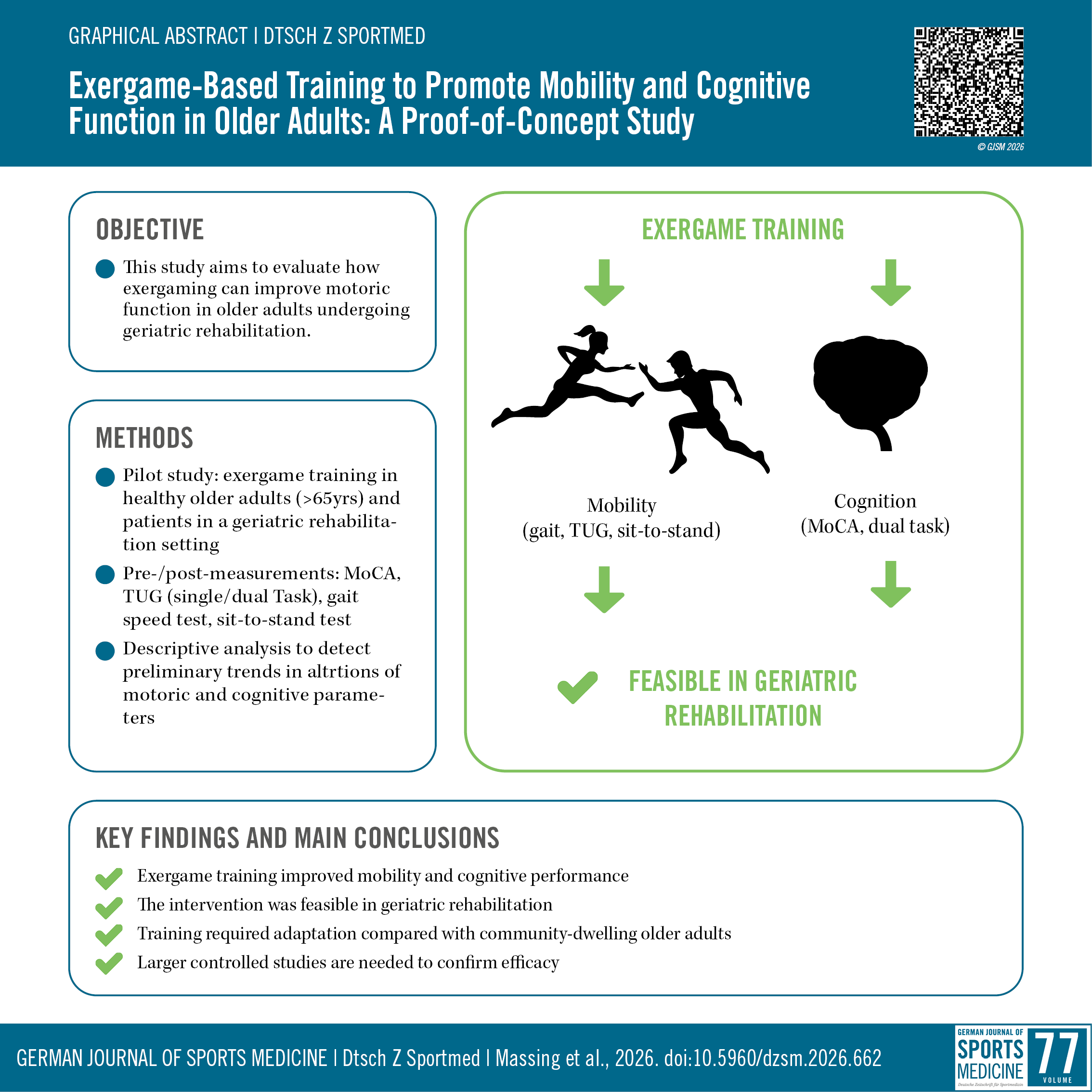
Background: Traditional training methods often lack motivational appeal, resulting in poor adherence. This proof-of-concept study examines the effects of a balance training system on cognitive and motoric function in community-dwelling older adults (CD) as well as in patients in geriatric rehabilitation (GR).
Methods: The CD sample consisted of 12 participants (4 male, 8 female, age: 70.9±4.1 years, intervention: 2x/week 20–25-min. for six weeks). 15 patients in GR were included (10 women, 5 men, age: 84.7±4.2 years; intervention: 5x/week 20–25 min. 3 weeks). Prae- and post-assessments included Montreal Cognitive Assessment test (MoCA), Timed Up and Go Test (TUG) under single- (ST) and dual-task (DT) conditions, gait speed test (GSS) and Sit-to-Stand Test (STS). For the statistical analysis, a pre-post comparison was carried out within the groups and the effect size was determined.
Results: The intervention groups demonstrated improvements across all tests after the balance training system (prae vs post: MoCA, CD: 25.7±2.4 vs. 27.7±1.9; GR: 23.2±4.0 vs. 24.3±3.4; TUG ST, CD: 5.9±0.6 s vs. 5.2±0.4 s; GR: 15.4±8.0 vs. 11.8±5.8 s ; TUG DT (costs) CD: 1.3±1.0 s vs. 1.0±0.8 s; GR 21.6±9.1 vs. 16.1±7.7 s; GSS: CD: 1.7±0.3 m/s vs. 2.0±0.2 m/s; GR: 0.9±0.2 vs. 1.0±0.2 m/s; STS: CD:13.7±2.5 to 15.7±2.8; GR: 11.5±7.0 vs. 16.2±8.3). All improvements despite GR TUG DT costs reached statistical significance.
Discussion: The findings indicate positive effects of a balance training system on cognitive function and functional mobility in older adults. The study highlights the potential of exergames as an effective training method alternative for the elderly.
Key Words:
Community-Dwelling Older Adults (Cd), Gait Speed Test (Gss), Timed Up And Go Test (Tug), Sit-To-Stand Test (Sts), Dual-Task Conditions
Introduction
The demographic shift is leading to a growing proportion of people who experience movement insecurity, falls, and loss of independence due to the physiological aging process (sarcopenia, loss of muscle mass, and functional decline) (11). Scientific evidence shows that regular physical activity has numerous beneficial effects on physical health, cognitive performance, subjective well-being, and self-efficacy (6).
 Nevertheless, motivation to engage in physical activity often declines with increasing age, particularly when traditional exercise formats are perceived as monotonous, physically demanding, or difficult to access (4).
Exergames offer a promising strategy to counteract declining motivation for physical activity in older adults by integrating gamification elements such as point systems, levels, or goal-oriented challenges as well as immediate visual and auditory feedback. Both factors increase motivation and training engagement while improving accessibility to regular physical activity (7). Their clinical as well as daily living effectiveness is largely attributed to immediate visual and auditory feedback, which facilitates motor learning and enhances movement control, a mechanism shown to be particularly relevant for motor skill acquisition in older adults (14, 20).
Moreover, exergames may promote a ‚flow state‘, i.e. a condition characterized by high concentration and intrinsic motivation, which has been shown to positively influence learning processes (18). The playful design of exergames can further reduce movement-related anxiety and enhance confidence in physical abilities, an effect that is particularly relevant for older adults (7). In addition to these motivational benefits, the effectiveness of exergames is increasingly being assessed using objective measures of functional performance.
Previous research indicates that exergame-based interventions can lead to meaningful improvements in functional performance measures commonly applied in gerontological and rehabilitation research. Reported outcomes include enhanced lower-limb strength and functional transfer ability assessed by the Sit-to-Stand test, increased gait speed, and improved dynamic balance reflected by the Timed Up and Go test (9, 15). In addition to motor outcomes, recent evidence suggests that cognitively enriched exergames combining physical and cognitive demands may also positively influence global cognitive functioning in older adults (20).
While earlier exergame research primarily focused on console-based systems such as the Nintendo Wii, Xbox Kinect, or PlayStation Move, more recent approaches emphasize the combination of multisensory stimulation, physical exertion, and immediate feedback for producing sustainable training effects (9, 13). A balance training system is used in a standing position on an unstable surface, which continuously challenges postural control (3) thereby possibly activating autochthonous back muscles. This instability enhances proprioceptive feedback, as users must constantly adjust their body position to maintain balance while interacting with the virtual environment. Thus compared to traditional exergames, which operate on stable ground, a balance training system may therefore provide a more complex and realistic sensorimotor training stimulus.
The present study is a pilot study investigating the feasibility and effects of ta balance training system on cognitive function, functional mobility, lower limb strength and gait velocity in older adults under two conditions: a community-dwelling setting and a setting of geriatric rehabilitation.
Methods
Study Design
Two pilot feasibility studies were conducted using a prae–post design. One study took place in an ambulatory setting at the German Sport University Cologne and involved community dwelling older adults, while the other was conducted in a geriatric rehabilitation setting with older patients. The primary objective of these pilot studies was to evaluate the feasibility and practicality of implementing a balance training system protocol in older adults. Secondary exploratory outcomes included potential changes in functional mobility and cognitive parameters. Both studies were approved by the Ethics Committee of the German Sport University Cologne (approval numbers 096/24 (community dwelling adults) and 251/24 (geriatric rehabilitation)). The intervention in community dwelling older adults was conducted over six weeks with two sessions per week (each lasting 30 minutes). In contrast, the intervention in the geriatric rehabilitation setting lasted three weeks with four to five sessions per week (approximately 15–20 minutes per session), reflecting the specific constraints of the rehabilitation environment.
Participants
Community Dwelling Older Adults: As this was a proof-of-concept study, the sample size was determined pragmatically based on recruitment feasibility and available resources rather than on a formal power calculation. Participants were required to be able to walk, stand, and maintain balance without major limitations that would hinder safe participation in the training program.
Exclusion criteria included acute or unstable chronic diseases that could increase health risks during physical activity (e.g., substantial mobility limitations such as adva nced osteoporosis or the need for walking aids, cognitive impairments or neurological disorders that would prevent independent participation, current involvement in other studies or training interventions, as well as cases in which it was known in advance that fewer than ten of the twelve planned training sessions could be attended).
15 community dwelling older adults were recruited for the study. 2 Persons stopped the study due to knee problems, 1 person due to time limits. A total of 12 community-dwelling healthy older adults aged 65 years and older finally participated in the study (4 men, 8 women; age: 70.9±4.09 years, range: 65–77 years). Since this studies was performed to check out the conditions for a randomized study, we did not yet include a control group.
Geriatric Patients – Inclusion and Exclusion Parameters: A total of 15 patients undergoing geriatric rehabilitation were recruited for the study (5 men, 10 women; age: 84.7±4.2 years; range: 75-91 years). Similar to the study with community dwelling older adults, the sample size was determined by the availability of eligible participants rather than by an a priori power analysis. To be included in the study, participants had to be able to independently mount and dismount a balance training system and stand for at least 30 minutes.
Exclusion criteria comprised the presence of lower- or upper-limb prostheses following amputation; advanced osteoporosis (grades 2-3); recent (<4 weeks) conservatively managed fractures of the extremities; recent pelvic or spinal fractures (< 4 weeks), regardless of treatment modality; acute ligament or tendon injuries of the lower extremities; pain of unknown origin; pronounced dizziness; significant cognitive impairments that would preclude understanding the tasks or compromise safety during training; as well as clinically relevant visual impairments. Patients were pre-selected by the physicians. Since this studies was performed to check out the conditions for a randomized study, we did not yet include a control group.
Intervention: Description of the Exergaming System and Training Concept
Training was conducted using a balance training system (ICAROS Guardian, ICAROS GmbH, Martinsried, Germany), a motion-sensitive balance system equipped with safety rails and a synchronized gaming application (figure 1). Participants stood on a hemispherical balance board and controlled the game through weight-shifting movements. A monitor positioned at eye level provided real-time visual feedback on body movements.
A qualified supervisor was present throughout the entire training period to ensure safety and protocol adherence. The exergames were completed in the same predefined order during each session. Difficulty and training intensity were progressively increased when appropriate to ensure an adequate and individualized training load.
Table 1 provides an overview of the exergames used, differentiated according to their motor and cognitive demands as well as the respective study setting. The original study design was intended for both groups to complete the same balance training system game modules. However, following a pilot phase with five geriatric rehabilitation patients, some adjustments were introduced to ensure appropriate physical load, cognitive feasibility, and safety for this population. In the geriatric group, Quantomize Dice, was implemented as a simplified version of Quantomize, an arithmetic mental task, replacing addition/subtraction, multiplication and division of numbers with dice-based tasks. The Predator game was excluded because its rapid task demands and dynamically shifting background proved overly challenging and distracting. Additional games used exclusively in the geriatric cohort included Colorunner Collectable and Maze. These adjustments enabled a safe and feasible group-specific intervention while maintaining the overall training framework.
 For the community dwelling older adults, the intervention consisted of a six-week training programme using a balance training system. Participants completed two supervised sessions per week, each lasting 20–25 minutes, resulting in a total of twelve sessions. A minimum rest period of 24 hours between sessions was ensured. All assessments were conducted in a controlled laboratory environment at the German Sport University Cologne.
The geriatric patients participated in a customised training programme. Over the course of their approximately three-week rehabilitation stay, they completed a total of twelve training sessions of about 20 minutes each on the balance training system Each session was supervised by a certified physiotherapist and conducted in a shared therapy room where other therapeutic activities were taking place simultaneously. Consequently, distracting external stimuli could not be fully controlled or eliminated.
Test Battery
At both baseline (T0) and post-intervention (T1), participants completed a standardised test battery in a fixed order. Baseline and post-intervention testing took place witin one week before, respectively after the last training regarding the community dwelling older adults. The baseline measurement of the geriatric patients took place on the day after recruitment and at least one day before the training intervention started. Post-intervention took place one day after the last training intervention. Assessments began with the Montreal Cognitive Assessment (MoCA) to evaluate global cognitive functioning, including memory, executive functions, visuospatial abilities, and attention (8).
Functional mobility was then assessed using the Timed Up and Go Test, during which participants stood up from a chair, walked three metres, turned around, returned, and sat down again (26). Immediately afterwards, dual-task ability was evaluated using the Dual-Task Timed Up and Go. Prior to standing up, participants were given a specific initial letter and instructed to name as many words as possible beginning with that letter while completing the Timed Up and Go sequence. Verbal fluency was chosen as the cognitive task for the Dual-Task Timed Up and Go rather than arithmetic tasks, as it engages executive functions (word retrieval, mental flexibility, inhibition) more comprehensively (1).
Lower-limb strength was assessed using the Sit-to-Stand Test (STS), with community-dwelling participants performing as many sit-to-stand repetitions as possible within 30 seconds (17). The group of geriatric rehabilitation patients completed a 60-second version.
The test battery concluded with an assessment of gait speed based on the principles of the 10-Metre Walking Test, an established and well-validated measure of functional capacity and mobility in older adults (24). Community-dwelling participants completed a 20-metre walking task, consisting of 10 metres forward and 10 metres back, whereas geriatric patients completed the standard 10-metre walking test due to feasibility constraints in the clinical setting.
All tests were administered by the same examiners following standardised procedures to ensure consistency across both measurement time points.
Statistical Analysis
Due to the exploratory design of this pilot study, data analyses focused predominantly on descriptive statistics to detect preliminary trends rather than confirm group differences. Data analysis was conducted using SPSS. The two settings (community-dwelling or geriatric rehabilitation) were analyzed separately. Descriptive statistics were calculated, and the Shapiro–Wilk test was used to assess normality. For normally distributed variables, paired t-tests were performed to evaluate prae–post differences, with results considered significant at p < 0,05. Effect sizes (Cohen‘s d) were computed to contextualise outcomes and inform power calculations for future confirmatory trials. The specific thresholds used for interpreting Cohen‘s d were: 0.2 (small effect), 0.5 (medium effect) and 0,8 (large effect) (10).Parametric or non-parametric tests were employed as appropriate based on data distribution.

Results
In the cohort of community-dwelling older adults, cognitive performance increased significantly from prae- to post-intervention (mean MoCA score prae- vs. post-intervention: 25.7±2.4 vs. 27.7±1.9; p=0.0015, Cohen’s d=0.95; figure 2A). In patients undergoing geriatric rehabilitation, cognitive performance also improved following the intervention. Mean MoCA scores increased from 23.20±3.97 at baseline to 24.73±3.43 post-intervention (p=0.003, Cohen’s d=0.93, figure 2B).
Functional mobility was assessed using the Timed Up and Go test under single- and dual-task conditions. In community-dwelling older adults, single-task Timed Up and Go completion time decreased significantly from 5.86±0.59 s at baseline to 5.24±0.40 s post-intervention (p=0.0003, figure 3). Dual-task Timed Up and Go performance also improved, as indicated by a reduction in dual-task costs from 1.29±0.98 s at baseline to 0.95±0.79 s post-intervention (p=0.0014, figure 3).
In the geriatric rehabilitation group, functional mobility improved substantially, with single-task Timed Up and Go completion time decreasing from 15.40±8.04 s at baseline to 11.76±5.78 s post-intervention (p=0.001, figure 3). Dual-task functional mobility likewise showed improvement, reflected by a reduction in dual-task costs from 6.15±3.25 s to 4.29±3.43 s; however, this change did not reach statistical significance (p=0.053, figure 3). Eleven participants demonstrated reduced dual-task costs, whereas four showed increased costs.
Gait performance improved in both groups following the intervention. In community-dwelling older adults, gait speed increased from 1.74±0.28 m/s to 2.01±0.22 m/s (p=0.003, Cohen’s d=1.12, figure 4). In the geriatric rehabilitation group, gait speed increased from 0.87±0.18 m/s to 1.02±0.15 m/s post-intervention (p<0.001, Cohen’s d=1.49, figure 4). All participants demonstrated increased gait speed, indicating a consistent enhancement in walking performance.
Lower-body functional strength also improved significantly (figure 4). In healthy older adults, performance in the 30-second sit-to-stand test increased from 13.7±2.5 to 15.7±2.8 repetitions (p=0.015, Cohen’s d=0.76). In the geriatric rehabilitation group, lower-body functional strength likewise improved, with repetitions in the 60-second sit-to-stand test increasing from 11.5±7.0 to 16.2±8.3, corresponding to a very large effect size (p<0.001, Cohen’s d=1.29).

Discussion
The present study investigated the effects of a balance training system intervention in community-dwelling older adults as well as patients undergoing geriatric rehabilitation. Significant improvements in both cognitive and physical health outcomes were observed in both groups by the exergame training intervention.
In the present study, a significant increase in cognitive function was observed in both the community-dwelling group and the participants undergoing geriatric rehabilitation. Our results are in line with the findings of Phirom et al. (25), who investigated the effects of interactive physical–cognitive exergame training. Significant improvements in cognitive function were particularly evident in the memory and orientation subdomains of MoCA.
The potential effects of interactive exergames on cognitive function can be supported by evidence from basic neurophysiological research. As summarized in a recent systematic review, there is evidence that console-based exergaming can induce neurophysiological adaptations, including increased release of brain-derived neurotrophic factor (BDNF) and alterations in neuronal networks associated with attention and working memory (2). An increase in BDNF was also demonstrated in a previous study conducted by our research group, which examined the effects of balance training using the Nintendo Wii in individuals with diabetes (19). In addition, a recent publication by Müller and colleagues (22) employing electroencephalography reported significant activations in the prefrontal cortex following exergame activity in older adults. These findings further support the assumption that exergame-based interventions may positively influence cognitive processing and neural activity.
However, compared to community-dwelling older adults, the exergame intervention required specific adaptations for use in a geriatric rehabilitation setting. Accordingly, game speed was reduced and cognitive demands were adjusted, for example by replacing mathematical equations with a visually guided numerical task using two dice. Age-related changes in sensory and motor performance are accompanied by an increasing reliance on central control processes. Within the framework of the Reduced Capacity Hypothesis, it is argued that sensory decline and reduced motor efficiency in older age lead to actions that were largely automated in younger years requiring increased cognitive supervision and executive attentional resources (29). The resulting cognitive–motor interference leads to significantly increased dual-task costs in older adults, which become apparent even under low cognitive load, particularly during postural tasks such as standing or walking (5).
Taken together, the present findings and the existing literature suggest that future research should focus on dose–response relationships, particularly with regard to the severity of cognitive demands, the type of cognitive tasks combined with physical activity, and their influence on neural adaptations.
Functional mobility refers to the practical, everyday movement ability that enables an individual to perform mobility-related tasks in daily life safely and efficiently (28). In the present study, functional mobility was assessed using the Timed Up and Go test under single- and dual-task conditions. Notably, improvements were observed despite shorter training sessions (approximately 25 minutes, twice weekly) compared with typical recommendations reported in previous exergame studies [for a review, see (15)]. These findings suggest that meaningful benefits may be achievable with more time-efficient training protocols, which may also improve feasibility and adherence in older adults.
Lower limb strength and gait velocity were additionally assessed to gain further insight into the effects of a balance training system exergaming intervention on functional mobility. Both parameters are key indicators of the functional status associated with sarcopenia (27), a condition that substantially impairs functional capacity and mobility in older adults (23). Although the present study was not specifically designed as an intervention to prevent sarcopenia, it may indicate that improvements in lower limb strength and gait velocity resulting from a balance training system may contribute to the longterm prevention of sarcopenia. This is consistent with previous research demonstrating that regular physical activity has numerous beneficial effects on physical health, including the prevention of sarcopenia (23), improvements in functional mobility (16), as well as enhancements in cognitive performance, subjective well-being, and self-efficacy (6).
The present study is a pilot study with a relatively small sample size. In addition, a control group was lacking in both conditions, which should be addressed in future studies. Interestingly, the composition of the sample, particularly the overrepresentation of women, reflects a phenomenon well documented in ageing research (21). Further studies are required to examine whether this phenomenon should be taken into account in the development and design of exergames.
It has to be kept in mind that in the geriatric rehabilitation setting the balance training system intervention was an add on to the care as usual, i.e. instead of either a 30 min physio- or ergotherapeutic session. The conditions for the performance of exergames had to be adapted for the geriatric participants. Neurocognitive tasks had to be simplified (e.g. picture of dicers instead of calculation tasks). Exergames which depended on a fast motoric flexibility were substituted by slow balance exergames. It has to be further investigated whether these adaptations may be generalized for geriatric patients.
In the present study, the gender distribution of women and men is not equal. As previous studies have shown (12), the higher life expectancy of women leads to a greater proportion of women, particularly in samples with older participants. This “feminization” of aging should be taken into account in the future when (further) developing digital physical activity approaches.
Conflict of Interest
K.B. is member of the scientific board of the ICAROS GmbH. Supported by the Koeln Fortune Program/ Faculty of Medicine, University of Cologne (E.A.).
Ethical Approval
Both studies were approved by the Ethics Committee of the German Sport University Cologne (096/24; 251/24). All participants provided written informed consent prior to participation, and the studies were conducted in accordance with the Declaration of Helsinki.
Summary Box
This proof-of-concept study investigated the effects of a balance training system on cognitive function and functional mobility in community-dwelling older adults and geriatric rehabilitation patients. After 3 to 6 weeks of training, both groups showed significant improvements in cognition (MoCA) as well as mobility and strength measures (TUG, gait speed, Sit-to-Stand). The findings suggest that exergames offer a motivating and effective alternative to traditional exercise for older adults.
References
- Comprehensive verbalfluency features predict executive function performance. SciRep. 2021; 11: 6929.
- Neurobiological effectsof exergame interventions in older adults with or without aneurocognitive disorder: A systematic review. Neurobiol Aging.2025; 154: 47-61.
- Trunk muscle electromyographic activity with unstable andunilateral exercises. J Strength Cond Res. 2005; 19: 193-201.
- Barriers to and facilitators of physical activity program use among older adults.Clin Med Res. 2014; 12: 10-20.
- Cognitive-Postural MultitaskingTraining in Older Adults - Effects of Input-Output ModalityMappings on Cognitive Performance and Postural Control. JCogn. 2021; 4: 20.
- World Health Organization2020 guidelines on physical activity and sedentarybehaviour. Br J Sports Med. 2020; 54: 1451-1462.
- The role ofmotivation factors in exergame interventions for fall preventionin older adults: A systematic review and meta-analysis. FrontNeurol. 2022; 13: 903673.
- A re-examination of MontrealCognitive Assessment (MoCA) cutoff scores. Int J GeriatrPsychiatry. 2018; 33: 379-388.
- Comparison between theeffects of exergame intervention and traditional physicaltraining on improving balance and fall prevention in healthyolder adults: a systematic review and meta-analysis. J NeuroengRehabil. 2021; 18: 164.
- Statistical Power Analysis for the Behavioral Sciences.Routledge; 2013.
- Baseline Report. Summary. 1st ed. WorldHealth Organization: Geneva; 2021.
- Longevity Science and Women‘s Health and Wellbeing.J Popul Ageing. 2023: 1-20. Epub ahead of print.
- Feasibility and Enjoyment ofExercise Video Games in Older Adults. Front Public Health. 2021;9: 751289.
- Aging, brain plasticity, andmotor learning. Ageing Res Rev. 2024; 102: 102569.
- Effects of active exergames on physical performance inolder people: an overview of systematic reviews and metaanalysis.Front Public Health. 2024; 12: 1250299.
- International ExerciseRecommendations in Older Adults (ICFSR): Expert ConsensusGuidelines. J Nutr Health Aging. 2021; 25: 824-853.
- 30-s chair-stand test as a measure oflower body strength in community-residing older adults. Res QExerc Sport. 1999; 70: 113-119.
- Flow Experience of OlderAdults Using the iStoppFalls Exergame. Games Cult. 2016; 11:201-222.
- Exergaming für PatientInnen mit metabolischem Syndrom?! [Exergaming for patients with metabolic syndrome?!]. Wien Med Wochenschr. 2020;170: 171-177.
- The Role of Augmented Feedback onMotor Learning: A Systematic Review. Cureus. 2021; 13: e19695.
- Counting older women:Measuring the health and wellbeing of older women in LMICs.Cell Rep Med. 2024; 5: 101607.
- Monitoring cognitive load while playing exergames in a fourweekintervention for older adults: an explorative EEG study. SciRep. 2025; 15: 32490.
- Global prevalence ofsarcopenia and severe sarcopenia: a systematic review andmeta-analysis. J Cachexia Sarcopenia Muscle. 2022; 13: 86-99.
- Assessing the reliability and validityof a shorter walk test compared with the 10-Meter Walk Test formeasurements of gait speed in healthy, older adults. J GeriatrPhys Ther. 2013; 36: 24-30.
- Beneficial Effects ofInteractive Physical-Cognitive Game-Based Training on FallRisk and Cognitive Performance of Older Adults. Int J EnvironRes Public Health. 2020; 17.
- The timed “Up & Go”: a test of basicfunctional mobility for frail elderly persons. J Am Geriatr Soc.1991; 39: 142-148.
- Screening for and Managingthe Person with Frailty in Primary Care: ICFSR ConsensusGuidelines. J Nutr Health Aging. 2020; 24: 920-927.
- Motor control: Translating researchinto clinical practice. Fifth edition, international edition.Wolters Kluwer: Philadelphia, Baltimore, New York, London,Buenos Aires, Hong Kong, Sydney, Tokyo; 2017.
- Effect of motor practice on dual-taskperformance in older adults. J Gerontol B Psychol Sci Soc Sci.2007; 62: P141-P148.
German Sport University Cologne
Institute for Cardiovascular Research and
Sport Medicine
Am Sportpark Müngersdorf 6, 50933
Cologne, Germany
Email: brixius@dshs-koeln.de