

Perceived Impact of Menstrual Cycle Symptoms on Soccer Performance in Elite Female Athletes: A Cross-Sectional Study
Wahrgenommene Auswirkungen menstruationszyklusbedingter Symptome auf die fußballspezifische Leistungsfähigkeit von Elite‑Sportlerinnen: Eine Querschnittsstudie
Graphical Abstract
Summary
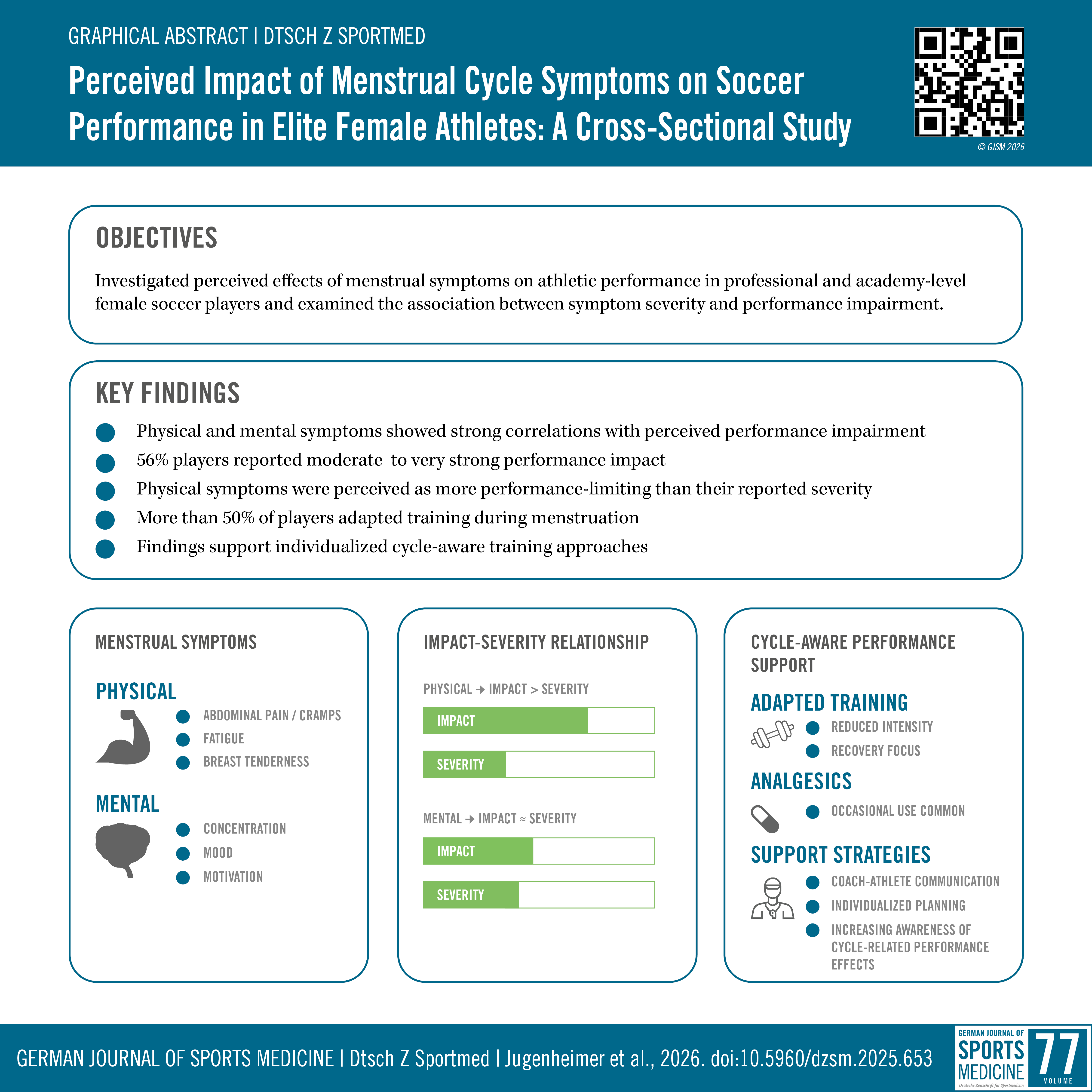
Objective: This study examined how professional and academy-level female soccer players perceive the impact of menstrual symptoms on their athletic performance and assessed the relationship between symptom severity and perceived performance impairment.
Methods: In this cross-sectional survey, 106 players in Austria completed an online questionnaire evaluating the severity of physical and mental menstrual symptoms and their perceived impact on performance. Paired-sample t-tests were used to compare symptom severity with perceived performance impairment.
Results: Players reported that physical symptoms impaired performance significantly more than their reported severity, whereas mental symptom severity and perceived impact were nearly identical. Strong positive correlations were observed between symptom severity and perceived performance impairment for both physical and mental symptoms, indicating that athletes with more intense symptoms consistently reported greater performance limitations.
Implications: These findings highlight the relevance of menstrual symptom burden in elite women’s soccer and emphasize the need for cycle-aware training environments. Increased awareness and individualized symptom-management strategies may help optimize performance, support athlete well-being, and facilitate more informed coaching practices.
Key Words:
Sports Performance, Performance Impairment, Professional Soccer Players, Individualized Management
Introduction
The menstrual cycle is increasingly recognized as an important factor influencing performance and training responses in female athletes, yet women remain underrepresented in sports science research, with only 39% female participation reported across major studies (5). Hormonal fluctuations may influence pain, mood, neuromuscular control, and musculoskeletal function (1, 4, 13). However, despite extensive physiological research, the subjective experiences of athletes remain insufficiently understood.
Objective performance findings across menstrual cycle phases are inconsistent. Some evidence suggests variations in strength, neuromuscular function, or exercise performance across phases (2, 9, 15), whereas other studies report minimal differences or methodologically limited results (3, 11). Meanwhile, menstrual symptoms such as dysmenorrhea, fatigue, irritability, or reduced concentration are highly prevalent and may be more relevant for day-to-day performance than physiological fluctuations alone (10, 12). Mental symptoms, including reduced focus and increased irritability, may further contribute to impaired decision-making and increased injury risk in fast-paced sports like soccer (6, 14).
To address this gap, this study investigates how professional and academy-level female soccer players
perceive the impact of menstrual symptoms on their performance. It further examines how symptom severity relates to perceived performance impairment, providing applied insights for individualized training and cycle-aware support strategies in elite women’s soccer.
Methods
Research Questions
The study addressed the primary research question: Do female soccer players perceive any impact of their menstruation on their on-pitch performance? A secondary question examined which symptoms are perceived to have the greatest impact on female soccer players performance?
Study Objective
This study aimed to evaluate the perceived impact of menstruation on soccer performance among professional and academy-level female players and to identify symptoms athletes associate most with performance impairments because of their menstruation. Based on prior research indicating high prevalence of premenstrual symptoms, we hypothesized that most players perceive menstruation as performance-limiting. These subjective insights are essential to inform athlete-centered support strategies in sport.
Study Design and Setting
A cross-sectional design was used to assess the relationship between menstrual symptoms and perceived performance changes. Participants were recruited from Austrian first and second division teams and the national women’s football academy. Data were collected between May and July 2025.
Participants
Eligible participants included all current players aged 14 and above from the mentioned teams. Inclusion required physiological menstruation (cycle length 20-35 days, consistent for at least 6 months) and the absence of hormonal contraceptive use. Players under 14 were excluded. Athletes received detailed study information and gave informed consent prior to participation.
Inclusion of Minors
Players aged 14-17 were included in accordance with austrian (Länder immer groß?) law (§173 ABGB), which permits mature minors to consent to non-invasive research procedures. Their participation is justified due to the relevance of this age group in elite-level women’s football.
Data Collection
Data were collected via a 24-item online questionnaire developed in cooperation with sports physicians and scientists from the Austrian Football Federation. The survey was distributed via secure email links and hosted on the GDPR-compliant platform SoSci Survey, ensuring complete anonymity. IP addresses and personal identifiers were not collected.
Variables and Measures
The questionnaire assessed perceived performance impact, symptom severity, pain management, most impacted types of training and personal adaptations in training. 

Statistical Analysis
Data were analyzed using SPSS v30. The primary analyses focused on within-subject comparisons using paired-sample t-tests to assess differences between perceived symptom severity and the perceived impact on athletic performance. To further explore relationships between variables, Pearson correlation analyses were performed. Secondary research questions were addressed using descriptive statistics, including means, medians, frequencies, and percentages. Results are reported in aggregate form, with the significance level for statistical tests set at α=0.05.
Ethical Considerations
Ethical approval was obtained from the Ethics Committee of Karl Landsteiner University (Ref. 1071/2024, approved 20.01.2025). All participants gave informed consent; minors provided self-consent per Austrian legal standards. Participation was voluntary and anonymous, with the right to withdraw at any time. Sensitive topics were addressed respectfully, and findings are reported in aggregate to preserve confidentiality.
Results
A total of 106 responses were collected, of which 91 met the predefined inclusion criteria and were included in the final analysis.
Sample Characteristics
Participants ranged in age from 14 to 33 years (M=23.13). Age at menarche ranged from 9 to 14 years (M=11.67). Over 60% of players reported a good understanding of their menstrual cycle and its effects, while only 4.4% reported limited knowledge, suggesting generally high awareness among participants.
Perceived Impact of Symptoms on Performance
To assess whether players perceive an impact of menstruation on their soccer performance, players rated symptom severity and perceived performance impact on a scale from 0-100. Paired-sample t-tests were conducted comparing the reported severity with the perceived impact. For physical symptoms, players rated the impact on performance (M=63.03, SD=19.05) higher than symptom severity (M=60.78, SD=18.89), t(89)=-2.47, p=.016 (as shown in table 1). A strong positive correlation was found (r=.895, p<.001).
For mental symptoms, no significant difference was observed between perceived symptom severity (M=68.10, SD=15.87) and performance impact (M=68.00, SD=14.93), t(49)=-0.74, p=.465. However, the correlation remained strong (r=.953, p <.001), indicating consistent individual associations between symptoms and performance.
Symptom Prevalence and Subjective Impact
The majority of participants experienced regular menstruation-related symptoms: 85.6% indicated recurring physical symptoms and 52.1% reported recurring mental symptoms. Overall, 56.4% stated that menstruation had a moderate to very strong impact on their performance, while 40.4% described only minor effects, and 3.2% perceived no impact.
Common physical symptoms included lower abdominal pain (94.5%), fatigue and sleep disturbances (67.0%), breast tenderness (60.4%), skin issues (39.6%), and diarrhea (34.1%). Less frequently reported symptoms included headaches (28.6%), nausea (17.6%), and dizziness (6.6%). The most frequent
mental symptoms were irritability (81.3%), mood swings (60.0%), and decreased motivation (54.2%). An overview of the most commonly reported physical and mental symptoms is shown in figure 1.
Menstrual Cycle Phase and Symptom Burden
Most participants (60.8%) identified menstruation as the phase with the greatest impact on performance. Another 21.6% reported the luteal (premenstrual) phase as most challenging, while 11.3% named the follicular phase. Only 3.1% could not specify a phase. These findings highlight the perceived burden during menstruation and the days preceding it.
Symptom Management Strategies
A majority (52.6%) reported modifying training routines during their cycle. Strategies included reducing training volume (69.6%), lowering intensity or skipping strength sessions (70.9%), focusing on recovery (46.8%), and applying mental strategies (29.1%). Analgesic use was frequent: 70.1% used analgesics occasionally, and 20.6% reported regular use.
Training Components Most Affected
Participants reported that endurance (61.1%) and strength training (47.8%) were most affected by menstrual symptoms, while technical training was less impacted (22.2%) (shown in table 2). A subgroup analysis comparing mental symptom severity in players who reported an impact on technical performance versus those who did not, revealed no significant difference, t(46)=1.32, p=.194, but a small to moderate effect size (Cohen’s d=0.43) suggested a possible trend.

Discussion
This study examined how elite and academy-level female soccer players perceive the impact of menstrual symptoms on their performance. The findings demonstrate that athletes who experience more intense symptoms also report stronger perceived performance impairments, particularly in relation to physical symptoms. While the average difference between physical symptom severity and perceived impact was small, the strong correlations indicate that symptom intensity is a central factor in athletes’ evaluations of readiness to perform. Mental symptom severity and perceived impact were nearly identical, suggesting that psychological complaints such as irritability, reduced motivation, or impaired focus translate directly into perceived limitations. This aligns with work showing that cognitive and attentional factors can influence motor behavior and decision-making in soccer (6, 14).
Existing research on objective performance changes across menstrual cycle phases remains inconsistent. Some studies report measurable variations in strength, neuromuscular control, or exercise performance across the cycle (2, 9, 15), whereas other studies find minimal or no performance differences (3, 11).
These inconsistencies highlight the value of subjective perspectives. Athletes often rely on internal assessments of discomfort, fatigue, and cognitive clarity when evaluating their ability to train or compete. Subjective experiences may therefore affect performance more immediately than physiological markers alone. This perspective is consistent with methodological recommendations emphasizing the integration of subjective data into menstrual cycle research (8).
From an applied perspective, more than half of the players in this study adjusted their training load during high-symptom phases, showing that menstrual symptoms meaningfully influence daily training decisions. Given the high prevalence of dysmenorrhea and premenstrual symptoms among young women and athletes (10, 12), it is not surprising that players adopt coping strategies such as reduced training intensity or altered session focus. Cycle-aware communication and individualized symptom-management approaches may therefore support performance consistency and athlete well-being, aligning with calls for more athlete-centered approaches in women’s sports (1, 7).
This study has limitations. Data were self-reported, which may introduce recall bias or individual variation in symptom awareness. The absence of objective performance measures prevents direct comparison of subjective impairments with measurable changes in performance. Additionally, the sample consisted exclusively of Austrian professional and academy players, limiting broader generalizability. Future studies should integrate subjective data with longitudinal performance tracking, hormonal verification, and objective testing to obtain a more comprehensive understanding of cycle-related performance variability.
Overall, the findings highlight that menstrual symptoms meaningfully affect athletes’ perceived performance readiness. Incorporating symptom awareness into training planning may support more individualized and effective load management in elite women’s soccer.
Practical Implications
- Many players report noticeable performance limitations during phases of high symptom burden.
- Both physical and mental symptoms contribute to reduced performance readiness.
- Athletes frequently adjust training load, often by reducing intensity or increasing recovery.
- High cycle awareness supports informed self-regulation among players.
- Open communication about menstrual symptoms may facilitate individualized training strategies.
Conflict of Interest
The authors have no conflict of interest.
Ethical Approval
Ethical Approval was obtained from the Ethics Commitee of Karl Landsteiner University (Reference No. 1071/2024). Athletes gave informed consent prior to participation.
Acknowledgements
This study was conducted as part of the Bachelor’s thesis of Amelie Jugenheimer at Karl Landsteiner University of Health Sciences, Krems, Austria.
The study was carried out in collaboration with the Austrian Soccer Federation and its Academy, which supported participant recruitment and contact with players.
AI-based tools were used during the writing process to improve clarity, structure, and readability. All content, analyses, and interpretations reflect the author’s own academic work and understanding.
Summary Box
What is already known on this topic
- Menstrual cycle-related symptoms can affect multiple performance determinants (pain, fatigue, motivation, focus), but athlete perceptions are underreported
What this study adds
- Players perceived performance impact rises with symptom severity. Physical symptoms are felt to impair performance more than their raw severity suggests; mental symptoms show similar severity and impact
- A majority modify training during high-symptom phases highlighting real-world coping strategies and the need for phase-aware planning How this might affect research, practice, or policy
- Supports individualized, cycle-informed load management and open coach-athlete communication in women’s soccer
- Encourages future work that combines subjective perceptions with objective metrics and evaluates targeted interventions
Literatur
- The Impact of Irregular Menstruation on Health: A Review of the Literature. Cureus. 2023; 15: e49146.
- Variations in strength-related measures during the menstrual cycle in eumenorrheic women: A systematic review and meta-analysis. J Sci Med Sport. 2020; 23): 1220-1227.
- The Impact of Menstrual Cycle Phase on Athletes‘ Performance: A Narrative Review. Int J Environ Res Public Health. 2021; 18: 1667.
- Effect of Estrogen on Musculoskeletal Performance and Injury Risk. Front Physiol. 2019; 9: 1834.
- Where are all the female participants in Sports and Exercise Medicine research? Eur J Sport Sci. 2014; 14: 847-851.
- Drop-Jump Landing Varies With Baseline Neurocognition: Implications for Anterior Cruciate Ligament Injury Risk and Prevention. Am J Sports Med. 2016; 44: 2347-2353.
- The Effect of Menstrual Cycle and Contraceptives on ACL Injuries and Laxity: A Systematic Review and Meta-analysis. Orthop J Sports Med. 2017; 5: 2325967117718781.
- Methodological Recommendations for Menstrual Cycle Research in Sports and Exercise. Med Sci Sports Exerc. 2019; 51: 2610-2617.
- The effects of menstrual cycle phase on physical performance in female soccer players. PLoS One. 2017; 12: e0173951.
- Prevalence, risk factors, and management practices of primary dysmenorrhea among young females. BMC Womens Health. 2021; 21: 392.
- The Effects of Menstrual Cycle Phase on Exercise Performance in Eumenorrheic Women: A Systematic Review and Meta-Analysis. Sports Med. 2020; 50: 1813-1827.
- Factors Associated with the Prevalence and Severity of Menstrual-Related Symptoms: A Systematic Review and Meta-Analysis. Int J Environ Res Public Health. 2022; 20: 569.
- Physiology of the Menstrual Cycle. Cephalalgia. 2000; 20: 148-154.
- Mental fatigue impairs soccer-specific decision-making skill. J Sports Sci. 2016; 34: 1297-1304.
- Maximal force and tremor changes across the menstrual cycle. Eur J Appl Physiol. 2016; 116: 153-160.