


Trends and Hotspots in Youth Strength Training Research: A Bibliometric Analysis of the 100 Most-Cited Articles
Trends und Hotspots der Forschung zum Krafttraining im Jugendalter: Eine bibliometrische Analyse der 100 meistzitierten Artikel
Graphical Abstract
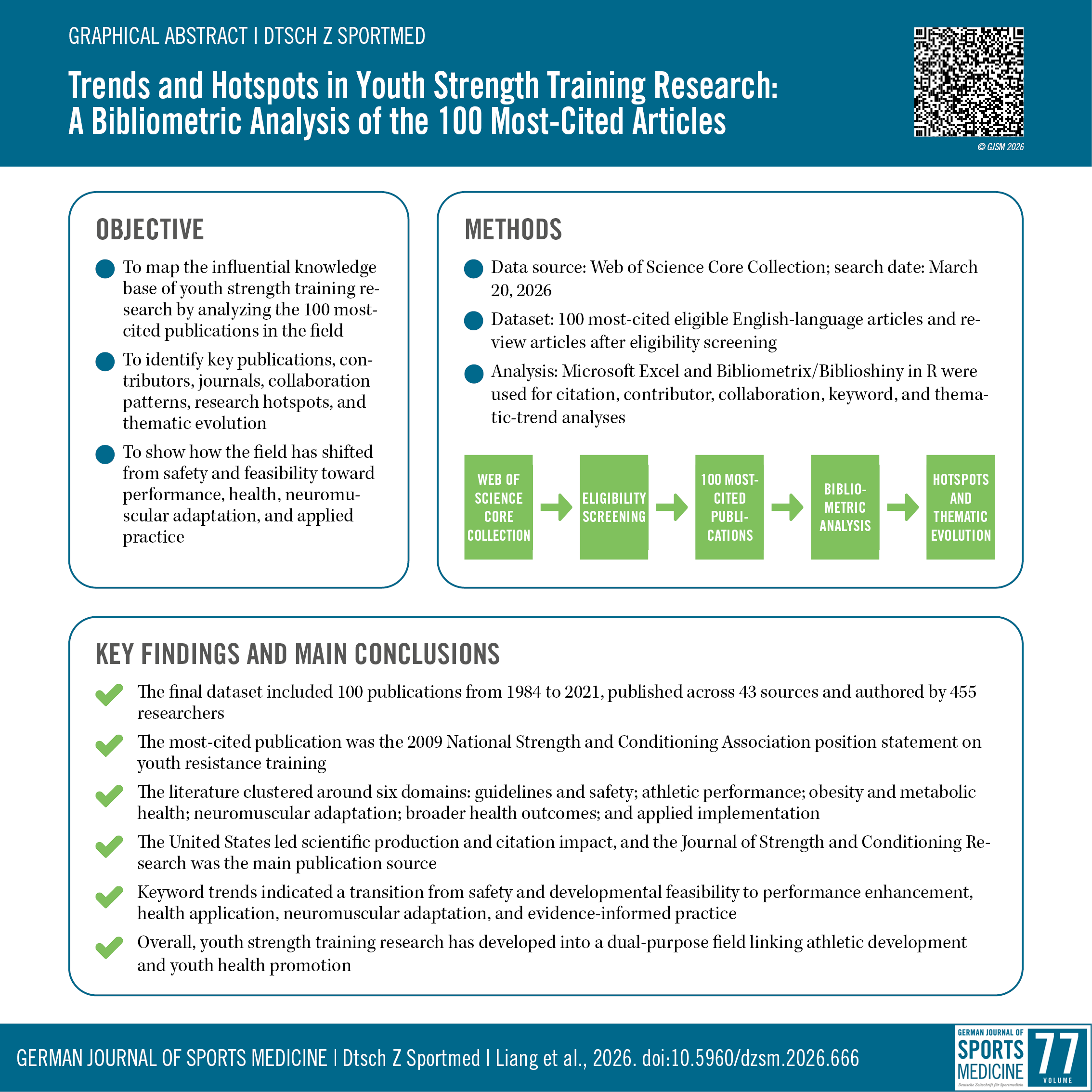
Summary
Objective: This study aimed to conduct a bibliometric analysis of the 100 most-cited publications on youth strength training to identify influential literature, major contributors, research hotspots, and thematic development in the field.
Methods: Data were retrieved from the Web of Science Core Collection on March 20, 2026. After screening according to predefined criteria, the 100 most-cited eligible publications involving children, adolescents, or young athletes were included. Microsoft Excel and Bibliometrix/Biblioshiny (R) were used to analyze publication characteristics, source distribution, leading contributors, collaboration patterns, keyword occurrence, and temporal thematic trends.
Results: The dataset included 100 publications published between 1984 and 2021 across 43 sources, involving 455 authors. The most-cited article was the 2009 National Strength and Conditioning Association position statement on youth resistance training. The literature was concentrated in a small number of core journals, led by the Journal of Strength and Conditioning Research. The United States ranked first in both scientific production and citation impact. The highly cited literature was mainly organized around six domains: guidelines and safety, athletic performance, obesity and metabolic health, neuromuscular adaptation, broader health-related outcomes, and applied implementation. Temporal keyword trends indicated a shift from early concerns with safety and developmental feasibility toward performance enhancement, health-related application, and evidence-informed practice.
Conclusion: Youth strength training research has evolved from a safety-focused stage into a more mature and interdisciplinary field characterized by performance, health, and practical application. This study provides a structured overview of the field’s influential knowledge base and may help guide future research, evidence synthesis, and practical program design for young populations.
Key Words: Youth, Strength Training, Resistance Training, Bibliometric Analysis, Research Hotspots, Thematic Evolution
Introduction
Strength training is an important component of physical development, athletic preparation, and health promotion in youth populations, including children and adolescents (7, 11). In addition to increasing muscular strength, previous studies have shown that strength training can improve athletic performance and muscular fitness (4, 16), support healthy body composition and metabolic function (14, 22), and contribute positively to long-term health and physical literacy in youth (8, 28).
Despite its well-established importance, participation in structured muscle-strengthening activities among adolescents remains limited. Epidemiological evidence from 28 European countries showed that only a minority of adolescents achieved sufficient muscle-strengthening activity (5), whereas national data from the United States also indicated low compliance with muscle-strengthening activity recommendations among youth (24).
As the literature has accumulated, research on youth strength training has gradually expanded from early concerns regarding safety and feasibility to broader topics, including athletic development, injury prevention, health-related benefits, and school-based intervention practice (2, 11). Existing position statements and reviews further indicate that the field now spans multiple disciplinary perspectives, including pediatric exercise science, physical education, strength and conditioning, and sports medicine (17, 25). These developments suggest that the field is not lacking in individual studies; rather, it has evolved into a research area characterized by thematic diversity and interdisciplinary perspectives.
However, most existing studies and reviews have primarily focused on whether strength training is safe, whether it is effective, and which performance- or health-related outcomes it may influence (4, 9). In contrast, the overall developmental landscape of the field itself remains insufficiently understood. It is still unclear which influential publications constitute the core knowledge base of youth strength training research, which authors, institutions, and countries have played leading roles in shaping the field, and how research hotspots and themes have evolved over time. Because the present study focuses not on the effectiveness of specific training interventions, but on the research field itself and its highly influential literature, bibliometric analysis is particularly well suited to identifying its knowledge structure, core contributors, collaboration patterns, and thematic trends (6, 27). Therefore, this study conducted a bibliometric analysis of the 100 most-cited articles on youth strength training indexed in the Web of Science Core Collection. Specifically, it aimed to identify influential publications, leading authors, institutions, countries, and journals, as well as collaboration patterns, research hotspots, and thematic trends, thereby providing a structured and comprehensive overview of the knowledge base of youth strength training research and offering a reference for future topic selection, evidence synthesis, and the design of related practical programs.
Materials and Methods
Study Design and Data Source
This study employed a bibliometric approach to analyze highly cited publications in the field of youth strength training research. Bibliometric analysis is well suited to identifying influential publications, core contributors, collaboration structures, and thematic evolution within a research field, thereby providing an overview of its knowledge structure and developmental trajectory (6, 27). Data were retrieved from the Web of Science Core Collection. This database was selected because it provides citation-based records suitable for identifying highly cited literature and for conducting citation analysis, collaboration network analysis, and knowledge mapping.
The literature search and data export were completed on March 20, 2026. The search covered all records available in the database from its inception to the date of retrieval. Only Articles and Review Articles published in English were considered.
Search Strategy and Eligibility Criteria
To improve retrieval sensitivity and reduce terminology bias, an expanded synonymous search strategy was adopted. The search was constructed around terms related to strength training and youth populations. The final search query was as follows: („strength training“ OR „resistance training“ OR „resistance exercise“ OR „weight training“ OR „muscle-strengthening exercise“ OR „strength exercise“ OR „strengthening exercise“) AND („adolescen“ OR „teen“ OR „youth“ OR „young athlete“).
The initial search yielded 2,324 records. After limiting the document types to Article and Review Article and restricting the language to English, 2,124 records remained for further screening.
In the present study, strength training was defined as a structured training modality primarily intended to improve muscular strength, power, strength-related performance, or neuromuscular capacity through external resistance, progressive overload, or other structured resistance-based stimuli (9, 11). Youth strength training research was used as an umbrella term referring to strength- and resistance-training studies involving children, adolescents, and young athletes. Adolescents were conventionally defined as individuals aged 10–19 years, consistent with commonly used age ranges in adolescent health research (26). Studies involving children or young athletes were retained only when their primary focus was clearly relevant to youth strength training, resistance-training prescription, developmental adaptation, health-related outcomes, or athletic performance in young populations.
The inclusion criteria were as follows: i) the study primarily focused on strength training or resistance training; ii) the study population consisted of children, adolescents, or young athletes, and the topic was clearly relevant to youth strength training research; iii) the document type was an original research article or review article; iv) the publication language was English.
The exclusion criteria were as follows: i) the record matched the search terms but did not primarily address youth strength training, such as studies on general physical activity, mental health, nutrition, drug or steroid use, disease management, or purely methodological testing studies; ii) the study population did not primarily involve children, adolescents, or young athletes, or the relevance to youth strength training research was unclear; iii) the document type was neither an Article nor a Review Article; iv) the publication language was not English.
To maintain consistency between the title and the final dataset, studies focusing primarily on special clinical rehabilitation populations and serving mainly disease management purposes were excluded from the final analysis. In contrast, studies involving health-related subgroups closely associated with youth strength training practice, such as overweight, obesity, or hypertension, were retained when the central intervention remained strength training or resistance training.
Screening, Data Extraction, and Standardization
All records were sorted in descending order by Times Cited to ensure consistency with the study design based on the 100 most-cited publications. Two researchers independently screened titles and abstracts. Full texts were reviewed when relevance could not be determined from the title and abstract alone. Disagreements were resolved through discussion, and when necessary, a third senior researcher adjudicated the decision.
After the relevance screening had been completed, eligible records were ranked by citation count, and the 100 most-cited publications were included in the bibliometric analysis (supplementary material online, table S1). The screening process is presented in figure 1.

Prior to the formal analysis, we verified author names, institution names, and journal names, and standardized them where necessary. The frequency of country/region and institution occurrences was calculated based on the number of times the author‘s affiliation appeared; therefore, the total frequency of these variables may exceed 100.
Bibliometric Analysis and Visualization
Bibliometric analysis was conducted using Microsoft Excel and Bibliometrix/Biblioshiny (R). Excel was used for data organization and descriptive statistics, whereas Bibliometrix was used for citation analysis, collaboration network analysis, keyword analysis, and thematic trend analysis (1). Following the general framework of bibliometric research, the present study incorporated both performance analysis and science mapping. The former was used to identify influential publications, leading authors, institutions, countries, and journals, whereas the latter was used to reveal collaboration structures, research hotspots, and thematic evolution (6, 27).
The analytical dimensions included annual publication output and document type distribution, influential publications and citation characteristics, contributions of authors, institutions, countries, and journals, author and country collaboration networks, keyword occurrence analysis, and thematic trend analysis. The results were presented in tables and visual maps to depict the knowledge structure, collaboration patterns, and thematic evolution of youth strength training research.
Results
 General Characteristics of the Dataset
Table 1 presents the overall characteristics of the final dataset. This dataset contains 100 highly cited articles on youth strength training, published between 1984 and 2021 from 43 sources. These articles were authored by 455 researchers, with an average of 6.21 co-authors per article. Only 4 articles are single-authored, involving 3 authors. International collaborators account for 35% of all included articles. The average publication time is 15.5 years, and the average number of citations per article is 111.3. The dataset contains 3202 cited references, 203 author keywords, and 360 keyword expansion entries.
Characteristics and Topical Profile of the 100 Most-Cited Articles
Most-Cited Publications: Table 2 presents the 10 most-cited publications in the final dataset. The most-cited article was Youth Resistance Training: Updated Position Statement Paper from the National Strength and Conditioning Association by Faigenbaum et al. (2009), with 706 citations. This was followed by the 2014 International Consensus statement on youth resistance training by Lloyd et al. (2014), which received 380 citations. The third-ranked publication was the randomized controlled trial by Lee et al. (2012), which examined the effects of aerobic versus resistance exercise on abdominal fat, intrahepatic lipid, and insulin sensitivity in obese adolescent boys and had 274 citations.
In summary, the highest-ranked publications were dominated by position statements, narrative reviews, and systematic reviews/meta-analyses. Among the top 10 papers, six were guidance or evidence-synthesis papers, whereas four were original intervention studies. The intervention studies were mainly concentrated in two directions: obesity- and metabolism-related outcomes in adolescents and sport-specific performance development in youth athletes.

Topical Distribution of the Most-Cited Publications
Table 3 summarizes the thematic distribution of 100 highly cited articles, based on a manual selection of article titles and abstracts. These articles were divided into six thematic areas. The largest group involved athletic performance and specific sport development (n=33, 33.0%), followed by obesity, fat accumulation, and metabolic health (n=20, 20.0%), guidelines, safety, and program design (n=18, 18.0%), and neuromuscular adaptation, maturation, and physiological mechanisms (n=15, 15.0%). Smaller but distinctive groups focused on broader health-related outcomes (n=8, 8.0%), including bone health, body composition, athletic performance, and psychosocial outcomes, as well as application implementation and practice (n=6, 6.0%), such as supervision, school-based programs, coaching practices, and resistance training skills assessment.

In summary, the highly cited literature on youth strength training mainly revolves around three research directions: the safety and standardization of resistance training in young populations, the improvement of athletic performance in youth athletes, and the impact of resistance training on health and metabolic outcomes in children and adolescents.
Core Journals and Source Distribution
The 100 most cited papers were published from 43 different sources, but the distribution is clearly concentrated in a few journals. The Journal of Strength and Conditioning Research is the primary source, contributing 26 papers, accounting for more than a quarter of the dataset. The British Journal of Sports Medicine and Pediatrics rank second, each with 5 papers. Frontiers in Physiology, International Journal of Sports Medicine, Journal of Sports Sciences, Medicine and Science in Sports and Exercise, and Sports Medicine each contributed 4 papers, while the Journal of Pediatrics and Pediatric Exercise Science each contributed 3 papers.
The Bradford’s law analysis, shown in supplementary material online, figure S1, further confirmed that the highly cited literature was concentrated in a small number of core journals, led by the Journal of Strength and Conditioning Research, the British Journal of Sports Medicine, and Pediatrics. This pattern suggests that youth strength training research is mainly disseminated through journals at the intersection of strength and conditioning, sports medicine, pediatric exercise science, and youth health research.
In summary, the source distribution suggests that research on youth strength training is mainly published at the intersection of strength and conditioning, clinical sports medicine, pediatric exercise science, and youth health-related research. Leading Countries, Authors, and Institutions
Country-level scientific production and citation performance: Table 4 presents the country-level scientific production and citation performance in the dataset. In terms of citation impact, the United States ranked first with 4,821 total citations, followed by Germany (1,712), Canada (1,049), and the United Kingdom (917). Australia (742) and Spain (443) also showed relatively high citation counts, whereas Greece (261), France (243), Brazil (239), and Portugal (174) contributed more modest citation totals. With respect to average article citations, France recorded the highest value (243), followed by the United States (133.9) and Greece (130.5). In terms of scientific production, calculated on the basis of author-affiliation occurrences, the United States also ranked first (164 occurrences), followed by Canada (71), the United Kingdom (45), and Germany (41).
In summary, these findings indicate that the highly cited literature on youth strength training was led primarily by North American and European countries, with the United States occupying the dominant position in both production and citation impact.
Leading authors: The author distribution, provided in supplementary material online,figure S2, indicates that the highly cited literature on youth strength training was shaped by a relatively small group of frequently publishing authors. Faigenbaum AD was the most prolific author, with 17 papers, followed by Granacher U with 8 papers and Lloyd RS and Myer GD with 6 papers each.
Leading institutions: The College of New Jersey ranked first, appearing in 22 articles, followed by the Federal University of São Paulo with 20 articles. The University of Calgary and the University of Potsdam each appeared in 15 articles, while the University of Newcastle contributed 11 articles. The University of Ottawa and the University of Pittsburgh each appeared in 10 articles, followed by Cardiff Metropolitan University with 9 articles. Cincinnati Children’s Hospital Medical Center and Memorial University of Newfoundland each appeared in 8 articles (supplementary material online, table S2).
In summary, the institutional distribution indicates that the highly cited literature on youth strength training was supported by a relatively concentrated group of universities and medical research centers, with notable contributions from institutions in North America, Europe, and Brazil.
Collaboration Patterns
Author collaboration patterns: The network indicates that collaboration among authors was organized around several recurring research groups rather than being evenly distributed across all contributors. Faigenbaum AD occupied a central position in the network, with multiple strong links to other authors, suggesting an important role in the collaborative structure of the field. Close collaborative ties were also observed among authors such as Lloyd RS, Myer GD, Behm DG, and Prieske O, forming a cluster mainly related to youth resistance training, athletic development, and performance-oriented research. Additional collaborative clusters were identified around authors such as Sigal RJ, Goldfield GS, Prud’homme D, and Kenny GP, reflecting another research line related to obesity, exercise intervention, and health outcomes in adolescents (supplementary material online, figure S3).
In summary, the author collaboration pattern suggests that the highly cited literature on youth strength training was shaped by several relatively well-defined collaborative groups, with a small number of highly connected authors playing central roles.
Country collaboration patterns: The country collaboration network is provided in figure 2. The network was centered on the United States, which showed strong collaborative links with several countries, particularly Canada, the United Kingdom, and Australia. These connections indicate that international cooperation in the highly cited literature was concentrated among a few leading countries. Additional links were observed among European countries such as Germany, Spain, Italy, and the Netherlands, although these connections appeared weaker than those involving the United States. Smaller nodes, including Cyprus, Qatar, Tunisia, and Chile, were located on the network periphery, indicating a lower level of participation in international collaboration within this dataset.

In summary, the country collaboration pattern suggests that the cooperative structure of youth strength training research was centered primarily on the United States, with support from other North American, European, and Oceanian countries.
Keyword Occurrence and Research Hotspots
Figure 3 presents a treemap of the most frequently used keywords in the dataset. The keyword distribution is mainly composed of terms related to the general population and training, with „children“ (appearing 36 times, 10%) and „strength“ (appearing 34 times, 10%) being the two most frequent keywords. This was followed by „exercise“ (25 occurrences, 7%), „physical activity“ (25 occurrences, 7%), and „program“ (22 occurrences, 6%). Other high-frequency words include „adolescents“ (appearing 16 times, 5%), „performance“ (appearing 16 times, 5%), „explosive power“ (appearing 14 times, 4%), „resistance“ (appearing 14 times, 4%), „physical performance“ (appearing 14 times, 4%), and „body composition“ (appearing 13 times, 4%).
Keyword analysis also revealed several more specific thematic clusters. One cluster was related to athletic performance, including terms such as explosive power, physical performance, vertical jump, sprinting, and sprint performance. A second cluster reflected health and body-composition outcomes, including body composition, overweight, insulin sensitivity, adipose tissue, and skeletal muscle. A third cluster was related to growth, adaptation, and adolescent development, with keywords including adolescent, adaptation, boys, and pre-puberty. Furthermore, injury was a recurring term, indicating that safety and injury-related issues remained an important part of the research area.

In summary, the keyword distribution indicates that research hotspots in youth strength training focus on three aspects. training prescription and program-related practices, improvement of athletic performance, and outcomes related to health and body composition, with particular attention to adaptations related to growth and maturation in young populations.
Temporal Evolution of Major Research Themes
Figure 4 shows the temporal distribution of major keywords in the dataset, providing an overview of the evolution of major research themes over time. In the earlier phase of the literature, the dominant terms were mainly related to participant characteristics and developmental status, including girls, males, boys, pubescent, and prepubescent. During the subsequent period, the keyword profile expanded toward more training- and health-related topics, with frequent terms such as resistance, exercise, physical activity, body composition, injuries, children, youth, strength, adolescents, performance, and program. In the more recent phase, the thematic emphasis shifted further toward physical performance and more specific sport-related and neuromuscular concepts, including vertical jump, sprint, sprint performance, stretch-shortening cycle, muscular fitness, and skeletal muscle. In addition, the appearance of terms such as position statement in the later period suggests growing attention to evidence synthesis and consensus-building within the field.
In summary, the temporal keyword distribution indicates that youth strength training research evolved from an early focus on developmental characteristics and basic training adaptation toward a broader emphasis on performance enhancement, health-related outcomes, and evidence-informed training practice.

Discussion
Intellectual Structure of the Field: from Safety Validation to Efficacy-Oriented Development
The present bibliometric analysis of the 100 most-cited publications indicates that youth strength training research has evolved around a relatively clear intellectual core. The most influential literature was dominated by position statements, consensus papers, and evidence syntheses, particularly those addressing the safety, feasibility, and program design of youth resistance training (2, 1). This pattern suggests that the early development of the field depended heavily on resolving a fundamental issue: whether children and adolescents can safely engage in resistance training when it is appropriately supervised and prescribed (17, 25).
At the same time, the present results show that the field has moved well beyond this initial safety-oriented stage. In the topical classification of the 100 most-cited articles, one of the largest domains was athletic performance and sport-specific development, and the keyword results highlighted terms such as strength, performance, power, physical performance, vertical jump, and sprint. These findings suggest that youth strength training research has gradually shifted from asking whether youth can train safely to examining how training can be optimized to improve athletic performance, muscular fitness, and sport-specific outcomes. This interpretation is consistent with previous syntheses showing that resistance training can improve strength, jumping ability, sprint performance, and broader physical performance in youth athletes (4, 16). It is also supported by later conceptual and applied work emphasizing athlete development and performance progression in young populations (3, 12). Accordingly, the field appears to have developed from a phase of safety validation toward a phase of efficacy optimization and applied athletic development.
Dual Orientation of the Field: Athletic Performance and Youth Health
Another major finding is that the highly cited literature is not confined to sport-performance enhancement. In both the topical classification and the keyword distribution, a substantial proportion of influential studies focused on obesity, body composition, insulin sensitivity, metabolic health, and other health-related outcomes. This pattern indicates that youth strength training research has developed along two major lines: one oriented toward athletic performance, and the other toward health promotion and clinical prevention.
The athletic branch of the literature is strongly represented by studies and syntheses centered on youth athletic development, with outcomes focused on strength, power, speed, and broader physical performance (12, 16). At the same time, the health-related branch is equally prominent. Several highly cited studies examined the effects of resistance training on adiposity, insulin sensitivity, body composition, and cardiometabolic outcomes in overweight or obese children and adolescents (14, 22). This health-oriented direction was further strengthened by large intervention trials examining body fat and cardiometabolic risk markers in obese adolescents (23). In addition, broader health-related outcomes such as bone health, motor performance, physical literacy, and psychosocial variables also emerged as meaningful themes (4, 28). Therefore, the present findings support the view that youth strength training has developed into a dual-purpose field, serving both competitive sport and youth health promotion.
Knowledge Production and Collaboration are International, but Geographically Concentrated
The results for countries, authors, institutions, and collaboration patterns indicate that the field is highly internationalized but remains geographically concentrated. The United States occupied the dominant position in both scientific production and citation impact, while Canada, Germany, the United Kingdom, and Australia also made substantial contributions. At the author level, the field was shaped by a relatively small group of recurring contributors, with Faigenbaum, Granacher, Lloyd, Myer, Behm, and Prieske occupying particularly prominent positions. At the institutional level, highly cited outputs were concentrated in a limited number of universities and research centers.
This concentration is also reflected in the collaboration networks. The author collaboration network showed that the literature was organized around several relatively stable research groups rather than being evenly distributed across all contributors. One prominent group centered on Faigenbaum and closely related collaborators, whose work has been particularly influential in youth resistance training safety, program design, and long-term athletic development (9, 11). Another visible line of collaboration involved obesity- and health-oriented intervention research, particularly in studies on body composition and cardiometabolic outcomes in adolescents (14, 23). Thus, although youth strength training research is clearly international, knowledge production in this field is still driven primarily by North American and European research systems.
Interdisciplinary Expansion and Translational Significance of the Field
The source distribution and thematic profile indicate that youth strength training research is no longer confined to traditional strength and conditioning science. Although the Journal of Strength and Conditioning Research was the dominant publication outlet, the field was also strongly represented in journals such as British Journal of Sports Medicine, Pediatrics, Sports Medicine, and Pediatric Exercise Science. This distribution suggests that the field now sits at the intersection of strength and conditioning, sports medicine, pediatrics, and health-related youth research.
This interdisciplinary expansion is further reflected in the content of the highly cited literature. Some influential studies addressed injury prevention and physical literacy (28), some focused on school-based strength and skill development (10), and others examined youth conditioning practice and skill competence (18). In addition, several reviews and conceptual papers linked youth resistance training to long-term athletic development and age-appropriate training prescription (12 21). Together, these findings suggest that the field has moved from a narrowly performance-focused paradigm toward a broader translational framework that includes athletic development, health promotion, injury prevention, physical literacy, and school/community implementation.
Temporal Evolution of Major Themes and Future Directions
The temporal distribution of major keywords suggests a meaningful thematic shift over time. Earlier studies were characterized by concerns related to developmental stage, maturation, and the basic feasibility of training in children and early adolescents (7, 11). In the subsequent period, the literature expanded toward intervention, safety, body composition, and health-related outcomes (8 14). In the most recent phase, the thematic emphasis shifted more clearly toward physical performance, muscular fitness, physiological adaptation, and evidence-informed practice, as reflected in later evidence syntheses and narrative reviews (15, 16). More recent work also highlights the importance of growth, maturation, and neuromuscular adaptation in interpreting youth strength-training outcomes (13, 20).
The developmental trajectory of the field can be summarized as a shift from developmental feasibility and safety, to health and intervention outcomes, and then to performance optimization, mechanistic understanding, and practical translation. Based on the present findings, several future directions appear particularly important. First, more longitudinal and maturity-sensitive studies are needed to distinguish training-induced adaptations from normal growth and development (13, 20). Second, greater attention should be given to school- and community-based implementation, especially in relation to physical literacy, skill competence, and long-term health promotion (10, 18).
In summary, the present bibliometric findings suggest that youth strength training research has evolved from a safety validation phase to a more mature stage characterized by performance enhancement, health-related application, interdisciplinary expansion, and evidence-informed translation.
Conclusion
This bibliometric analysis of the 100 most-cited publications on youth strength training showed that the influential literature in this field has developed from an early emphasis on safety and feasibility toward a broader focus on athletic performance, health-related outcomes, neuromuscular adaptation, and applied implementation. The highly cited publications were concentrated in a limited number of core journals and were led primarily by North American and European countries, authors, and institutions. Overall, youth strength training has emerged as a dual-purpose research field linking athletic development with youth health promotion. By mapping influential publications, contributors, collaboration patterns, and thematic trends, the present study provides a structured overview of the field’s knowledge base and may help guide future research, evidence synthesis, and practical program design for young populations.
Limitations
This study was limited by its restriction to the Web of Science Core Collection, English-language publications, and the 100 most-cited articles. Citation-age bias and the underrepresentation of newer studies should also be acknowledged. In addition, thematic classification involved a degree of researcher judgment, and country- and institution-level frequencies were calculated based on author-affiliation occurrences. Finally, bibliometric findings reflect publication patterns and knowledge structure rather than methodological quality or intervention effectiveness.
Conflict of Interest
The authors have no conflict of interest.
Funding
No funding.
Ethical Approval and Informed Consent
Ethical approval and informed consent were not required as this study used publicly available bibliometric data.
Statement of Author Contributions
Q.L. drafted the manuscript. All authors contributed to the study, revised the manuscript, and approved the final version.
Summary Box
What is already known about this topic?
Youth strength training is considered safe and effective when properly supervised, with benefits for muscular fitness, performance, and selected health outcomes.
What does this study add?
This bibliometric analysis of the 100 most-cited publications shows that the field has shifted from early concerns about safety and feasibility toward performance, health-related outcomes, neuromuscular adaptation, and applied practice.
References
- Bibliometrix: An R-tool for comprehensive science mapping analysis. J Informetrics. 2017; 11: 959-975.
- Canadian Society for Exercise Physiology position paper: Resistance training in children and adolescents. Appl Physiol Nutr Metab. 2008; 33: 547-561.
- Effectiveness of traditional strength vs. power training on muscle strength, power and speed with youth: A systematic review and meta-analysis. Front Physiol. 2017; 8: 423.
- Effects of resistance training in children and adolescents: A meta-analysis. Pediatrics. 2010; 126: e1199-e1210.
- The epidemiology of muscle-strengthening activity among adolescents from 28 European countries. Scand J Public Health. 2022; 50: 295-302.
- How to conduct a bibliometric analysis: An overview and guidelines. J Bus Res. 2021; 133: 285-296.
- Strength training for children and adolescents. Clin Sports Med. 2000; 19: 593-619.
- Resistance training for children and adolescents: Are there health outcomes? Am J Lifestyle Med. 2007; 1: 190-200.
- Pediatric resistance training: Benefits, concerns, and program design considerations. Curr Sports Med Rep. 2010; 9: 161-168.
- Benefits of strength and skill-based training during primary school physical education. J Strength Cond Res. 2015; 29: 1255-1262.
- Youth resistance training: Updated position statement paper from the National Strength and Conditioning Association. J Strength Cond Res. 2009; 23: S60-S79.
- Effects of resistance training in youth athletes on muscular fitness and athletic performance: A conceptual model for long-term athlete development. Front Physiol. 2016; 7: 164.
- The Influence of Growth, Maturation and Resistance Training on Muscle-Tendon and Neuromuscular Adaptations: A Narrative Review. Sports (Basel). 2021; 9: 59.
- Effects of aerobic versus resistance exercise without caloric restriction on abdominal fat, intrahepatic lipid, and insulin sensitivity in obese adolescent boys: A randomized, controlled trial. Diabetes. 2012; 61: 2787-2795.
- Physiological adaptations following resistance training in youth athletes: A narrative review. Pediatr Exerc Sci. 2016; 28: 501-520.
- Effects and dose-response relationships of resistance training on physical performance in youth athletes: A systematic review and meta-analysis. Br J Sports Med. 2016; 50: 781-795.
- Position statement on youth resistance training: The 2014 International Consensus. Br J Sports Med. 2014; 48: 498-505.
- Development, test-retest reliability, and construct validity of the Resistance Training Skills Battery. J Strength Cond Res. 2014; 28: 1373-1380.
- Free-weight resistance training in youth athletes: A narrative review. Sports Med. 2020; 50: 1567-1580.
- A meta-analysis of maturation-related variation in adolescent boy athletes’ adaptations to short-term resistance training. J Sports Sci. 2017; 35: 1041-1051.
- Resistance training for children and adolescents. Transl Pediatr. 2017; 6: 137-143.
- Effects of resistance training on insulin sensitivity in overweight Latino adolescent males. Med Sci Sports Exerc. 2006; 38: 1208-1215.
- Effects of aerobic training, resistance training, or both on percentage body fat and cardiometabolic risk markers in obese adolescents: The Healthy Eating Aerobic and Resistance Training in Youth randomized clinical trial. JAMA Pediatr. 2014; 168: 1006-1014.
- Meeting the 2008 Physical Activity Guidelines for Americans among U.S. youth. Am J Prev Med. 2013; 44: 216-222.
- Resistance Training for Children and Adolescents. Pediatrics. 2020; 145: e20201011.
- The age of adolescence. Lancet Child Adolesc Health. 2018; 2: 223-228.
- Bibliometric methods in management and organization. Organ Res Methods. 2015; 18: 429-472.
- Resistance training in youth: Laying the foundation for injury prevention and physical literacy. Sports Health. 2017; 9: 436-443.