


A Digital Platform Concept to Make Multidomain Prevention Accessible for Older Adults
Ein digitales Plattformkonzept, um multimodale Prävention für ältere Menschen zugänglich zu machen
Summary
Digital health interventions, which use digital technologies to support healthcare, are attracting growing interest because they can reach large populations. Germany was the first country worldwide to integrate digital health applications (DiGA) into statutory health insurance. While DiGA are prescribed for existing diseases, the digital space still lacks a concept for prevention, understood here as preserving health and functional independence in later life.
This concept study describes such a concept and outlines its planned regional piloting. The concept involves developing a digital platform that bundles local and digital activities related to nutrition, learning, exercise and social participation, and matches them to the individual needs of older adults. Whether such a platform can promote health-oriented behavior remains to be demonstrated.
However, as prevention has become more important in aging societies, a platform of this kind could exist alongside DiGA as an alternative focused on prevention.
Key Words: E-health, Diga, Behavior Change, Healthy Aging
Context and Problem Statement
Multidomain Prevention
Prevention comprises measures that aim to avoid or delay the onset of disease and to reduce its burden (7). International consensus recommends multicomponent exercise, which combines several types of training such as aerobic, resistance, balance, and flexibility exercise, for older adults as preventive and therapeutic medicine, extending healthspan and reducing the burden of noncommunicable disease (13). Multidomain trials extend this logic beyond the exercise domain and show greater effectiveness when several life domains are combined. In the Finnish Geriatric Intervention Study to Prevent Cognitive Impairment and Disability (FINGER), two years of dietary guidance, exercise, cognitive training, and vascular risk monitoring improved or maintained cognitive function in 1,260 older adults (19), a model now adapted in more than 25 countries (14). Despite this effectiveness, health systems have yet to implement and integrate such interventions at scale.
The proportion of older adults in Germany who meet the World Health Organization (WHO) activity recommendations declines with age. Only 43% of adults aged 65 to 79 and 25% of those 80 and older meet the WHO recommendation on aerobic activity, and the shares drop to 22% and 10% when muscle-strengthening is added (4). Among adults aged 65 and older, 56% of women and 68% of men are overweight or obese (22). About one in five community-dwelling older adults also consumes less protein than recommended (11), and a meta-analysis of 148 studies linked stronger social relationships to a 50% higher likelihood of survival, an influence comparable to established mortality risk factors (12). Many older adults who intend to be active never act on the intention (21), new behaviors need months of supported repetition to become habits, and routines often collapse once structured support ends (9). Additionally, since most structured interventions only reach a small proportion of the population, scalable, multidomain formats that extend to vulnerable groups are a priority (14, 15).
Digital Delivery
Digitally supported programs can improve physical activity, diet, and cognitive function in older adults, although effects vary across interventions (5, 27). Since 2020, German physicians can prescribe digital health applications (Digitale Gesundheitsanwendungen, DiGA), which statutory health insurance reimburses (24). Each DiGA is approved as a medical device for the detection, monitoring, treatment, or alleviation of disease (24) and operates as a closed system, a standalone product of a single provider with functions fixed to the approved indication. Applications for prevention in healthy users therefore fall outside this framework. Although lifestyle applications flood app stores, few offer an age-appropriate design. This results in usability problems and technology anxiety, which keep uptake among older adults modest (8). When health status or needs change, users switch applications. Each switch costs stored data, familiar routines, and established trust, promotes app fatigue (1), and interrupts the repetition that habits require (9). Tighe et al. addressed this fragmentation in a systematic review of digital interventions for the self-management of chronic noncommunicable diseases in adults (26). The authors proposed a digital platform that hosts a suite of discrete, evidence-based interventions and guides users toward the features that match their needs and preferences, so that support can follow needs as they change. Their search identified no such platform. A scoping review submitted by our group points in the same direction, identifying no digital platform that offers older adults multidomain prevention with open boundaries, stakeholder integration, and real-world scalability (6).
Objective of this Concept Study
The prevention of chronic disease and functional decline in later life needs a digital structure that is not tied to one diagnosis or application, adapts as needs change, and leads into multidomain real-world activity. The offerings such a platform would broker already exist. Sports clubs, adult education centers, nutrition courses, and neighborhood initiatives operate in most municipalities, yet a lack of awareness and poor distribution of information about these offers remains a major barrier to participation, especially for older adults. This disadvantages people with limited mobility or small social networks, groups that health promotion already struggles to reach (15). National portals list programs but do not connect them to individual needs (3). This concept study introduces such a platform concept. It develops a simple impact model, derives the platform functions for each step, and presents ELSA, a pilot project planned in Cologne, Germany, as its first implementation.
Concept Description
From Visibility to Prevention
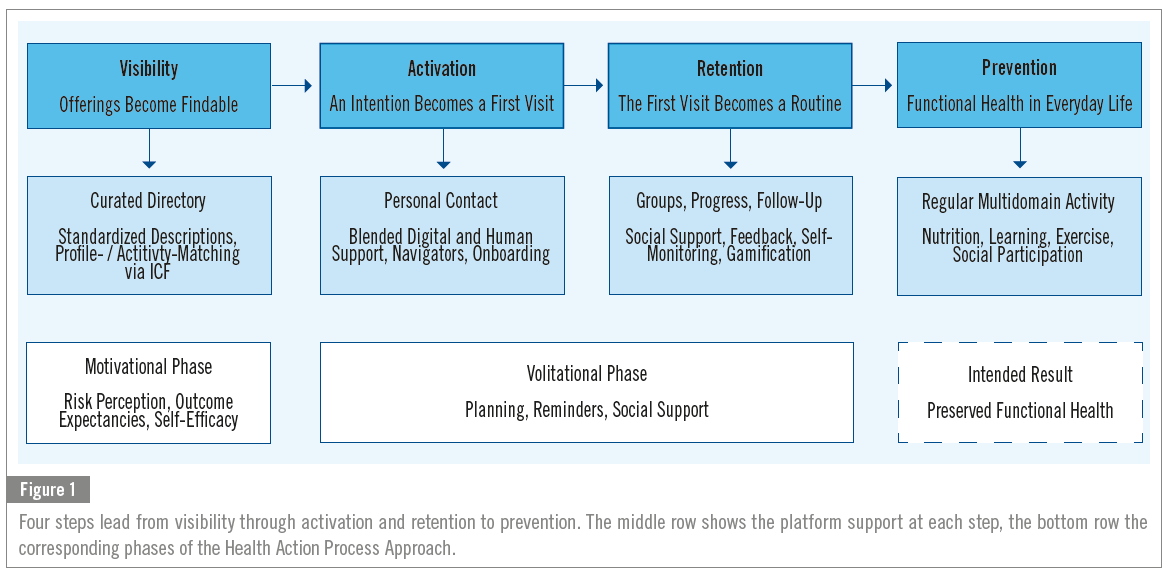
The concept rests on an impact model with four steps (figure 1). Visibility means that older adults can find out which offers exist near them and which fit their needs. Activation turns the intention to take part into a first visit. Retention turns the first visit into a routine. Prevention is the intended result of this chain, because regular physical, social, and cognitive activity, supported by balanced nutrition, preserves the functional health described in the introduction.
The Health Action Process Approach (HAPA) explains why these steps need different support (23). It separates a motivational phase, in which people form an intention, from a volitional phase, in which they plan and carry out the behavior. Visibility serves the motivational phase, because no intention to take part can form around an unknown offer, and a concrete, reachable one strengthens the confidence that participation is possible. The volitional phase begins when someone first takes part in an activity booked through the platform. At this first visit, the personal contact on site is decisive. A good experience brings the person back, and the platform in turn has to encourage the next booking and support the new behavior with features tailored to the individual. To strengthen retention, such features would show users their own progress, offer rewards (for example through gamification), connect them with a group, and contact them after they stay away; these elements match established behavior change techniques (17, 18, 28). The aim is a positive behavior change that leads to regular multidomain activity and thus to lasting prevention.
The Platform as Infrastructure
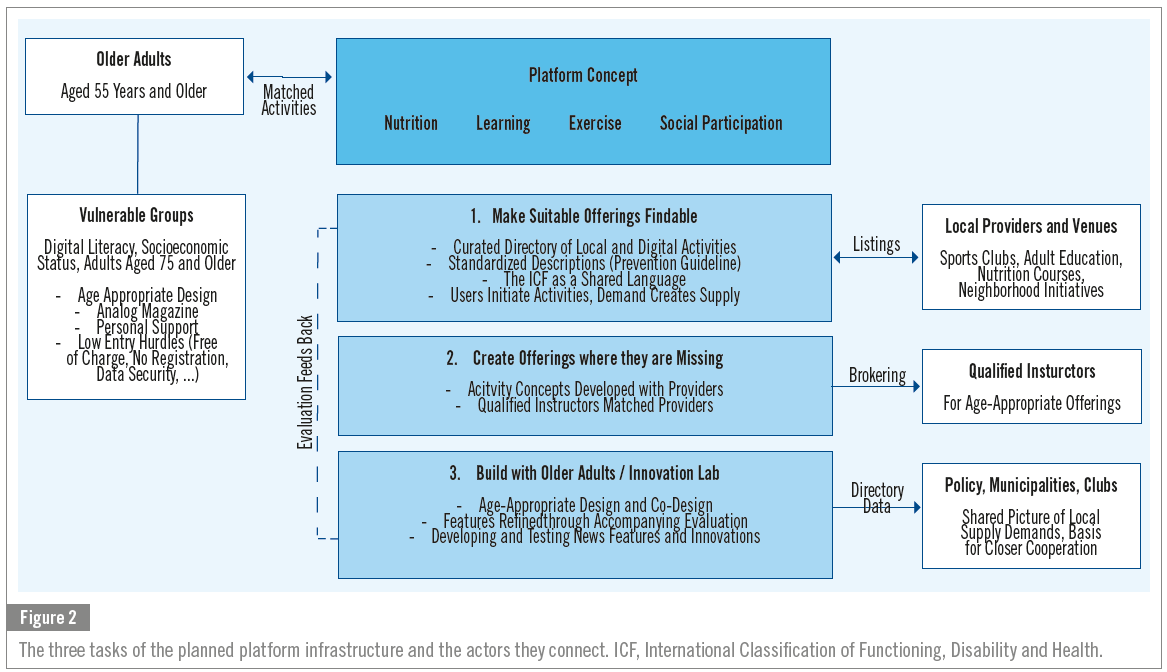
This section presents the complete vision with three tasks (figure 2), not a blueprint for immediate implementation. Its elements would follow step by step, with the necessary resources and after successful evaluations.
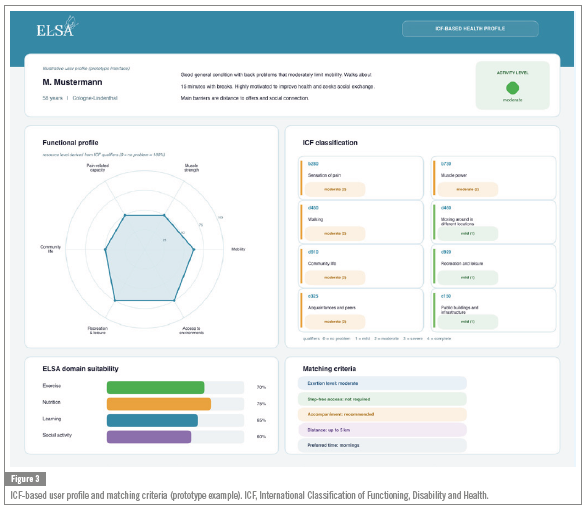
The first task rests on a directory of local and digital activities across nutrition, learning, exercise, and social participation, with standardized descriptions based on the quality criteria of the statutory prevention guideline (10). The fit between person and offering draws on the International Classification of Functioning, Disability and Health (ICF), which describes health as functioning in everyday life (30) (figure 3). Recommendations would thus stay in everyday language and preserved or improved daily functioning would count as success, in line with the preventive aim of the concept. Offers matching the profile would appear first, users could search the directory with filters, and book an activity directly on the platform. Users could also start their own activities and connect with one another, so demand creates new supply. After taking part, they could rate offers and report barriers, which keeps the directory current.
The second task begins where visibility alone would merely expose gaps. Directory and demand data would show which activities older adults look for but cannot find nearby. Many providers have suitable facilities but no age-appropriate programs, and qualified instructors often lack access to these venues. The platform would act as a broker to close the gap in development. It would identify unmet demand, develop age-appropriate activity concepts together with a local provider and place a qualified instructor to run the program within the provider‘s existing structures. Delivery would stay with the provider, and the platform would run an offer itself only where no provider takes it on. Comparable placement models are long established in youth sport, for example when sports clubs place licensed coaches in schools within structured cooperation programs. The directory would also give policy makers, municipalities, providers, and clubs a shared picture of local supply and demand and thus a basis for closer cooperation.
The third task is co-design. Digital services often fail older adults when their needs are ignored (8), so development would follow age-appropriate design and co-design, refined by an accompanying evaluation. Older adults would stay closely involved and help design every new feature. They would also steer supply and demand themselves and organize in a community that works like a social network. The Andalusian public platform Enbuenaedad followed a comparable process. The structure and contents of the platform were designed by older adults in forums and prototype tests, which contributed to its rapid acceptance (20). The platform now has more than 10,000 registered users.
Integration of Artificial Intelligence
Artificial intelligence (AI) will be part of this infrastructure from the start, though not every function needs it. The matching core will be a transparent, criteria-based algorithm that compares the ICF-based profile with the standardized offer descriptions. Every recommendation can be explained and audited, and the approach needs no training data, which matters for a platform that starts small. For users, AI will be accessible as a chat assistant, kept as simple as possible and labeled as such. They can describe a need in their own words, ask which activities are available nearby, and see which criteria make an offer appear. In the background, several self-hosted agents will translate the user‘s everyday language into the profile, guide onboarding, and phrase reminders after periods of inactivity, while the algorithm decides what is recommended.
Automation determines whether the concept scales, because matching a changing local supply to individual profiles exceeds what navigators or providers can do by hand. However, large language models can produce plausible but incorrect statements, a risk that weighs heavily in a health context and the reason the recommendation logic stays deterministic. The evaluation will treat the AI agents as study objects, recording which recommendations users accept and where the agents fail.
Planned Implementation: The ELSA Pilot
The project name ELSA derives from ‘Ernährung’, ‘Lernen’, ‘Sport’, and ‘soziale Aktivität’, the German terms for nutrition, learning, exercise, and social activity. ELSA is the planned first implementation of this infrastructure, a prevention platform for adults aged 55 years and older, developed within a doctoral research project. The pilot is planned in Cologne, Germany, where the number of people aged 65 to 79 is projected to grow by 17.4% by 2045 and the number of those aged 80 and older by 21.9% (25). It would take place in Lindenthal, a district that combines dense club structures, senior networks, adult education, and public sport facilities. Findings from this favorable urban setting would not transfer directly to rural areas or to districts with fewer resources or lower formal education levels. Wider use would therefore require a further pilot in a structurally different district and a business plan for sustainable operation.
Onboarding is a known barrier to the uptake of digital health offerings, because usability problems and technology anxiety arise mainly at first use (8). The pilot would recruit participants through trusted local channels such as general practitioners, pharmacies, sports clubs, and senior networks, and participation would remain free of charge. Registration would stay as simple as possible and follow login patterns users already know. Trained navigators would be available in addition, setting up the ICF-based profile with interested persons on site or by telephone and selecting first offers, so that the first contact would lead into a real-world activity. The platform would also work without a login, which keeps the directory open to people for whom registration is a hurdle, although profile-based matching would then not be available. An analog magazine would present the offerings to people who do not use digital services, since daily internet use falls from 89% among people aged 50 to 59 to 53% among those aged 70 and older (2).
Several studies will accompany the pilot, among them qualitative interviews and think-aloud sessions with the target group. Planning for the main study, which will examine whether the platform can contribute to lasting behavior change, is in its early stages. Suitable measurement instruments must be identified and the theoretical models behind the concept adapted to rapidly developing technology. We aim to analyze how HAPA constructs such as intention, action planning, and self-efficacy (23) and functional health based on the ICF interact, and how platform use and individual features such as reminders or the community influence these variables. Log data will provide objective measures of use and booking behavior for this analysis. A feasibility study could come first and lead into a randomized controlled trial, whose sample size will depend on the partnerships established with local providers and the number of offers secured. Such a trial should run for at least six months, with a follow-up of three to six months, because new routines take time to stabilize (9). A study protocol will follow and lay out these decisions.
Visuals
Figure 1 shows the impact model with its four steps and the support that serves each step. Figure 2 shows the three tasks of the planned platform infrastructure and the actors they connect. Figure 3 illustrates an ICF-based user profile and its translation into offer criteria.
Conclusion and Outlook
This concept study describes access to multidomain prevention in later life as an infrastructure problem and proposes a platform concept as a testable response. Beyond visibility, the platform aims at lasting behavior change. Social features would translate established behavior change techniques into everyday use, among them social support, goal setting, self-monitoring, feedback, and prompts and cues (18, 28). The AI agents outlined in Section 2.3 will personalize this guidance as usage data accumulate. The concept occupies the space between disease-specific DiGA and commercial lifestyle applications by offering a prevention platform that is open and covers multiple domains.
The implementation must take the following challenges into account. As a two-sided market (one that creates value only when users and providers both take part), the platform faces the cold-start problem, needing users to attract providers and providers to attract users. Starting in a single district with a verified initial supply of offers reduces this problem but does not remove it. A platform of this kind must also track usage data and define measurable goals for its intended use. Only a thorough record of such data can show whether attrition reaches the high levels reported for digital health interventions (16) and whether the platform contributes to positive behavior change. Sensitive health data place the platform under the General Data Protection Regulation, and any use of AI must follow ethical principles and the European AI Act, with explainable recommendations and local processing. Financing remains structurally unresolved, because German prevention funds support projects in short cycles while an infrastructure needs continuous operation (29).
Health systems worldwide must give prevention a larger role and use the possibilities of digitalization to deliver it. With the ELSA project, we are testing a platform concept that opens access to healthy aging through a multidomain approach. All steps will be documented and published so that lessons can be learned from both success and failure. What works in the pilot can move to other municipalities. Prevention in later life would then no longer depend on whether people happen to hear about local offers, but on an infrastructure that turns them into everyday activities that promote healthy aging.
Conflict of Interest
TE leads the ELSA project presented in this manuscript, self-funded its prototype, and may be involved in its future operation. KB and WZ declare no conflicts of interest.
Funding
TE is supported by a PhD fellowship from the Stiftung der Deutschen Wirtschaft (Foundation of German Business), which had no role in the conception or preparation of this manuscript. The platform prototype is self-funded. No other external funding supported this work.
Ethical Approval and Informed Consent
Not applicable. This concept study reports no data from human participants. Ethical approval for the pilot evaluation will be obtained from the responsible ethics committee before recruitment.
Data Availability
Not applicable. No datasets were generated or analyzed for this concept study.
Author Contributions / Statement of Author Contributions
Author Contributions / Statement of Author Contributions
TE developed the concept, drafted the manuscript, and prepared the figures. KB and WZ contributed to the conceptual framing and critically revised the manuscript. All authors read and approved the final version.
Acknowledgments
AI-based tools supported structuring and language editing during manuscript preparation and were not used for scientific writing. The authors carry full scientific responsibility for the content.
Summary Box
What is already known about this topic?
Multidomain interventions that combine exercise with nutrition, cognitive training, and social participation can preserve functional health in later life. Suitable local offerings exist in most German municipalities, yet a lack of awareness and poor distribution of information remain a major barrier to participation, especially for older adults. Reimbursed digital health applications (DiGA) treat diagnosed diseases, and commercial lifestyle applications rarely offer age-appropriate design.
What does this concept study add?
It introduces a four-step impact model, making suitable offerings visible, activating a first visit, retaining participation as a routine, and thereby supporting prevention through regular multidomain activity. The platform concept serves these steps as one infrastructure and would be developed with older adults and existing local providers.
Practical implications
A co-designed pilot in Cologne, Germany, is planned to test whether visibility converts into first participation and health-oriented behavior change. Findings, including setbacks, will be published.
References
- App fatigue in mHealth: beyond improving apps,advance equity by meeting people where they are. PLOS DigitHealth. 2025; 4: e0001107.
- ARD/ZDF-Medienstudie 2025:Basispräsentation. 2025. [Accessed July 14, 2026].
- Gesund aktiv älter werden[Accessed July 5, 2026].
- Bewegungsförderung bei älterenErwachsenen (ab 65 Jahren) in Deutschland: Bestandsaufnahme(Kurzversion). 2024 [Accessed July 8, 2026].
- Effects of a blended face-to-faceand eHealth lifestyle intervention on physical activity, diet,and health outcomes in Hong Kong community-dwelling olderadults: a randomized controlled trial. BMC Public Health. 2025;25: 2145.
- Mapping digital platforms forlifestyle changes in older adults: a scoping review. (submitted). JMed Syst. 2026.
- Prävention und Krankheitsprävention. In:Bundesinstitut für Öffentliche Gesundheit, ed. Leitbegriffeder Gesundheitsförderung und Prävention. 2025.
- Digital healthplatforms for the elderly? Key adoption and usage barriers andways to address them. Technol Forecast Soc Change. 2023;189:122319.
- Making health habitual: the psychologyof ‘habit-formation’ and general practice. Br J Gen Pract. 2012;62: 664-666.
- Leitfaden Prävention: Handlungsfelderund Kriterien nach § 20 Abs. 2 SGB V, Fassung vom 17.Dezember 2025. 2025 [Accessed July 5, 2026].
- Prevalence of proteinintake below recommended in community-dwelling older adults:a meta-analysis across cohorts from the PROMISS consortium.J Cachexia Sarcopenia Muscle. 2020; 11: 1212-1222.
- Social relationships andmortality risk: a meta-analytic review. PLoS Med. 2010;7:e1000316.
- Global consensuson optimal exercise recommendations for enhancing healthylongevity in older adults (ICFSR). J Nutr Health Aging. 2025;29:100401.
- World-Wide FINGERSNetwork: a global approach to risk reduction and prevention ofdementia. Alzheimers Dement. 2020; 16: 1078-1094.
- Strategies to improveengagement of ‘hard to reach’ older people in research on healthpromotion: a systematic review. BMC Public Health. 2017; 17: 349.
- Rates of attritionand dropout in app-based interventions for chronic disease:systematic review and meta-analysis. J Med Internet Res. 2020;22: e20283.
- Effectivetechniques in healthy eating and physical activity interventions:a meta-regression. Health Psychol. 2009; 28: 690-701.
- The behavior changetechnique taxonomy (v1) of 93 hierarchically clusteredtechniques: building an international consensus for thereporting of behavior change interventions. Ann Behav Med.2013; 46: 81-95.
- A 2 year multidomainintervention of diet, exercise, cognitive training, and vascularrisk monitoring versus control to prevent cognitive decline inat-risk elderly people (FINGER): a randomised controlled trial.Lancet. 2015; 385: 2255-2263.
- Creationprocess of the digital platform to foster healthy and active aging:enbuenaedad. Front Public Health. 2019; 7: 22.
- How big is the physical activity intentionbehaviourgap? A meta-analysis using the action controlframework. Br J Health Psychol. 2013; 18: 296-309.
- Overweight andobesity among adults in Germany: results from GEDA 2019/2020-EHIS. J Health Monit. 2022; 7: 21-28.
- Modeling health behavior change: how to predictand modify the adoption and maintenance of health behaviors.Appl Psychol. 2008; 57: 1-29.
- §§ 20, 20a, 33a, 134[Accessed July 2, 2026].
- Bevölkerungsvorausberechnung für Köln 2025 bis 2045:mit kleinräumigen Berechnungen bis 2035. KölnerStatistische Nachrichten 12/2025. 2025 [Accessed July 5,2026].
- Toward a digital platform for theself-management of noncommunicable disease: systematicreview of platform-like interventions. J Med Internet Res. 2020;22: e16774.
- Digital interventions forhealthy ageing and cognitive health in older adults: a systematicreview of mixed method studies and meta-analysis. BMC Geriatr.2024; 24: 217.
- Older adults’ userengagement with mobile health: a systematic review ofqualitative and mixed-methods studies. Innov Aging. 2023;7:igad007.
- Why businessmodeling is crucial in the development of eHealth technologies. JMed Internet Res. 2011; 13: e124.
- International classification offunctioning, disability and health: ICF. World HealthOrganization. 2001 [Accessed 20 August, 2026].
Institute of Movement and Sport Gerontology
German Sport University Cologne
Am Sportpark Müngersdorf 6
50933 Köln, Germany
t.eberle@lb.dshs-koeln.de