


Beyond Muscle Quantity: Rethinking Sarcopenia as a Disorder of Brain-Muscle Communication?
Über die Muskelmasse hinaus: Sarkopenie als dysregulierte Interaktion zwischen zentralem Nervensystem und Skelettmuskulatur
Summary
Sarcopenia is classically defined by age-related loss of muscle mass, strength, and function, yet strength and functional decline consistently outpace the loss of muscle tissue itself, a mismatch that a purely muscle-centered model cannot fully explain. Mounting evidence therefore hints towards neurogenic contributors to sarcopenia. In this concept study, we propose reframing sarcopenia as a disorder of brain-muscle communication, integrating a framework across three complementary levels of neuromuscular organization:
i) corticospinal connectivity, ii) motor-unit behavior, and iii) muscle synergies, introducing the concept that each level is individually informative but insufficient alone to capture the neural contribution to sarcopenia-related muscle weakness. We further argue that conventional static and single-task assessments may underestimate this neural component, and that combining them with dynamic and ecologically valid dual-task paradigms could reveal compensatory motor control reorganization.
Moreover, we propose a self-reinforcing loop in which selective fast-twitch fiber loss and impaired neural drive interact to amplify functional decline over time. If validated, multimodal neurophysiological profiling could help identify individual neural phenotypes and inform personalized resistance and motor-cognitive training. The evidence remains cross-sectional and hypothesis-generating: the key emerging tool is unvalidated in sarcopenia, and etiological heterogeneity across sarcopenia subtypes is unaddressed.
Key Words: Dynapenia, Powerpenia, Connectivity, Motor Unit, Muscle Synergies.
Context & Problem Statement
Sarcopenia, the age-related progressive decline of skeletal muscle mass, strength, and function, has evolved from a long-standing classification as a geriatric syndrome to a formally recognized muscle disorder in the last decade, complete with its own ICD-10-CM code (M62.84) (12). This updated classification reflects growing clinical urgency: sarcopenia affects roughly one in five community-dwelling individuals over the age of 65, with prevalence climbing to approximately half of those over 80 (12, 34), and it is a well-established contributor to frailty, falls, disability, and loss of independence (7).
A longstanding observation in sarcopenia research is that strength declines faster than muscle mass (6), an observation that has recently prompted calls to reframe sarcopenia as a disease of the ageing motor system as a whole, rather than as a disorder that is exclusively muscle-centered (25). That is, older adults lose knee- and leg-extensor strength at roughly two- to five-fold the rate at which they lose the corresponding muscle tissue (11), a mismatch that gaining muscle mass does not fully reverse (6). This observation is difficult to reconcile with an exclusively myogenic model of sarcopenia, in which the loss of contractile tissue is assumed to account for the decline in strength. In fact, it prompted the introduction of “dynapenia” and “powerpenia” as a complementary or alternative constructs (5, 6, 13), reflecting the recognition that muscle strength, power and mass are not necessarily lost in parallel.
A potential explanation lies in the neural mechanisms governing force production. Voluntary force output reflects the coordinated interaction between descending neural drive, the activation of spinal motoneurons and skeletal muscle fibers, and the afferent feedback arising from the periphery (15). Age-related alterations at any level of the neural control of movement, including central drive, spinal transmission, motor units (MUs) behavior, and the coordination of multiple muscles into functional synergies, may contribute to a decline in force production despite relatively preserved muscle tissue. Here we examine this possibility across three complementary levels of neuromuscular organization: i) corticospinal connectivity, ii) MU behavior, and iii) the coordination of multiple muscles into functional synergies. We integrate previously published exploratory findings from a previous exploratory study (16) and propose a framework for how these converging lines of evidence may inform the next generation of assessment and intervention in sarcopenia.
Concept Description
The Three-Level Neuromuscular Organization
Framework
Neural control of movement is a multilevel process that unfolds across interconnected stages rather than a process reducible to any single measure. Thus, we organize the current evidence around three complementary levels, each accessible through distinct neurophysiological approaches, and we argue that each one is necessary, yet insufficient on its own, to capture the neural mechanisms contributing to sarcopenia.
Brain-muscle interaction can be characterized through a range of functional connectivity metrics that quantify statistical interdependence between simultaneously recorded neural and peripheral electrophysiological signals, each with distinct assumptions and limitations (2, 15). Among these, corticomuscular coherence (CMC) quantifies the frequency-domain oscillatory synchronization between cortical activity measured by electroencephalography (EEG) and muscular activity measured by surface bipolar electromyography (EMG). CMC findings in aging are genuinely heterogeneous: studies report both increases and decreases in CMC in older relative to younger adults, with outcomes depending largely on the muscle studied, the task constraints, and the frequency band examined (14, 18). CMC is nonetheless the most widely used metric in this context, generally treated as a marker of aging (19) as well as of effective corticospinal interaction and neural drive to skeletal muscle (15).
Classically computed CMC reflects the pooled and rectified discharge of an entire MU population and cannot disentangle individual MU activity. This is a genuine methodological ceiling, because the MU is the final common pathway for force generation, and aging is known to alter MU behavior directly: reduced excitatory synaptic input (24), diminished intrinsic motoneuron excitability (26), and structural remodeling (30) collectively reduce discharge rates and impair the muscle’s capacity for volitional force modulation (27). Recent decomposition algorithms applied to high-density surface EMG (HDsEMG) now allow non-invasive identification of large MU populations, opening a new observation window onto motoneuron behavior in aging and training (4).
The methodological leap that matters most for the argument of this concept study is the recent coupling of HDsEMG decomposition with simultaneous high-density EEG, enabling coherence to be computed not against the pooled EMG signal but against the firing-event train of a single, identified MU, termed cortico-motoneuronal coherence (CMnC) (38). Such an approach differs substantially from classical CMC, which typically assesses brain and muscle synchrony at the population level. With CMnC, the focus is instead on identifying which specific MUs within a motor-unit pool, presumably heterogeneous in fiber-type composition and recruitment threshold, receive cortically synchronized drive and which do not.
Applied to sarcopenia, this methodology could help distinguish between alternative interpretations of the increased CMC reported in sarcopenic older adults compared to non-sarcopenic individuals (16), of which compensatory upregulation is one plausible but currently unconfirmed hypothesis, alongside alternatives such as reduced afferent modulation discussed below. For instance, CMnC could clarify whether the increased CMC observed in sarcopenic older adults reflects a genuine increase in corticospinal drive, which should manifest as a greater proportion or magnitude of coherent MUs, or instead reflects reduced afferent modulation, which would leave MU coherence largely unchanged. Current MU-extraction methods, however, remain largely limited to static contractions (10) constraining this distinction in practice. To our knowledge, this methodology has not yet been applied to a sarcopenic population and therefore represents a clear and immediate next step toward disentangling the neural mechanisms underlying the increased CMC observed in sarcopenia.
Independent MU evidence provides further support for the ecological-validity argument developed in this manuscript. In a recent preprint investigation, older adults with sarcopenia displayed greater MU discharge variability and altered common synaptic input specifically under dual-task conditions, relative to non-sarcopenic controls and master athletes (28). This is important for two reasons. First, it shows that MU alterations in sarcopenia are at least partly task-dependent, potentially latent under single-task isometric conditions and apparent only under added cognitive load. Second, it converges with (and helps interpret) the CMC literature’s own well-documented sensitivity to task constraints (15), suggesting that both the population-level (CMC) and single MU signatures of sarcopenia may share a common dependency on ecological task demand.
That is, whereas corticospinal drive and MU behavior characterize the neural control of individual muscles, functional movement requires the coordination of activity across multiple muscles. In this context, muscle synergies address this higher-order level of motor organization by capturing low-dimensional, spatiotemporal patterns of coordinated multi-muscle activation, typically derived through non-negative matrix factorization of several bipolar surface EMG sensors (1).
Notably, aging is associated with measurable reorganization of muscle synergies during walking: changes in number, structure, and temporal activation generally interpreted as reduced motor flexibility, particularly evident under increased task difficulty (8, 32). However, it remains unknown whether sarcopenia is associated with a reorganization of muscle synergies that extends beyond, or differs qualitatively from, the effects of chronological aging, and whether such reorganization is exacerbated under dual-task conditions. To date, and to our knowledge, no study has examined muscle synergy structure in a sarcopenia-defined population or linked synergy-level organization with concurrently measured corticospinal drive or MU behavior within the same individuals. A critical next step for the field will be to integrate muscle synergy analysis with measures of brain-muscular communication and MU behavior within the same participants and during locomotor tasks.
Beyond these three levels, remodeling at the neuromuscular junction itself, including axonal sprouting and cyclical denervation-reinnervation (30), represents a complementary, peripheral substrate of impaired brain-muscle communication that lies outside the connectivity‑based framework developed here (23, 30, 31). At the cellular level, alterations remain conceptual at this stage but may independently contribute to the disproportionate loss of muscle strength and function in sarcopenia and interact with the neural mechanisms outlined above. For instance, altered intracellular Ca2+ handling and excitation-contraction coupling, together with impaired sarcolemmal excitability, may directly constrain force generation and transmission independently of neural drive (22). Muscle excitability, for example, depends in part on Na+/K+-ATPase activity, which is stimulated by β2-adrenergic receptor signaling and by calcitonin gene-related peptide released from intact sensory nerve endings, but can be inhibited by reactive oxygen species (ROS) (36). This provides a potential point of convergence through which sensory innervation and redox state may jointly influence a key electrophysiological determinant of force development. Mitochondrial dysfunction may further amplify these disturbances through impaired energy availability and increased ROS production (22), with redox imbalance potentially further compromising Na+/K+-ATPase activity and muscle excitability (36). These mechanisms remain conceptual, as do the central mechanisms proposed here. Nevertheless, they emphasize that the neural framework developed in this manuscript is not intended to replace peripheral or cellular explanations of sarcopenia-related weakness, but rather to represent one complementary layer within a broader, multifactorial model.
Interestingly, a recurring theme across all three levels of the neuromuscular organization is representesd by task-dependence. CMC values are strongly shaped by task constraints: static, isometric, or otherwise constrained paradigms producing connectivity patterns that differ systematically from those observed during dynamic and ecologically valid tasks such as overground or dual-task walking (8, 14, 16). For instance, increased MU discharge variability in sarcopenia appears specifically under dual-task, not single-task, conditions (28), and muscle synergy reorganization with age is most apparent when task difficulty is deliberately increased (32).
This convergence points to a critical methodological limitation: neurophysiological studies of aging and sarcopenia have predominantly relied on isolated motor conditions, including single-joint isometric contractions or seated tasks performed under minimal cognitive load. While these paradigms maximize experimental control and signal-to-noise ratio, they may mask neural alterations that emerge only when motor control is challenged under ecologically relevant conditions, such as walking while processing information or maintaining balance while monitoring one’s surroundings and responding to environmental demands. Many activities of daily living inherently involve the simultaneous performance of motor and cognitive tasks (29), and under such dual-task conditions older adults show greater movement variability, as well as reduced force control and locomotor stability, relative to single-task performance (37).
Mobile brain/body imaging (MoBI) enables the investigation of brain-body dynamics via wearable wireless sensors during unconstrained, ecologically relevant locomotor tasks such as overground walking (15). Previous studies employing MoBI and related neurophysiological approaches have provided insight into efferent neural drive during gait in older adults (3, 8, 14, 16), highlighting its dependence on task complexity. Thus, building on this task-dependence, future studies should consider locomotor single- and dual-task paradigms not simply as ecologically valid extensions of conventional isometric protocols, but as potentially necessary conditions for revealing specific components of the neural alterations associated with sarcopenia. For instance, a single-task, isometric assessment may yield a seemingly unremarkable neurophysiological profile in individuals whose corticomuscular or MU alterations emerge primarily under the combined motor-cognitive dual-task demands encountered repeatedly during real-world everyday activities.
The Conceptual Model
Skeletal muscle is not a homogeneous tissue, but comprises fiber types with distinct contractile, metabolic, and innervation properties. Type II (fast-twitch) fibers are typically associated with larger and higher-threshold MUs, which discharge at lower mean rates and with greater discharge rate variability than lower-threshold MUs (9). Moreover, a substantial body of evidence indicates that aging preferentially affects type II fiber size relative to type I (20). If this selective vulnerability extends to the MUs and fiber populations recruited during everyday tasks that demand a substantial fraction of available force-generating capacity in older adults, such as walking, stair climbing, and sit-to-stand transitions, then the resulting deficit could be disproportionately expressed during these functionally critical movements. This may occur even when the function of low-threshold MUs and the integrity of type I fibers are relatively preserved.
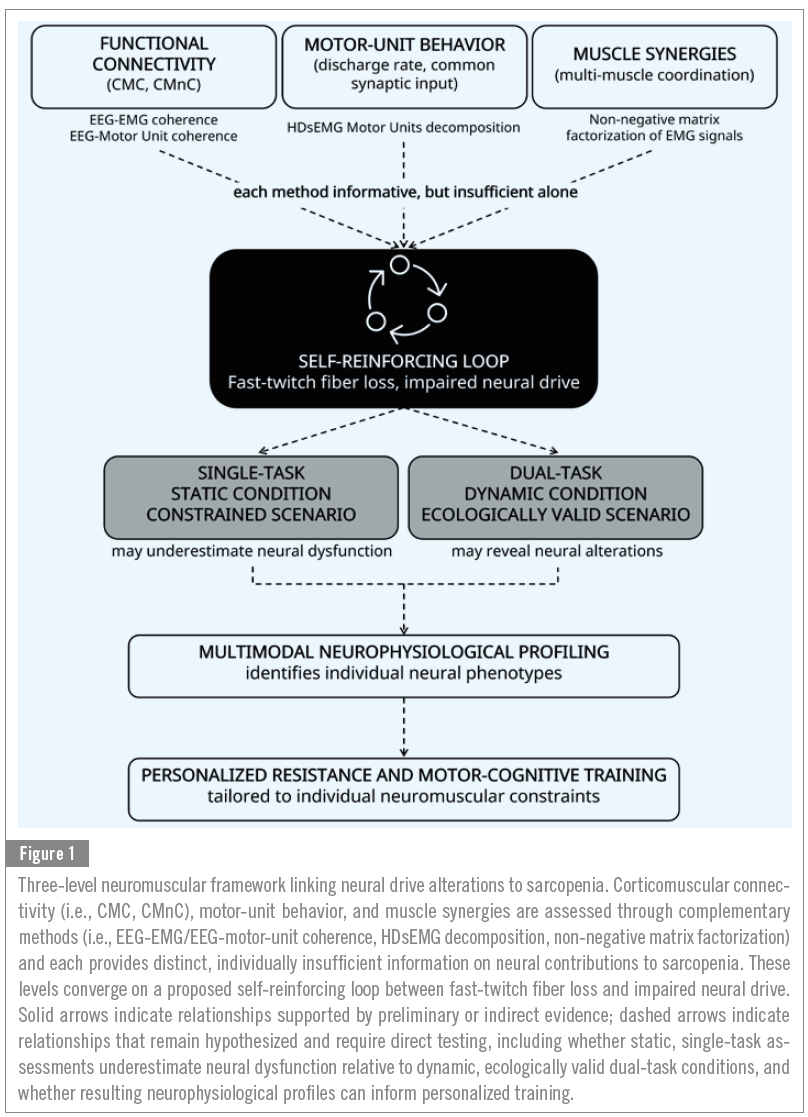
A hypothesis in this context is that the functional consequences of sarcopenia may depend not only on the extent of muscle loss, but also on which MU populations are required to compensate for the resulting reduction in force-generating capacity. Lower-limb muscles are repeatedly challenged during gait, stair climbing, postural transitions, and other weight-bearing activities, often under conditions in which the force demands represent a substantial fraction of an older individual’s available capacity. As maximal force-generating capacity declines, these tasks may increasingly require recruitment of higher-threshold MUs, potentially amplifying the functional consequences of selective vulnerability within fast-twitch fiber populations. This framework predicts that the relationship between muscle mass, MU recruitment, and functional performance may differ across muscle groups and levels of task demand, with the effects becoming most apparent during demanding or ecologically relevant motor behaviors. Importantly, this remains a hypothesis rather than an established mechanism and will require future studies combining measures of muscle morphology, MU behavior, and functional performance to test it directly (figure 1).
A related but distinct question is directionality: whether selective fiber-type or MU loss underlies impaired neural drive, or conversely, whether altered neural drive contributes to selective peripheral loss, remains unresolved. In the first scenario, primary loss of fast-twitch fibers or their MUs could alter peripheral feedback, such that increased CMC in sarcopenic participants would reflect a compensatory cortical response rather than a primary abnormality.In the second scenario, reduced descending drive to higher‑threshold motor units could chronically under‑recruit fast‑twitch fibers, promoting disuse‑related atrophy-consistent with findings that cortical drive and maximal voluntary activation decline with age (21), and emerging evidence that motor unit and neuromuscular junction impairments are already detectable at the pre-sarcopenic stage, alongside a progressive decline in muscle strength and mass across sarcopenia stages (33). However, conventional CMC metrics assess non-directional, instantaneous brain-muscle synchronization and thus cannot distinguish between these scenarios. Future studies should therefore leverage directional connectivity metrics (i.e., Granger causality, Directed Transfer Function, or Partial Directed Coherence) to disentangle the causal interactions between cortical and muscular activity.
One possibility is that neuromuscular decline in sarcopenia reflects none of the above scenarios, but rather a self-reinforcing interaction between central and peripheral mechanisms. That is, an initial perturbation at either level of the neuromuscular system, whether a modest reduction in descending drive or a modest loss or dysfunction of specific MUs, could alter neural and sensory signaling between these levels, thereby increasing vulnerability at the other level. If such interactions contribute to the progression of neuromuscular decline, this framework might have important implications for future intervention design. Because the underlying process may operate as a self-reinforcing loop rather than a unidirectional cascade, interventions targeting either central or peripheral components could, in principle, influence the other through adaptive changes across the system. This possibility provides a rationale for combining resistance-training approaches with motor-cognitive, neurophysiologically-informed exercise paradigms, as discussed in the next section. However, these proposed mechanisms remain untested in integrated longitudinal designs.
Training and Translational Implications
Resistance training remains the most consistently supported intervention for sarcopenia, with established benefits for muscle strength and more modest effects on muscle mass (17). However, if sarcopenia-related weakness is partly driven by neural dysfunction, resistance training alone may not fully address the underlying neuromuscular impairment. This is particularly important given that neural drive changes have been shown to emerge primarily under dual-task or ecologically relevant demands (3, 28), making combined resistance and motor-cognitive training a plausible complementary strategy. However, it remains unclear whether currently available motor-cognitive training systems adequately integrate structured resistance-training principles. Furthermore, whether such systems have been validated for sarcopenic and older populations is similarly unresolved, and this represents an important translational gap given these populations’ narrow tolerance for non-individualized training loads. Relatedly, neural adaptations to resistance training may themselves contribute substantially to functional improvements in older adults (35) , as they appear to retain the capacity for MU adaptations following strength training, with increases in discharge rate linked to improved force production (4). Thus, neural mechanisms should not be considered secondary to muscle adaptations, and different training modalities may engage distinct aspects of neuromuscular control, particularly when combined with motor-cognitive dual-task demands.
A key next step is therefore to determine whether neurophysiological profiling can help identify which components of neuromuscular function may be most responsive to targeted training. The framework outlined above, integrating CMnC during isometric tasks, MU discharge characteristics during single- and dual-task conditions, and CMC alongside muscle synergy analyses during dynamic, ecologically valid tasks (i.e., overground walking), could provide complementary insights into the mechanisms underlying individual differences in functional impairment. Moreover, such profiling may help identify individuals for whom altered central drive, MU function, or multi-muscle coordination, as well as greater susceptibility to cognitive-motor interference, differentially contribute to functional limitations. This information could then be used to investigate whether training demands (i.e., motor, cognitive, or motor-cognitive components) can be adapted to an individual’s neurophysiological profile, rather than applying a uniform training stimulus across individuals with potentially different neuromuscular constraints.
However, establishing whether such neurophysiologically informed training improves functional outcomes will require prospective longitudinal studies integrating mechanistic profiling with intervention and repeated functional assessments. An important remaining question is whether tailoring training demands to an individual’s neurophysiological profile can enhance strength, mobility, and dual-task adaptations beyond conventional resistance training or standardized motor-cognitive intervention (e.g., exergaming). Ultimately, the goal is not to replace traditional exercise strategies, but to determine whether combining their established peripheral and central effects with task-specific motor-cognitive demands can provide a more targeted approach to the heterogeneous neuromuscular impairments observed in sarcopenia.
Conclusion / Outlook
Several caveats should temper the framework proposed here. First, the evidence directly concerning sarcopenia remains limited to small samples in which associations between neurophysiological measures and muscle strength have yet to be replicated; these findings are hypothesis-generating rather than confirmatory. Second, the directionality question (i.e., whether neural changes precede or follow muscular adaptations) cannot be resolved by cross-sectional studies regardless of phenotyping depth. Longitudinal and interventional designs, incorporating repeated neurophysiological assessment as well as measures of muscle morphology, fiber type, and MU behavior, will be necessary to determine whether these alterations reflect a self-reinforcing or a primarily unidirectional relationship. Third, CMnC remains technically demanding and is not yet standardized, with its validity in sarcopenic populations scarcely established. Relatedly, interpreting an observed increase in CMC as a compensatory mechanism remains preliminary, as it relies on a single study (16) and both increased and reduced CMC have been reported across neurological and age-related conditions (8,19). Determining whether altered corticospinal coupling reflects effective neural compensatory mechanisms will require studies integrating these neurophysiological metrics with functional performance and longitudinal measurements. Finally, sarcopenia encompasses heterogeneous etiologies, including age- and disuse-related forms. Thus, whether the mechanisms discussed here are shared across distinct clinical subtypes or are phenotype-specific remains to be established. Adequately powered studies combining comprehensive phenotypiccharacterization with multimodal neurophysiological assessments will be essential to address this question.
The evidence reviewed here supports a broader view of sarcopenia-related weakness, in which muscle dysfunction cannot be considered independently of the neural processes governing force and movement generation. Across multiple neuromuscular levels, emerging neurophysiological approaches provide complementary insights into these mechanisms, particularly under ecologically relevant motor-cognitive demands rather than constrained laboratory settings. Whether these neural alterations are upstream drivers, downstream consequences, or components of a self-reinforcing process with muscle dysfunction remains unresolved.
Addressing this question will require multimodal, longitudinal, and ecologically valid approaches capable of linking neural, muscular, and functional adaptations over time. Such work can ultimately help advance the field beyond a predominantly muscle-centric model of sarcopenia toward an integrated framework of neuromuscular dysfunction. Furthermore, it can provide a mechanistic basis for identifying individuals who may respond differently to specific combinations of training demands (i.e., motor, cognitive, or motor-cognitive components). Within this context, neurophysiological assessments extend beyond phenotyping to characterize heterogeneity, shed light on underlying mechanisms, and inform more targeted strategies aimed at mitigating sarcopenia-related functional decline.
Conflict of Interest
The authors have no conflict of interest.
Funding
n/a.
Ethical Approval and Informed Consent
This work does not involve the collection, analysis, or reporting of new data from human participants. It is based exclusively on previously published literature and conceptual synthesis.
Data Availability
n/a.
Author Contributions / Statement of Author Contributions
The authors confirm that this concept study did not include any new experiments involving human participants, identifiable personal data, or biological samples. Therefore, approval from an Institutional Review Board (IRB) or ethics committee was not required. All referenced studies cited in this manuscript were conducted in accordance with the ethical standards of the respective original investigations.
Acknowledgments
n/a.
Summary Box
Context & Problem Statement: Muscle strength and function decline faster than muscle mass in sarcopenia, a mismatch that purely muscle-centered models cannot explain, pointing to neural contributors to age-related muscle weakness.
Concept Description: We propose a three-level framework: i) corticospinal connectivity, ii) motor-unit behavior, and iii) muscle synergies, where each level is individually informative but insufficient alone, and we argue that neural alterations in sarcopenia may emerge primarily under ecologically valid, dual-task dynamic conditions rather than static and constrained single-task assessments.
Training and translational implications: Because sarcopenia-related muscle impairments can be partly neural, resistance training alone may not fully address them. Thus, neurophysiological profiling could help identify which individuals may benefit the most from combining resistance training with concurrent cognitive demands (i.e., motor-cognitive dual-task paradigms).
Conclusion/Outlook: Whether these neural alterations are upstream drivers, downstream consequences, or components of a self-reinforcing process with muscle dysfunction remains unresolved, and resolving this will require longitudinal, multimodal, and ecologically valid designs.
References
- Shared and specific muscle synergies in naturalmotor behaviors. Proc Natl Acad Sci USA. 2005; 102: 3076-3081.
- A Tutorial Review of FunctionalConnectivity Analysis Methods and Their InterpretationalPitfalls. Front Syst Neurosci. 2016;9.
- Playing ExergamesFacilitates Central Drive to the Ankle Dorsiflexors During Gaitin Older Adults; a Quasi-Experimental Investigation. FrontAging Neurosci. 2019; 11: 263.
- Ageing does not impairmotor neuron adaptations: comparable motor unit responsesto strength training in young and older adults. The Journal ofPhysiology. 2026; 604: 2796-2815.
- Sarcopenia ≠ dynapenia. Journals ofGerontology - Series A Biological Sciences and Medical Sciences.2008; 63: 829-834.
- What is dynapenia? Nutrition. 2012; 28: 495-503.
- Sarcopenia: RevisedEuropean consensus on definition and diagnosis. Age andAgeing. 2019; 48: 16-31.
- Corticomuscularand intermuscular coherence as a function of age and walkingbalance difficulty. Neurobiology of Aging. 2024; 141: 85-101.
- Hierarchical control of motor units involuntary contractions. Journal of Neurophysiology. 2012; 107:178-195.
- Tutorial:Analysis of motor unit discharge characteristics from highdensitysurface EMG signals. Journal of Electromyography andKinesiology. 2020; 53: 102426.
- Longitudinal study ofmuscle strength, quality, and adipose tissue infiltration.American Journal of Clinical Nutrition. 2009; 90: 1579-1585.
- Sarcopenia and the new ICD-10-CMcode: screening, staging, and diagnosis considerations. FedPract. 2017; 34: 24-32.
- Powerpenia Shouldbe Considered a Biomarker of Healthy Aging. Sports Med - Open.2024; 10: 27.
- A pilot study assessing reliability andage-related differences in corticomuscular and intramuscularcoherence in ankle dorsiflexors during walking. PhysiologicalReports. 2020; 8: e14378.
- Assessing Brain–Muscle Connectivityin Human Locomotion through Mobile Brain/Body Imaging:Opportunities, Pitfalls, and Future Directions. Front PublicHealth. 2018; 6: 39.
- Corticospinal Control of Human Locomotion as a NewDeterminant of Age-Related Sarcopenia: An Exploratory Study.JCM. 2020;9(3):720.
- Resistance exercise as atreatment for sarcopenia: prescription and delivery. Age andAgeing. 2022; 51: afac003.
- Corticomuscular coherencewith and without additional task in the elderly. Journalof Applied Physiology. 2012; 112: 970-981.
- Changes of corticomuscularcoherence: An early marker of healthy aging? Age.2013; 35: 49-58.
- Effects of age on humanskeletal muscle: a systematic review and meta-analysis ofmyosin heavy chain isoform protein expression, fiber size, anddistribution. American Journal of Physiology-Cell Physiology.2024; 327: C1400-C1415.
- Aging and muscle: A neuron’sperspective. Current Opinion in Clinical Nutrition and MetabolicCare. 2013; 16: 21-26.
- Altered Ca2+ Handlingand Oxidative Stress Underlie Mitochondrial Damage andSkeletal Muscle Dysfunction in Aging and Disease. Metabolites.2021; 11: 424.
- Impactof ageing and disuse on neuromuscular junction andmitochondrial function and morphology: Current evidenceand controversies. Ageing Research Reviews. 2024; 102: 102586.
- Age-related changes in latesynaptic inputs to corticospinal neurons and their functionalsignificance: A paired-pulse TMS study. Brain Stimulation. 2020;13: 239-246.
- Reframingsarcopenia as a disease of the ageing motor system. The LancetHealthy Longevity. Published online August 2026: 100898.
- Intrinsic motoneuronexcitability is reduced in soleus and tibialis anterior of olderadults. GeroScience. 2021; 43: 2719-2735.
- Do motoneuron dischargerates slow with aging? A systematic review and meta-analysis.Mechanisms of Ageing and Development. 2022; 203: 111647.
- Dual tasking exacerbatesforce and neural control unsteadiness in sarcopenic older adults[preprint]. medRxiv. Preprint posted online April 29, 2026.
- The Dual-Tasking Overload on Functional Mobility Is Related toSpecific Cognitive Domains in Different Subtypes of Parkinson’sDisease. Topics in Geriatric Rehabilitation. 2019; 35: 119-124.
- Age-dependent motorunit remodelling in human limb muscles. Biogerontology. 2016;17: 485-496.
- Neuromuscular JunctionAging: A Role for Biomarkers and Exercise. Le Couteur D, ed. TheJournals of Gerontology: Series A. 2021; 76: 576-585.
- Sex-specific tuning of modularmuscle activation patterns for locomotion in young andolder adults. Federolf PA, ed. PLoS ONE. 2022; 17: e0269417.
- Neuromuscular impairmentat different stages of human sarcopenia. J cachexia sarcopeniamuscle. 2024; 15: 1797-1810.
- Sarcopenia. Nat Rev Dis Primers.2024; 10: 68.
- Evidence of resistance training-induced neuraladaptation in older adults. Experimental Gerontology. 2021; 151:111408.
- Effects of Age on Na+,K+-ATPaseExpression in Human and Rodent Skeletal Muscle. Front Physiol.2016; 7.
- The effects of cognitive-motor andmotor-motor dual tasks on gait performance and dynamicstability in older adults with and without sarcopenia: a crosssectionalstudy. BMC Geriatr. 2026; 26: 536.
- Corticomuscular coherence existedat the single motor unit level. NeuroImage. 2025; 305: 120999.
‘Gabriele d’Annunzio’
University of Chieti-Pescara, Department
of Medicine and Aging Sciences
Via dei Vestini, 31, 66100 Chieti (CH), Italy
federico.gennaro@unich.it