


Insights into Physical Activity and Fitness of Older Adults in Swiss Residential Care Facilities: A Cross-Sectional Study
Erkenntnisse zur körperlichen Aktivität und funktionellen Fitness älterer Erwachsener in stationären Pflegeeinrichtungen der Schweiz: Ergebnisse einer Querschnittsuntersuchung
Summary
Objectives: Older adults in residential care facilities (RCFs) often experience physical and cognitive decline. This study aimed to (a) describe physical activity (PA) levels and fitness in this population and (b) identify factors associated with PA behavior.
Methods: This cross-sectional analysis used baseline data from the pilot non-randomized controlled study ”„Bliib fit - mach mit!“ in residential care facilities“ conducted in Switzerland. Wrist-worn accelerometers (GENEActiv) measured sedentary time and PA (light, moderate, vigorous) over seven days, summarized as daily medians, interquartile ranges, and bout durations. Physical fitness was assessed using the Short Physical Performance Battery (SPPB), 2 Minutes Walking Test (2MWT), and handgrip strength. Linear regressions identified predictors of light and moderate PA.
Key Results: Thirty-one participants were included (74% women; mean age: 83±8.8 years; mean Charlson Comorbidity Index: 5.6±1.7). Mean SPPB was 6.7±2.9. In the 2MWT, men walked 100.6±29.9 m and women 96.4±25.9 m; handgrip strength was 28.7±6.4 kg in men and 19.9±4.2 kg in women. Participants spent 86% of waking time sedentary, 12.4% in light, and 1.6% in moderate PA. The 2MWT showed the strongest association with PA (adjusted R² = 41.3% moderate PA, 31.2% light PA).
Conclusion: Adults in Swiss RCFs were of advanced age with high comorbidity and high sedentary time. Routine fitness screening may help identify elderly with low PA. These findings underscore the importance of reducing sedentary time and promoting PA among RCF residents more broadly, potentially supported by improved physical fitness.
Key Words: Accelerometry, Long-Term Care, Exercise, Sedentary Behavior
Introduction
Global demographic trends show a substantial increase in the proportion of older adults worldwide. By 2030, one in six people will be aged 60 or older, with this population projected to grow from 1 billion in 2020 to 2.1 billion by 2050 (38). With rising life expectancy, multimorbidity affects more than two-thirds of adults aged 65 years and older and is associated with chronic disease burden, polypharmacy, functional impairment, and greater care dependency (31).
As functional limitations and care needs increase, demand for residential care facilities (RCFs) is rising. In Switzerland, 13% of adults aged 80 years lived in RCFs in 2023, while overall residential care needs are projected to rise by 43% by 2040 (11, 26). Following admission to RCFs, residents often experience progressive declines in physical function due to ageing, frailty, multimorbidity, physical inactivity, cognitive impairment, and acute health events (20, 31, 36).
Beyond these vulnerabilities, older adults in RCFs spend much of the day sedentary, with limited physical activity (PA) despite its well-established benefits (14, 20, 28). International studies using device-based assessment methods such as accelerometry have demonstrated that sedentary behavior is highly prevalent among older adults in RCFs and is associated with poorer physical function, reduced mobility, lower muscle strength, impaired balance, and decreased ability to perform activities of daily living (14, 32).
Regarding the Swiss context, data on device-based measures of PA and physical functioning among older adults in RCFs remain scarce, with most evidence derived from hospitalized or general older populations (33, 34). Previous accelerometry studies in hospitalized older adults reported very low PA levels and high sedentary time, underscoring the need for device-based assessments in RCFs (33, 34). In addition, differences in organizational structures, staffing models, financing systems, and resident case mix may limit the transferability of international findings to the Swiss RCF context (26). A further challenge in many RCFs is the lack of routine assessment of PA and physical fitness, which may hinder the identification of residents at risk of functional decline and limit opportunities for targeted interventions. Moreover, current PA guidelines are primarily designed for healthy, community-dwelling older adults and may not adequately address the needs of frail, multimorbid RCF residents (8). Given the ageing Swiss population and the increasing demand for RCFs, device-based data on PA behavior and physical functioning in this setting are of particular public health relevance and are needed to inform context-specific recommendations (11, 26, 31). This study aimed a) to gain insights into PA levels and physical fitness among older adults living in Swiss RCFs and b) to examine clinical and functional factors, i.e. physical fitness parameters, associated with their PA behavior. By providing device-based data on PA and physical functioning in this population, these findings may inform the development of context-specific PA guidelines and future intervention strategies. Due to the exploratory nature of the study, no formal hypotheses were predefined.
Methods
Study Design and Setting
This cross-sectional study is based on baseline data from the pilot, non-randomized controlled study ““Bliib fit – mach mit!” in residential care facilities”. Four institutions in Eastern Switzerland participated, including one with two facilities. Data was collected between December 2024 and March 2025. The study was approved by the Ethics Committee of Eastern Switzerland (BASEC, project no. 2024-01990), and all participants provided written informed consent. It adhered to the Declaration of Helsinki and was reported in accordance with STROBE. The intervention study was also registered at ClinicalTrials.gov (NCT06738186).
Participants
Participants were recruited from RCFs in Eastern Switzerland by on-site study coordinator (responsible care professional). Care staff pre-determined general physical and cognitive ability to independently carry out exercise instructions and checked medical records of potential participants. One of four investigators verified inclusion criteria: (1) written informed consent, (2) low-to-moderate fall risk, (3) sufficient physical/cognitive ability for independent exercise, and (4) MMSE ≥ 20. Risk of falls was assessed according to the “StoppSturz” procedure using three alarm questions on falls in the past 12 months, unsteadiness, and fear of falling (13). A “yes” answer triggered functional screening (Timed Up and Go, Five Times Sit-to-Stand) and fall risk classification. Exclusions included: (1) no German proficiency, (2) high fall risk, (3) unstable cardiovascular/medical conditions, and (4) planned transfer within 3 months.
Sample Size Calculation
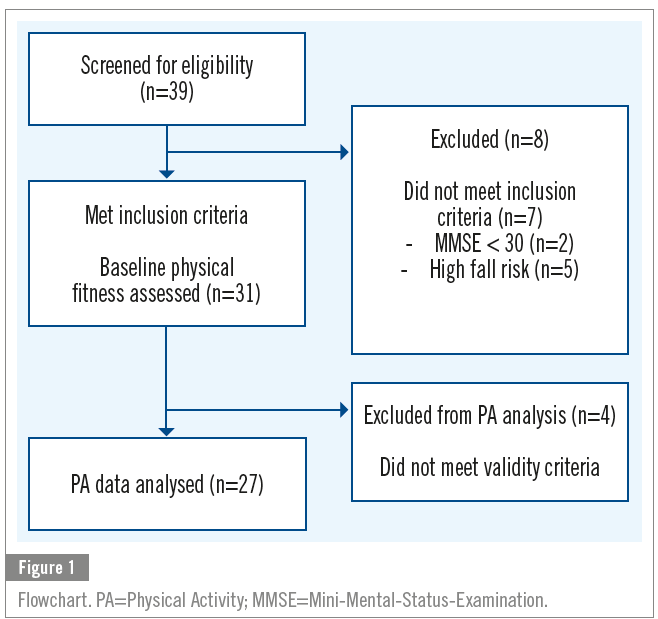
The study size was based on the mentioned pilot study that indicated a required sample of 40 participants (medium effect size, 80% power, 5% type I error, 20% expected dropout) (7, 16). Of 39 individuals screened, seven did not meet the inclusion criteria (2 MMSE <30, 5 high fall risk) and 1 declined participation. In total, 31 participants met the inclusion criteria, and their baseline physical fitness was examined. We were able to analyze the PA data from 27 participants, as they met the validity criteria (7, 16).
Variables and Measurement
Physical Fitness
All physical fitness tests were assessed by the same investigators, and standardized measurement procedures were used to reduce measurement bias.
Short Physical Performance Battery (SPPB)
The SPPB, is an objective and valid measurement instrument to assess lower extremity function and mobility (>65 years of age). It consists of three test items, 4-m walking, chair-rise-test and standing balance (16). The SPPB total score ranges from 0 (worst) to 12 (best), with performance categorized as poor (0-6), moderate (7-9), or good (10-12) (7, 16).
Grip strength (hand dynamometer)
The grip strength test is a valid assessment in older adults to assess upper extremity muscle strength. In men, handgrip strength values below 27 kg are classified as weak, whereas in women the corresponding cut-off is 16 kg (1, 10).
2 Minutes Walking Test (2MWT)
The 2MWT examines overall physical fitness. Established reference values assess walking and functional endurance impairments in older adults (24, 27). A cross-sectional study on normative 2MWT values reported mean distances of 144.1 m (95% CI 132.6-155.6) for community-dwelling men and 134.3 m (95% CI 125.7-142.9) for women older than 80 years (5).
Physical Activity Levels
PA was assessed using a GENEActiv accelerometer (Activinsights Ltd., Cambridgeshire, UK) worn on the non-dominant wrist for at least 7 consecutive days (6). Valid data required a daily wear time of ≥10 h with no non-wear periods ≥60 min on at least 3 days (2 weekdays and 1 weekend day) (17, 22). The device recorded at 60 Hz with an epoch length of 60 s; raw data were downloaded using the GENEActiv software and processed with the GGIR package (version 3.2.6), applying the HDCZA algorithm to detect non-wear time (23). Intensities were classified using Euclidean Norm Minus One (ENMO) cut-points, which are comparable across different accelerometers and validated for older adults aged ≥70 years (21, 30), with thresholds of 18 mg for sedentary-to-light and 60 mg for moderate-to-vigorous activity. Intensities are presented in the context of World Health Organization (WHO) PA recommendations, which define them using Metabolic Equivalent of Tasks (METs) or individual capacity and recommend weekly activity volume rather than specific ENMO thresholds (37).
Statistical Analysis
Physical Activity Levels and Fitness
Clinical characteristics (sex, age, BMI, CCI) and physical fitness outcomes (2MWT, handgrip strength, SPPB) were reported as sex-stratified means and standard deviations (SD). All PA data were presented as daily medians (minutes) and IQR for each intensity category. In addition, we characterized the accumulation of activity in bouts of different duration, defining light and moderate-to-vigorous PA in bouts of 1-5, 5-10, and >10 minutes, and sedentary time in bouts of 10-20, 20-30, and ≥30 minutes (10). To assess day-to-day variability in moderate activity, a 10-minute cut-off of total accumulated (unbouted) daily moderate PA was used to classify days as lower or higher activity, based on the Canadian Physical Activity Guidelines (35).
Associations of Clinical Characteristics and PA Levels
Data from n=27 participants were analyzed using R 4.5.1. First, univariate linear regressions were computed for the predictors 2MWT, SPPB, handgrip strength, CCI, sex, and age on log-transformed light and moderate PA outcomes. Log-transformation corrected right-skewed distributions and linearized multiplicative relationships (12).
Due to the limited sample size and to avoid overfitting, we selected the strongest univariate predictor based on statistical significance and then restricted the final multiple linear regression models to a single predictor: 2MWT [29]. Model diagnostics were used to verify linear regression assumptions: homoscedasticity (Breusch-Pagan test), residual normality (Shapiro–Wilk test), and independence (Durbin–Watson test). All tests were conducted at the α=0.05 level.
Results
Physical Fitness and PA Levels
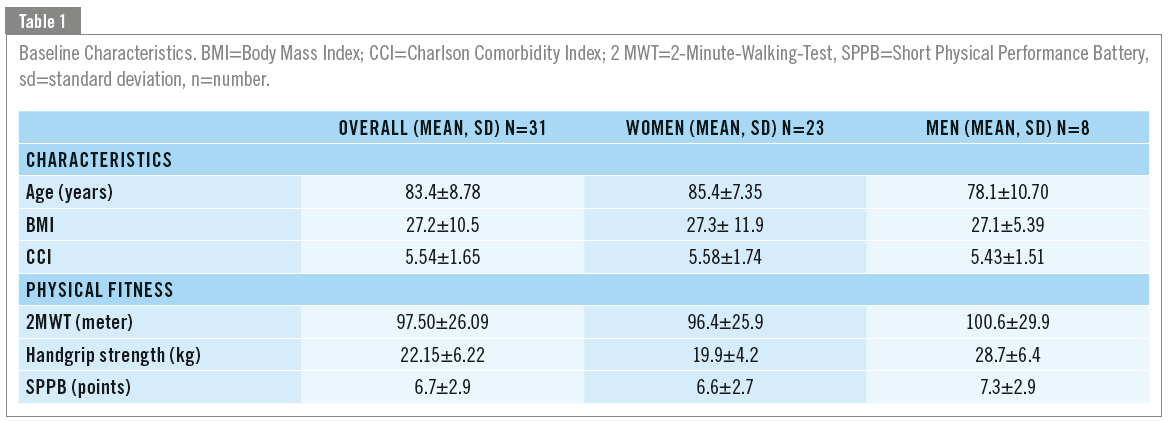
A total of 31 participants were included (74% women; mean age 83±8.8 years). The average CCI was 5.6±1.7. The mean SPPB was 6.7±2.9. In the 2MWT, men walked 100.6±29.9 m and women 96.4±25.9 m. Mean handgrip strength was 28.7±6.4 kg in men and 19.9±4.2 kg in women.
The Baseline characteristics of the included study participants are summarized in table 1.
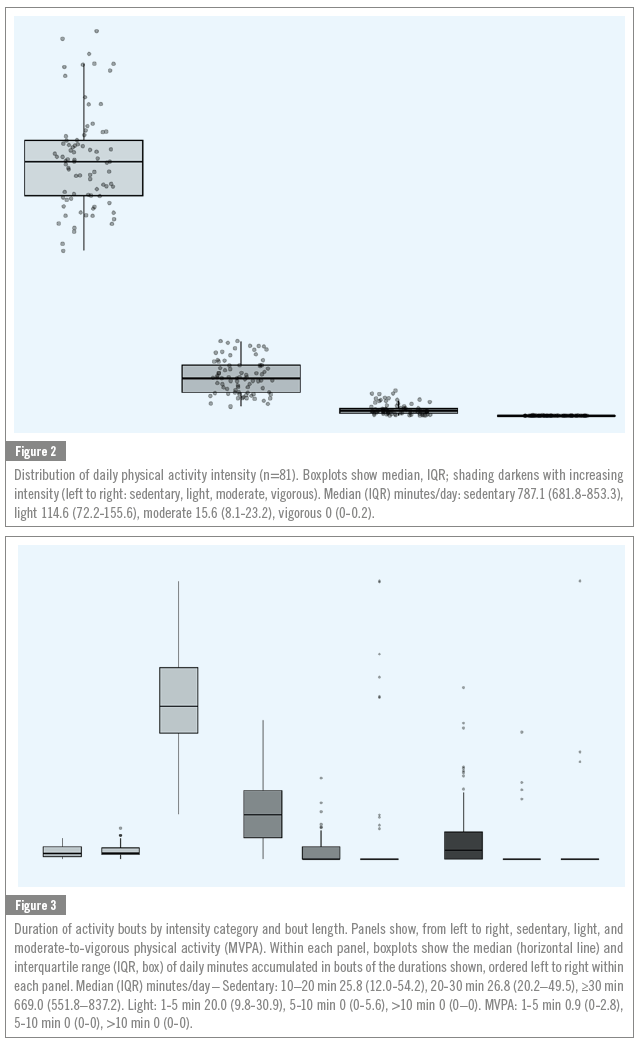
Based on the defined validation criteria for PA, 27 patients were included in the PA level analysis, with 3 valid days per participant (2 weekdays, 1 weekend day), resulting in 81 valid days (figure 1). Residents spent most waking time sedentary (median 787.1 min/day, IQR 681.8-853.3; 86%), with 114.6 min (IQR 72.2-155.6; 12.4%) in light and 15.6 min (IQR 8.1–23.2; 1.6%) in moderate PA; vigorous activity was negligible (0.0 min, IQR 0.0-0.2) (figure 2).
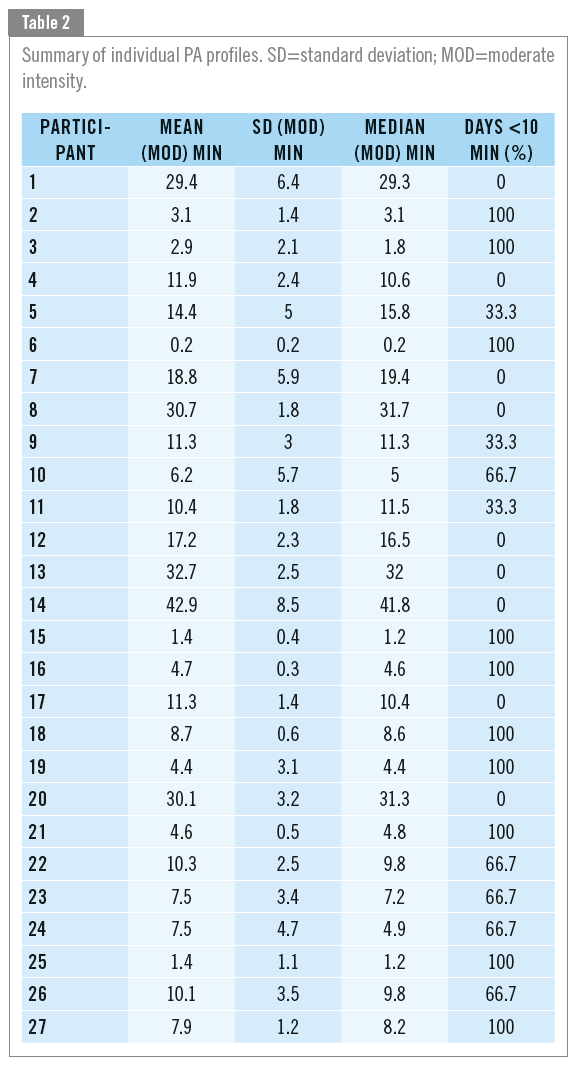
Regarding consistency, 33.3% achieved ≥10 min of moderate PA daily, while 37.0% never reached this threshold. The remaining 29.7% showed inconsistent patterns. Mean daily moderate activity was 2.8±2.1 min (table 2).
Sedentary behavior was characterized by prolonged bouts of sitting time >30 minutes. Most residents engaged in short activity bouts of 1-5 minutes at light to moderate intensity. Only a few residents showed bouts of >10 minutes at light or moderate intensity (figure 3).
Associations of Clinical Characteristics and PA Levels
Univariate Associations
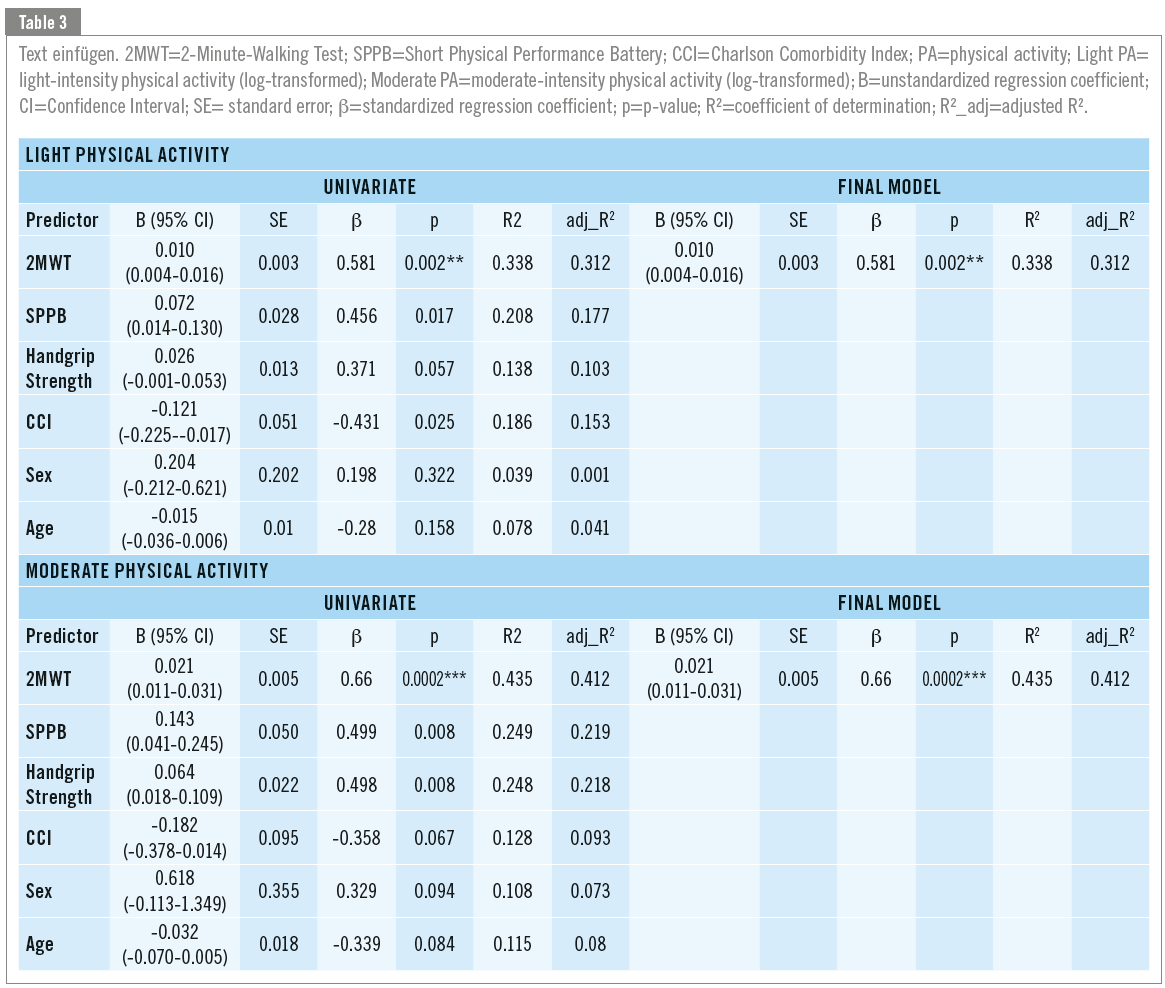
Univariate linear regression analyses identified significant associations between log-transformed daily PA levels and clinical characteristics (table 3). For light PA, the 2MWT was the strongest univariate predictor (B=0.010, p=0.002) followed by SPPB (B=0.072, p=0.017) and CCI (B=-0.121, p=0.025). For moderate PA, 2MWT was again the strongest predictor (B=0.021, p=0.0002), followed by the SPPB (B=0.143, p=0.008) and handgrip strength (B=0.064, p=0.008).
Final Multiple Linear Regression Analyses
Final multiple linear regression models showed that, for light PA, 2MWT was the strongest predictor (B=0.010, p=0.002). The model explained 33.8% of the variance (adjusted R2=0.312). The exponential factor was 1.0101, indicating a 1.01% higher light PA per additional meter in the 2MWT (95% CI (%)=[0.43%, 1.59%]).
For moderate PA, 2MWT was also the only independent predictor (B=0.021, p=0.0002). The model explained 43.5% of the variance (adjusted R2=0.412). The exponential factor was 1.0209, indicating a 2.09 % higher moderate PA per additional meter in the 2MWT (95% CI (%)=[1.11%, 3.1%]).
All standard model assumptions were met (Durbin-Watson, Breusch-Pagan, Shapiro-Wilk). Two influential observations were retained based on clinical plausibility. Scatterplots confirmed linearity; residual plots showed no patterns.
Discussion
This study provides insights into PA and fitness of older adults in Swiss RCFs. Participants were characterized by advanced age, severe comorbidity, and moderate functional limitations. Although mean handgrip strength exceeded sarcopenia cut-offs, 2MWT performance was markedly lower than age-matched norms (1, 5, 7, 10, 15). This discrepancy underscores the multidimensional nature of physical function in this population. It may also be partly explained by selection effects, measurement-related factors (e.g. different measurement time) and the institutional living environment, which can restrict opportunities for PA such as walking in everyday life (2, 9). Residents of the included RCFs spent 86% of waking time sedentary, 12.4% light, and 1.6% moderate activity—aligning with prior studies (79%, 20%, 1% respectively) (3, 19). Sedentary time was predominantly accumulated in prolonged bouts exceeding 30 minutes. Next to low PA levels, this is alarming as sedentary behavior contributes to the decline of muscle strength, leads to balance problems and increases fall risk and depression (29).
In contrast to sedentary time, PA was predominantly accumulated in short bouts of 1-5 minutes at light to moderate intensity (8). Activity patterns varied substantially between residents. Nevertheless, previous evidence suggests that even inactive older adults benefit from small amounts of PA (35-60 min/week), and that this vulnerable population should increase PA gradually (28).
These findings demonstrate the high prevalence of sedentary behavior in older adults living in Swiss RCFs and suggest that reducing prolonged sedentary time could represent a relevant target for future interventions. It is therefore recommended to implement structured PA activities and exercise programs to reduce sedentary time, such as encouraging residents to walk to the dining hall or organizing motivating group activities of moderate intensity with exercise to train muscle strength, balance and endurance. Relationship-centered approaches may complement interventions targeting fitness parameters and promoting PA behavior, as staff-resident relationships and social support are directly associated with residents‘ PA levels. Positive daily staff-resident interactions, family involvement, and a person-centered care culture further support residents‘ PA engagement (18, 25). The Canadian Society for Exercise Physiology furthermore recommends limiting sedentary time to 8 hours of wake time, accumulating moderate-to-vigorous physical activity, and prioritizing sleep quality (29). However, these guidelines explicitly note that they may not be appropriate for individuals with disabilities or medical conditions and are not tailored to older adults living in care facilities. Our results therefore underscore the need for population-specific recommendations, as even these guidelines do not adequately capture the functional heterogeneity and care needs of this population. The 2MWT explained 41.3% and 31.2% of the variance in log-transformed moderate and light PA, respectively. This suggests that walking endurance is strongly related to PA levels in this population. However, longitudinal or intervention studies are needed to examine whether improving endurance influences PA. Routine assessment of physical fitness and PA may help identify RCF residents at risk of low PA, prolonged sedentary behavior, and functional decline. However, to our knowledge, there is no gold standard for measuring these outcomes in older adults in RCFs, and routine assessment remains uncommon despite its potential. Regular use of the SPPB, handgrip strength, and the 2MWT could support identification of residents with low PA, high sedentary time, and functional limitations, and help define targets for tailored PA interventions (4).
Limitations
This study has several limitations. The cross-sectional design precludes causal inference between PA, physical fitness, and clinical characteristics. The small sample size may limit generalizability, and inclusion required sufficient cognitive and physical capacity to participate, potentially introducing selection bias toward healthier residents. Consequently, PA and fitness levels in the broader RCF population may be lower than observed. As PA was assessed over a limited period, it may not capture habitual or seasonal patterns. Although accelerometry provides device-based PA assessment, wrist-worn devices may have limited ability to distinguish specific postures or activity types. Furthermore, PA behavior and physical performance may have been influenced by daily variations in health status and contextual factors. Due to the limited sample size, regression analyses were restricted to single predictors, and findings should therefore be interpreted cautiously. Despite these limitations, this study has several strengths. Accelerometry provided ecologically valid real-world data, and standardized assessments together with high adherence to monitoring protocols enhanced methodological rigor. Overall, this study contributes valuable evidence on PA and physical fitness in Swiss RCFs.
Conclusion
This cross-sectional study showed that older adults living in Swiss RCFs are characterized by advanced age, substantial comorbidity, and predominantly sedentary behavior, spending 86% of their waking time sedentary. The 2MWT showed the strongest association with PA levels. Despite statistical associations, the cross-sectional design and small sample size preclude causal inference. Nevertheless, routine screening of SPPB, handgrip strength, and 2MWT may help identify residents with low PA levels, high sedentary time, and functional limitations in RCFs that may affect engagement in PA. Interventions targeting sedentary behavior and PA could support the maintenance of physical function and mobility in this setting. Longitudinal studies are needed to further investigate these relationships.
Conflict of Interest
The authors have no conflict of interest.
Funding
The findings reported in this study are part of a broader evaluation funded by Gesundheitsförderung Schweiz, Beisheim Stiftung and Amt für Gesundheitsvorsorge St. Gallen. The funding agencies had no influence on the conduct of the study, data collection, its analysis, interpretation and reporting of results.
Ethical Approval and Informed Consent
The study was conducted in accordance with the Declaration of Helsinki and approved by the Ethics Committee of Eastern Switzerland (Ethikkommission Ostschweiz, EKOS; Project-ID: 2024-01990, BASEC No. 2024-01990). The study protocol was prospectively registered in the ClinicalTrials.gov Protocol Registration System (Protocol ID: 2024-01990).
Written informed consent was obtained from all participants prior to study participation. Potential participants received verbal and written study information from trained study personnel and were given sufficient time to ask questions and decide about participation. Only participants providing written informed consent were included in the study.
Older adults from participating RCFs and the public were not formally involved in the study design, data interpretation, or dissemination of findings.
Data Availability
Data are available from the corresponding author upon reasonable request, subject to ethics committee approval, due to privacy considerations.
Author Contributions / Statement of Author Contributions
Funding acquisition and study oversight: SH, AK; conceptualisation: CT, AK; data collection: CT, AK, AS, SH; data analysis: CT, AK; writing: CT, AS; review and editing: CT, AK, AS, SH.
Acknowledgments
We would like to thank the residents and care staff of the RCFs for their study participation.
Declaration of AI Use
Perplexity (OpenAI) and ChatGPT were used to support R code development and scientific text refinement. The authors reviewed all AI-assisted outputs and take full responsibility for the final content and analyses.
Summary Box
What is already known on this topic?
Older adults living in residential care facilities (RCFs) are at high risk of cognitive and functional decline, and sedentary behavior. However, objectively measured data on physical activity (PA) and physical fitness in Swiss RCFs are limited.
What does this study add and how might this impact practice or research?
This study provides accelerometer-based data showing that residents spent most of their waking time sedentary and identifies the 2-minute walking test (2MWT) as the physical fitness measure most strongly associated with PA levels. The findings highlight the importance of routinely assessing PA and physical fitness among older adults living in RCFs and may help identify targets for tailored PA interventions. Future longitudinal research should further investigate strategies to reduce sedentary behavior and maintain functional health in this population.
References
- Grip Strength Cutpoints for the Identification of Clinically Relevant Weakness. J Gerontol A Biol Sci Med Sci. 2014; 69: 559-566.
- Editorial: Circadian rhythm and performance in sports. Front Sports Act Living. 2025; 7: 1605582.
- Levels and patterns of daily physical activity and sedentary behavior measured objectively in older care home residents in the United Kingdom. J Aging Phys Act. 2015; 23: 133-143.
- Assessment of MuscleFunction and Physical Performance in Daily Clinical Practice:A position paper endorsed by the European Society for Clinicaland Economic Aspects of Osteoporosis, Osteoarthritis andMusculoskeletal Diseases (ESCEO). Calcif Tissue Int. 2019; 105:1-14.
- Two-Minute Walk TestPerformance by Adults 18 to 85 Years: Normative Values,Reliability, and Responsiveness. Arch Phys Med Rehabil. 2015; 96:472-477.
- Risk and Protective Factors for Frailty in Pre-Frail and FrailOlder Adults. Int J Environ Res Public Health. 2023; 20: 3123.
- Short PhysicalPerformance Battery as a Measure of Physical Performance andMortality Predictor in Older Adults: A Comprehensive LiteratureReview. Int J Environ Res Public Health. 2021; 18: 10612.
- Recommendations on Physical Activity and Exercise forOlder Adults Living in Long-Term Care Facilities: A TaskforceReport. J Am Med Dir Assoc. 2016; 17: 381-392.
- Facilitators andbarriers to enhancing physical activity in older patients duringacute hospital stay: a systematic review. Int J Behav Nutr PhysAct. 2022; 19: 99.
- Global variation in gripstrength: a systematic review and meta-analysis of normativedata. Age Ageing. 2016; 45: 209-216.
- Healthcare. Pocket Statistics 2025.2024.
- Discovering Statistics Using R. Repr. Sage;2014.
- StoppSturz VorgehenPhysiotherapie. Manual. PHS Public Health Services; 2021.
- Accelerometer-Measured Sedentary and Physical Activity Time and TheirCorrelates in European Older Adults: The SITLESS Study.Newman A, ed. J Gerontol Ser A. 2020; 75: 1754-1762.
- Lower Extremity Functionand Subsequent Disability: Consistency Across Studies,Predictive Models, and Value of Gait Speed Alone ComparedWith the Short Physical Performance Battery. J Gerontol A BiolSci Med Sci. 2000; 55: M221-M231.
- A Short PhysicalPerformance Battery Assessing Lower Extremity Function:Association With Self-Reported Disability and Prediction ofMortality and Nursing Home Admission. J Gerontol. 1994; 49:M85-M94.
- How many days ofmonitoring predict physical activity and sedentary behaviourin older adults? Int J Behav Nutr Phys Act. 2011; 8: 62.
- Factors that Influence PhysicalActivity among Residents in Assisted Living. J Gerontol SocWork. 2017; 60: 120-137.
- Patterns of Sedentary Behavioramong Older Adults in Care Facilities: A Scoping Review.Int J Environ Res Public Health. 2021; 18: 2710.
- TimeEffects on Physical Performance in Older Adults in NursingHome: A Narrative Review. J Nutr Health Aging. 2019; 23: 586-594.
- Calibrationand Cross-Validation of Accelerometer Cut-Points to ClassifySedentary Time and Physical Activity from Hip and Non-Dominant and Dominant Wrists in Older Adults. Sensors (Basel).2021; 21: 3326.
- AccelerometerData Collection and Processing Criteria to Assess PhysicalActivity and Other Outcomes: A Systematic Review and PracticalConsiderations. Sports Med. 2017; 47: 1821-1845.
- GGIR: AResearch Community–Driven Open Source R Package forGenerating Physical Activity and Sleep Outcomes From Multi-Day Raw Accelerometer Data. J Meas Phys Behav. 2019; 2: 188-196.
- A Review of Handgrip Strengthand its Role as a Herald of Health. Open Orthop J. 2022; 16:e187432502201100.
- Barriers and facilitators toaddressing sedentary behaviour and physical inactivity amongnursing home residents: a qualitative study. BMC Geriatr. 2025;25: 648.
- Bedarf anAlters- Und Langzeitpflege in Der Schweiz. SchweizerischesGesundheitsobservatorium (Obsan); 2025.
- Motor assessment usingthe NIH Toolbox. Neurology. 2013; 80: S65-S75.
- StayActive, Stay Healthy: A Cross-Sectional View of the Impact ofPhysical Activity Levels on Health Parameters of Older AdultsInstitutionalized in Nursing Homes of Barcelona. Life. 2025; 15:412.
- Canadian 24-HourMovement Guidelines for Adults aged 18–64 years and Adultsaged 65 years or older: an integration of physical activity,sedentary behaviour, and sleep1. Appl Physiol Nutr Metab. 2020;45: S57-S102.
- RawAccelerometer Data Analysis with GGIR R-package: DoesAccelerometer Brand Matter? Med Sci Sports Exerc. 2016; 48:1935-1941.
- Translational longevitymedicine: a Swiss perspective in an ageing country. Swiss MedWkly. 2023; 153: 40088.
- Objectively Measured PhysicalActivity and Sedentary Behaviors Among Older Adults inAssisted Living Facilities: A Scoping Review. J Appl Gerontol.2024; 43: 1544-1559.
- Accelerometry assessedphysical activity of older adults hospitalized with acute medicalillness - an observational study. BMC Geriatr. 2020; 20: 382.Published 2020 Oct 2.
- Steps parameters ofelderly patients hospitalised for an acute medical illness in aSwiss University Hospital: an observational pilot study. SwissMed Wkly. 2022; 152: 40012.
- New Canadian PhysicalActivity Guidelines. Appl Physiol Nutr Metab. 2011; 36: 36-46.
- Frailty and Multimorbidity:A Systematic Review and Meta-analysis. J Gerontol A Biol SciMed Sci. 2019; 74: 659-666.
- 1st ed.World Health Organization; 2020.
- Ageing and Health; 2025 [accessedMay 25, 2026].
OST – Eastern Switzerland University of Applied Sciences
Rosenbergstrasse 59
9001 St. Gallen, Switzerland
caroline.tanner@ost.ch