


Lactate Thresholds in Sports Medicine – an Updated Physiological Perspective on Endurance Exercise
Laktatschwellen in der Sportmedizin – Eine aktualisierte physiologische Perspektive auf Ausdauerbelastungen
Summary
Lactate has long been used to assess endurance performance and prescribe training intensity, yet its physiological interpretation and practical application have evolved considerably. This review integrates classical lactate threshold concepts with contemporary developments in exercise physiology and performance diagnostics. Lactate is now recognized as a central metabolic intermediate, functioning as an oxidative substrate and signaling molecule, rather than a by-product of anaerobic metabolism. Consequently, lactate responses reflect dynamic system-wide processes rather than discrete metabolic transitions.
Lactate thresholds and maximal lactate steady state are re-evaluated within the framework of maximal metabolic steady state. Critical power/speed has emerged as a complementary indicator of the upper boundary of sustainable exercise, although all markers are influenced by methodological and contextual factors. The concept of physiological resilience highlights that metabolic thresholds are not fixed but dynamically shift with fatigue and prior exercise.
From an applied perspective, lactate thresholds remain valuable for defining exercise intensity domains and supporting diagnostic assessments. However, their role in training has shifted from primary targets toward anchors within an overall training-intensity distribution. The first and second lactate thresholds (LT1, LT2) provide physiologically grounded reference points for prescribing and monitoring exercise intensity across populations, yet require integration into modern, system-level models of endurance performance that account for performance level, health status, and training goals.
Key Words: Exercise Testing, Max imal Steady State, Critical Power, Exercise Intensity Domains, Endurance Training, Metabolic Thresholds
Introduction
Lactate measurements are well established in endurance diagnostics and training prescription. During incremental exercise, lactate typically increases exponentially with rising work rate, reflecting the balance between lactate production and clearance and providing a physiological basis for identifying metabolic transitions (9). Metabolic thresholds can be identified from different physiological responses, including lactate and ventilatory or gas-exchange variables, with lactate providing a marker of peripheral metabolic responses. Accordingly, numerous lactate threshold (LT) concepts have been proposed to define meaningful points along the lactate-work rate relationship. This topic was comprehensively reviewed around 15 years ago by two German research groups, highlighting both its practical importance and conceptual complexity (1, 9). At that time more than twenty LT concepts had been described, which can be broadly grouped into fixed lactate concentrations, thresholds based on the first rise above baseline (LT1), and methods detecting changes in curve slope or approximating maximal lactate steady state (LT2, MLSS) (9). However, nomenclature and the assignment of individual methods to LT1 and LT2 remain heterogeneous and insufficiently standardized. Many of these thresholds correlate strongly with endurance performance.
The large number of concepts has also generated considerable ambiguity. Many LT definitions represent methodological variations rather than distinct physiological phenomena. Fixed thresholds (e.g. 4 mmol·L-¹) were derived under specific conditions and should not be considered universal metabolic breakpoints due to considerable inter- and intraindividual variability in lactate responses (1, 8, 9). MLSS emerged as a physiologically plausible reference point for endurance performance and was widely regarded as the highest intensity at which a metabolic steady state can be maintained for prolonged exercise (1, 9). The accepted gold standard for MLSS determination requires repeated constant-load trials, limiting practical applicability (9). Incremental LT testing remains the most pragmatic approach in applied settings, although its interpretation is influenced by protocol design and measurement procedures (1, 9, 20). At the same time, the understanding of lactate metabolism has evolved considerably. Lactate is now recognized as a key metabolic intermediate and signaling molecule.
In summary, this warrants an updated synthesis of lactate thresholds within contemporary concepts of metabolic steady states and exercise intensity domains (5).
The Mechanistic Basis and Physiological Meaning of Lactate in Metabolism
Lactate is not a waste product, but a central part of energy metabolism. Lactate is continuously produced even under fully aerobic conditions and serves as fuel for tissues such as skeletal muscle, heart, and brain (1, 15). The concept of lactate shuttling describes how lactate is exchanged between cells and organs, allowing energy to be redistributed according to demand (3, 12). Thus, lactate metabolism is a dynamic and well-regulated system.
During exercise, rising lactate does not indicate a switch to anaerobic metabolism. It reflects a mismatch between lactate production and its clearance, oxidation, and transport (1, 15). Higher lactate production mainly indicates increased carbohydrate flux rather than limited mitochondrial oxygen availability (12). Lactate formation supports glycolytic ATP production through maintenance of cellular redox balance and may exert buffering effects, challenging earlier views that linked lactate directly to fatigue or acidosis (6, 15). Lactate also acts as a signaling molecule, influencing training adaptations such as mitochondrial development, angiogenesis, and gene regulation (4, 12). Thus, lactate responses are integrative markers of whole-body regulation rather than simple indicators of oxygen limitation.
From Maximal Lactate Steady State to Maximal Metabolic Steady State
Maximal lactate steady state has traditionally been regarded as the gold standard for defining the highest sustainable exercise intensity, representing the upper boundary at which lactate production and clearance remain in equilibrium. This concept aligns closely with the notion of a metabolic steady state and has been widely used as reference for endurance performance diagnostics (9). However, lactate stability alone does not fully capture systemic homeostasis during exercise, which depends on the coordinated regulation of metabolic, respiratory, and neuromuscular processes (5).
This broader perspective has led to the concept of maximal metabolic steady state (MMSS), emphasizing that performance is constrained by the integrative capacity of these systems rather than any single variable. Within this framework, exercise intensity domains are defined by the ability (or inability) to achieve a physiological steady state across these systems. Up to the moderate intensity domain, oxygen uptake and lactate can stabilize over time, whereas in the high and very high intensity domains, a progressive loss of homeostasis occurs, ultimately leading to task failure (5). Importantly, fatigue arises from combinations of central and peripheral mechanisms, including substrate depletion, metabolite accumulation, acid-base disturbances, and neuromuscular limitations. While severe acidosis may contribute to fatigue under some conditions, it is now recognized as only one component of a complex multifactorial process (6).
MLSS, LT2, and critical power/critical speed (CP/CS) represent closely related but distinct constructs. While MLSS and LT2 are derived from lactate responses, CP/CS is mathematically defined as the asymptote of the hyperbolic power-duration relationship and derived from multiple exhaustive exercise bouts of varying duration Physiologically, CP/CS is closely associated with the highest exercise intensity at which oxygen uptake and key metabolic variables (e.g., lactate, pH, phosphocreatine, and inorganic phosphate) can attain a steady state (5). Evidence suggests that CP/CS provides a robust estimate of the upper boundary of steady-state exercise, typically located slightly above lactate-based thresholds (16).
Recent work has introduced physiological resilience (or durability) as an important characteristic of endurance performance (17) emphasizing that lactate thresholds and CP/CS are not fixed, but decline during prolonged or repeated exercise, with considerable individual variability. Metabolic thresholds are therefore dynamic and state-dependent, influenced e.g. by prior exercise, substrate availability, thermoregulation, and neuromuscular fatigue. Laboratory assessments in a fresh state therefore may overestimate sustainable intensities in real-world conditions.
Emerging frameworks such as durability, fatigability, and repeatability aim to describe these dynamics (18), but their practical implementation remains limited. Current approaches lack standardized definitions and validated protocols, and the extent to which they provide information beyond established performance markers remains a matter of ongoing discussion (10, 17, 18).
These developments suggest that the concept of maximal metabolic steady state should be understood as a dynamic and context-dependent construct. Metabolic markers retain value for performance diagnostics and training guidance. However, their interpretation must account for temporal variability and fatigue-induced shifts in physiological capacity. Future research is required to better integrate these dynamic aspects into both performance diagnostics and training models, and to determine how emerging constructs such as physiological resilience can be reliably measured and practically applied.
Current Models for Endurance Performance Diagnostics and Training Intensity Prescription
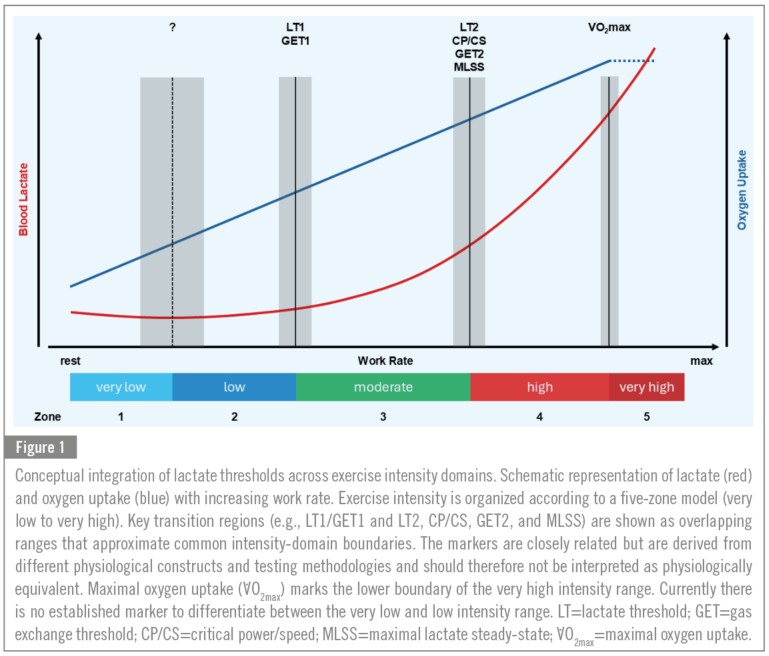
Modern endurance diagnostics and training prescription are commonly structured using either a three-zone or an extended five-zone intensity model. The three-zone model is based on distinct physiological domains separated by metabolic thresholds derived from gas exchange and/or lactate responses (9, 19). Exercise below LT1 is associated with stable metabolic conditions, while the moderate domain (between LT1 and LT2) is characterized by elevated but relatively steady lactate concentrations and oxygen uptake. In contrast, intensities above LT2 involve a progressive loss of physiological stability, with continuously rising lactate and oxygen uptake until exhaustion.
To improve practical applicability, this framework is often extended into a five-zone model (very low to very high intensity, figure 1), typically anchored to physiological markers including LT1, LT2 and maximal oxygen uptake (V˙O₂max). This allows for a more detailed description of training intensity distribution. A recent consensus statement emphasizes the need for standardized terminology to improve communication across research and applied settings (2).
Incremental exercise testing enables simultaneous assessment of submaximal metabolic responses and maximal aerobic capacity. Lactate-derived thresholds are among the strongest predictors of sport-specific endurance performance (1, 9, 21).
For the lower boundary between low and moderate exercise, LT1 provides the most practical and physiologically meaningful anchor. LT1 reflects the first systematic rise in lactate above baseline and corresponds to the transition from stable to increasingly challenged metabolic conditions, accompanied by changes in substrate use, muscle recruitment, and oxygen uptake kinetics, although its precise determination remains method-dependent (9, 16). However, the physiological nature and optimal determination of LT1 have received less research attention than the upper threshold and remain less standardized. At present, no clearly defined physiological marker exists to differentiate between the very low- and low-intensity domains (2).
For the upper boundary between moderate and high exercise, CP/CS has emerged as a complementary marker that currently shows the strongest construct validity for delineating the boundary between sustainable and non-sustainable exercise intensities (5, 16). LT2/MLSS are typically located slightly below CP/CS and show greater interindividual variability (16). These approaches are based on different principles and reflect related but distinct physiological constructs.
Despite these differences, lactate-based thresholds and CP/CS should be considered complementary. Lactate tests provide a comprehensive assessment of both domain boundaries (LT1 and LT2/MLSS proxies) and maximal aerobic capacity within a single protocol, although V˙O₂max should be distinguished from V˙O₂peak when established criteria for maximal oxygen uptake are not met. CP/CS marks the upper boundary above which progressive metabolic disruption and inevitable task failure occur but does not provide information on the lower intensity boundary (4). Combining both approaches therefore yields a more complete characterization of the individual metabolic profile in applied settings.
Lactate and gas exchange thresholds offer overlapping but not identical information. While gas exchange methods provide a non-invasive assessment of metabolic transitions, lactate measurements offer direct insight into systemic metabolic responses (9, 19).
CP/CS determination requires multiple exhaustive constant-load or time-trial efforts and is influenced by methodological and protocol-specific factors (16). Simplified approaches such as the 3-min all-out test can improve feasibility, although potentially at the expense of greater measurement uncertainty. For lactate-based diagnostics, stepwise incremental protocols are preferable to continuous ramp protocols, as sufficient stage duration is required to characterize the lactate-work rate relationship. Graded exercise testing is widely established in both sport science and clinical settings and aligns with established clinical exercise testing standards by enabling the integrated assessment of electrocardiographic responses, blood pressure, clinical symptoms, and gas exchange variables under relatively stable physiological conditions.
CP/CS provides a complementary marker of the upper limit of sustainable metabolic steady state, whereas lactate-derived thresholds remain essential for describing the full spectrum of exercise intensities. All markers should be interpreted as context-dependent rather than fixed values, as intensity boundaries may shift with fatigue, prior exercise, and environmental conditions.
Methodological Considerations in Lactate Threshold Testing
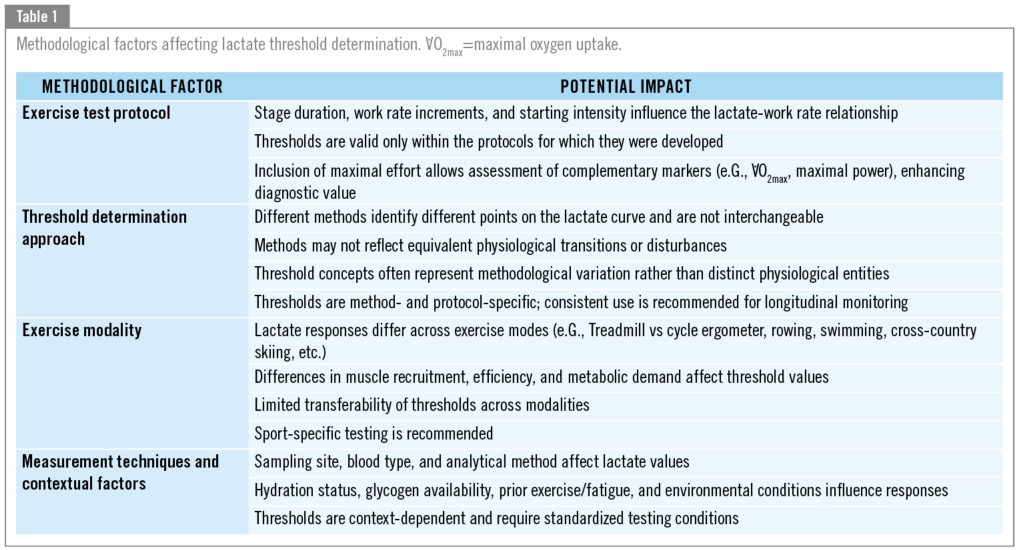
Graded exercise tests vary in stage duration, work rate increments, and starting intensity, influencing the lactate-work rate relationship and resulting threshold values. Threshold concepts are therefore valid only within the protocols and populations for which they were developed (9, 20). While maximal exertion is not required for the assessment of lactate curves, its inclusion may improve threshold determination by certain concepts and enables the assessment of complementary performance markers such as V˙O₂max and maximal power output (1, 9, 16).
A major limitation is the non-interchangeability of threshold determination methods, as different approaches identify different points on the lactate curve and do not necessarily reflect the same physiological transition. Threshold concepts therefore represent methodological variations rather than distinct physiological entities, and their interpretation remains method- and protocol-specific (1, 9, 16). Consequently, the applied threshold method should be considered when interpreting or comparing values from the literature, and consistent use of a single method is recommended for longitudinal monitoring.
Exercise modality, measurement techniques, and contextual factors further influence lactate responses and threshold values, limiting transferability and requiring careful standardization (1, 15). Sampling site, blood type, and analytical method can introduce systematic differences, while factors such as prior exercise, hydration, glycogen availability, and environmental conditions further affect responses (9, 11). Key methodological factors and their practical implications are summarized in table 1.
Lactate Thresholds in Training and Clinical Context
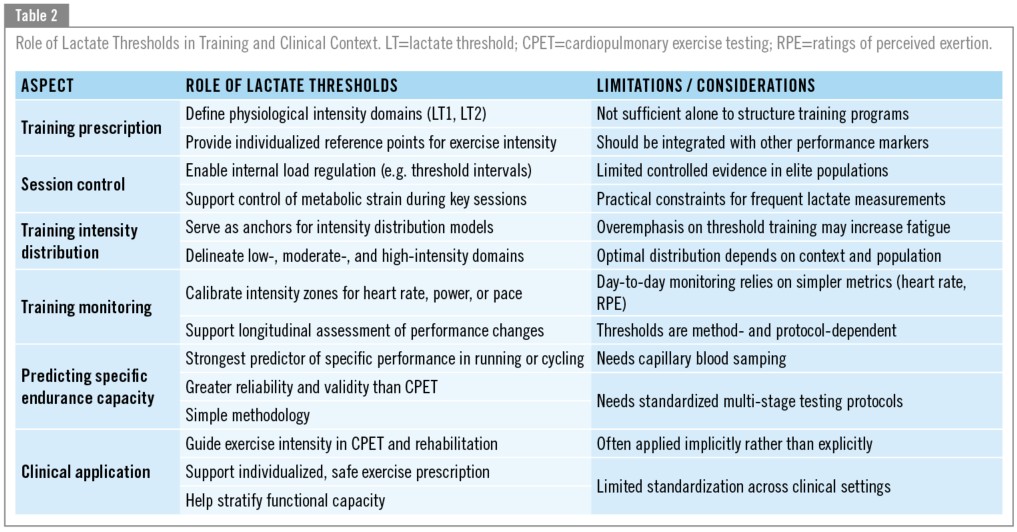
Lactate measurements have long been central to the management of endurance training, serving as both a diagnostic marker and a tool for prescribing exercise intensity. Early “threshold training” approaches emphasized maintaining exercise near lactate-derived intensities, often without considering overall training-intensity distribution (TID). However, lactate thresholds define only the intensity anchors, whereas training adaptations are also influenced by how training load is distributed across intensity domains (13).
Contemporary approaches apply lactate more selectively. Lactate-guided threshold interval training uses lactate as a practical marker of proximity to the upper limit of sustainable metabolic steady state, integrating information on multiple physiological processes beyond lactate kinetics alone (7). This allows individualized control of training intensity, although evidence remains largely observational, with limited controlled data in elite populations.
The broader TID literature highlights limitations of threshold-focused training. Excessive training in the moderate domain (between LT1 and LT2) may increase fatigue and constrain overall training volume (23). In contrast, successful programs typically combine predominantly low-intensity exercise with selective higher-intensity work, as reflected in pyramidal or polarized models (14).
LTs are best interpreted as intensity anchors within a broader framework. They define physiological intensity domains and help calibrate training loads, while training adaptation also depends on how exercise is distributed across these domains. This methodological dependency is also relevant to current concepts such as “zone 2” training, as different threshold definitions may result in different zone boundaries and consequently affect the calculation and comparison of TID (22). In practice, lactate testing is mainly used for calibration, while routine monitoring relies on simpler measures such as heart rate, power output, or perceived exertion (13).
In exercise physiology, lactate thresholds and the intensity domain framework have also clinical relevance, although lactate measurements are used less frequently than in athletic settings. Thresholds derived from lactate or gas exchange can support the assessment of exercise tolerance and the prescription of individualized exercise intensities, particularly when maximal exercise testing is not feasible or not desired in prevention and rehabilitation settings. Exercise performed below LT1 is generally well tolerated and suitable for most patients, whereas higher intensities require careful and individualized prescription but may elicit greater central and peripheral adaptations, including improvements in central hemodynamics, maximal aerobic capacity, and mitochondrial function. In selected situations, lactate measurements may provide additional guidance when conventional clinical markers are inconclusive or when clearly defined intensity limits are desired. Accordingly, the intensity-domain framework provides a useful basis for individualized exercise prescription across clinical populations, even if it is not always explicitly described in these terms (9). LTs remain valuable for defining intensity domains and guiding selected sessions, but their effectiveness depends on integration within an appropriate TID (table 2).
Conclusion and Future Directions
Lactate remains a valuable marker in exercise physiology, but its interpretation has evolved from a simple indicator of anaerobic metabolism to an integrative marker of metabolic regulation. Lactate thresholds continue to provide practical anchors for performance diagnostics, exercise prescription, and the definition of exercise intensity domains. However, they should be interpreted within broader frameworks that consider maximal metabolic states, critical power/speed, training-intensity distribution, and the dynamic nature of physiological performance capacity.
Several questions remain unresolved. Future research should clarify the relationships among lactate thresholds, maximal lactate steady state, CP/CS, and emerging concepts such as physiological resilience. Additional work is needed to improve the standardization, validity, and comparability of testing protocols across laboratories, exercise modalities, and populations. Dynamic changes in lactate responses and lactate-derived thresholds during prolonged exercise may provide information on the ability to maintain metabolic stability under fatigue and thus contribute to the assessment of physiological resilience, although their additional diagnostic value remains unclear. Machine learning and other AI-based analytical approaches may help integrate lactate, gas exchange, heart rate, and performance data to model exercise intensity regulation.
From an applied perspective, more evidence is needed regarding the use of lactate-guided training approaches and intensity-domain frameworks in both athletic and clinical populations. Particular attention should be given to female and youth athletes, older adults, and other underrepresented groups, who remain insufficiently represented in the current evidence base. In addition, future studies should evaluate whether threshold- and domain-based approaches can improve exercise prescription, adherence, and long-term outcomes in patients with cardiovascular, metabolic, pulmonary, and other chronic diseases. Expanding research in these populations will improve the generalizability, clinical applicability, and translational relevance of contemporary concepts for exercise testing, training prescription, and rehabilitation.
Conflict of Interest
The authors have no conflict of interest.
Funding
No funding was received.
Ethical Approval and Informed Consent
During the preparation of this manuscript, the authors used ChatGPT (OpenAI) to improve the readability and language of the text. All scientific content, interpretation, and conclusions were critically reviewed and revised by the authors. The authors take full responsibility for the content of the published article.
Data Availability
N/A
Author Contributions / Statement of Author Contributions
O.F.: Conceptualization, literature review, writing – original draft preparation, manuscript revision.
R.L.: Critical review and revision of the manuscript.
T.M.: Critical review and revision of the manuscript.
K.R.: Critical review and revision of the manuscript.
K.K.: Conceptualization, critical review, and manuscript revision.
All authors contributed to the development of the manuscript, critically reviewed the final version, and approved the manuscript for publication.
Acknowledgments
N/A
Summary Box
Lactate remains a valuable marker in exercise physiology, but its interpretation has evolved from a simple indicator of anaerobic metabolism to an integrative marker of metabolic regulation.
Lactate thresholds are method-dependent and require standardized testing procedures and interpretation within broader frameworks that consider maximal metabolic states, critical power/speed, training-intensity distribution, and the dynamic nature of physiological performance capacity.
Lactate-guided threshold training uses lactate as a practical marker of proximity to the upper limit of sustainable metabolic steady state, integrating information on multiple physiological processes beyond lactate kinetics alone.
References
- Blood lactate diagnostics in exercise testing and training. Int J Sports Physiol Perform. 2011; 6: 8-24.
- Physical Activity and Exercise Intensity Terminology: A Joint American College of Sports Medicine (ACSM) Expert Statement and Exercise and Sport Science Australia (ESSA) Consensus Statement. J Sci Med Sport. 2025; 28: 980-991.
- The lactate shuttle during exercise and recovery. Med Sci Sports Exerc. 1986; 18: 360-368.
- Lactate as a myokine and exerkine: drivers and signals of physiology and metabolism. J Appl Physiol (1985). 2023; 134: 529-548.
- Power-duration relationship: Physiology, fatigue, and the limits of human performance. Eur J Sport Sci. 2018; 18: 1-12.
- Lactic acidosis: implications for human exercise performance. Eur J Appl Physiol. 2025; 125: 1761-1795.
- Does Lactate-Guided Threshold Interval Training within a High-Volume Low-Intensity Approach Represent the „Next Step“ in the Evolution of Distance Running Training?. Int J Environ Res Public Health. 2023; 20: 3782.
- Reliability of time-to-exhaustion and selected psycho-physiological variables during constant-load cycling at the maximal lactate steady-state. Appl Physiol Nutr Metab. 2017; 42: 142-147.
- Lactate threshold concepts: how valid are they? Sports Med. 2009; 39: 469-490.
- Methodological gaps and conceptual challenges regarding the concept of resilience, durability, fatigability, and repeatability. J Appl Physiol (1985). 2025; 139: 1720-1721.
- Methodische Aspekte der Laktatbestimmung [Methodological Aspects of Lactate Determination]. Dtsch Z Sportmed. 2008; 59: 305-308.
- Lactate metabolism: historical context, prior misinterpretations, and current understanding. Eur J Appl Physiol. 2018; 118: 691-728.
- Monitoring Training Loads: The Past, the Present, and the Future. Int J Sports Physiol Perform. 2017; 12: S22-S28.
- Training Periodization, Intensity Distribution, and Volume in Trained Cyclists: A Systematic Review. Int J Sports Physiol Perform. 2023; 18: 112-122.
- Lactate: Friend or Foe. PM R. 2016; 8: S8-S15.
- An Examination and Critique of Current Methods to Determine Exercise Intensity. Sports Med. 2020; 50: 1729-1756.
- Physiological Resilience: What Is It and How Might It Be Trained? Scand J Med Sci Sports. 2025; 35: e70032.
- Durability, fatigability, repeatability, and resilience in endurance sports: definitions, distinctions, and implications. J Appl Physiol (1985). 2025; 139: 1703-1709.
- A conceptual framework for performance diagnosis and training prescription from submaximal gas exchange parameters - theory and application. Int J Sports Med. 2005; 26: S38-S48.
- Die sportmedizinische Laktatdiagnostik: Technische Rahmenbedingungen und Einsatzbereiche. Dtsch Z Sportmed. 2013; 64: 367-371.
- Predicting competition performance in long-distance running by means of a treadmill test. Med Sci Sports Exerc. 1998; 30: 1552-1557.
- What Is “Zone 2 Training”?: Experts’ Viewpoint on Definition, Training Methods, and Expected Adaptations. Int J Sports Physiol Perform. 2025; 20: 1614-1617.
- Recent advances in training intensity distribution theory for cyclic endurance sports: theoretical foundations, model comparisons, and periodization characteristics. Front Physiol. 2025; 16: 1657892.
Department of Sport
Exercise and Health
University of Basel, Grosse Allee 6, 4052 Basel, Switzerland
oliver.faude@unibas.ch
ORCID:0000-0002-2832-7780