

Physical Activity Research through the Lense of Equity: Insights from Germany and Switzerland
Forschung zur körperlichen Aktivität durch die Linse der Chancengerechtigkeit: Erkenntnisse aus Deutschland und der Schweiz
Summary
Regular physical activity benefits physical and mental health, yet many individuals remain insufficiently active and spend substantial time of their day sedentary, particularly those with low socioeconomic position (SEP). Consequently, disadvantaged groups face higher burdens of obesity and non-communicable diseases. SEP does not directly cause poor health but rather represents a “risk of risks,” shaped by structural, social, and environmental disadvantages. Vulnerable groups are also less likely to be reached by preventive interventions, creating inequities in both exposure to health risks and access to health-promoting resources.
Using the authors’ own research projects as examples, this article examines how current exercise and health science research addresses health equity and includes vulnerable populations. Epidemiological evidence reveals persistent social inequalities in children’s motor development and physical activity, while school-based programmes often struggle to engage families with low socioeconomic position (SEP), resulting in greater benefits for more advantaged groups. Similarly, interventions targeting vulnerable populations can be tailored to specific needs and settings, but challenges related to recruitment, participation, and long-term implementation remain. Overall, the projects suggest that health inequalities are still insufficiently addressed and may, in some cases, be inadvertently reinforced by current research and intervention practices.
Key Words: Health Equity, Socioeconomic Inequalities, Physical Activity Promotion, Vulnerable Populations, Reach and Inclusion in Health Research
Introduction
Despite the strong evidence for beneficial effects of regular physical activity and reduced sedentary behaviour on physical and mental health (6), we still face the problem that too many people remain insufficiently active (20) and spend much of their waking time sedentary (1). These patterns are highly prevalent across all ages with particularly pronounced burdens among individuals with low socio-economic positions (SEP) (15). As a result, obesity and other serious health consequences (e.g. non-communicable diseases, such as diabetes, cardiovascular diseases, cancer, depression) affect people with low SEP disproportionally often (1).
SEP thus serves as an indicator of ‘vulnerable’ populations as health and well-being consistently improve with increasing SEP (35). However, low SEP is not a direct cause of poor health; rather it reflects a ‘higher risk of risks‘ resulting from complex interactions of economic, structural, social, cultural, environmental, and behavioural factors linked to socioeconomic disadvantage (21).
Additionally, it is well known that health promoting measures such as intervention programmes often fail to reach those with the highest needs - vulnerable groups such as people with low SEP (9,(a href="https://www.germanjournalsportsmedicine.com/#l35">35). There is inequity at different stages of interventions, including uptake, adherence, or outcome (3). Therefore, health inequity has two dimensions: being at a higher risk of facing health risks and being less likely to benefit from health promotion and prevention programmes.
This article explores how current exercise and health science research in Germany and Switzerland engage with questions of health equity and the inclusion of vulnerable populations. With respect to health equity and inequity, we use the following conceptual distinctions: (Socially determined) health inequalities are health differences arising from avoidable, social circumstances and, therefore, unjust - commonly known as health inequities. Health equality of opportunity denotes the outcome or goal that everyone should have the same opportunities to develop, maintain, and restore their health. In contrast, health equity refers to the pathway toward this goal, emphasizing the creation of conditions that enable individuals with fewer opportunities to attain full health. Finally, vulnerable populations are groups with increased susceptibility to illness and fewer protective factors due to both individual and structural characteristics, which results – at least to some extent – in avoidable health inequities.
Our operationalisation and use of these terms – particularly regarding health equity, equality, and vulnerable populations – strictly align with the established national frameworks and strategies in Switzerland, such as the conceptual foundations by Health Promotion Switzerland (10) and the Swiss Health Observatory’s 2025 Obsan Report on Health Equity (7).
Although links between SEP and health are well established, little research has examined to what extent exercise and health science research that is not explicitly focussing on inequalities addresses – or inadvertently perpetuates - social inequalities. Few analyses assess whether research designs and interventions genuinely reach vulnerable groups. Addressing this gap is essential to ensure that the field advances, rather than undermines, health equity.
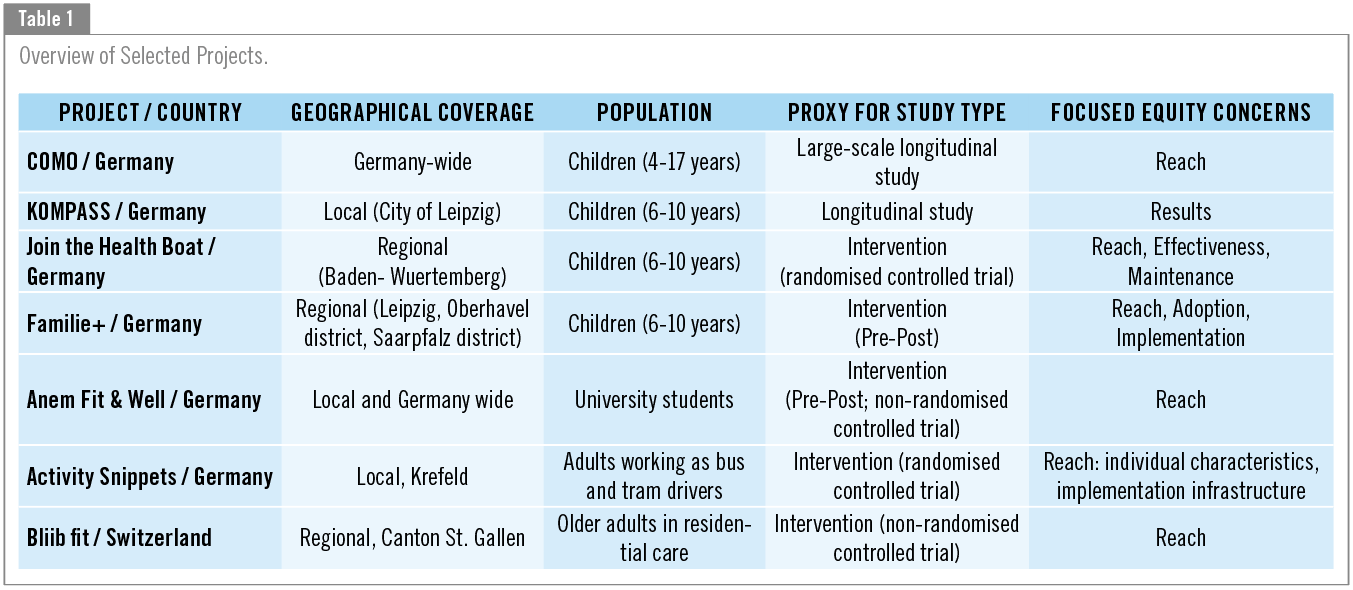
The projects presented in this article were not selected systematically (for an overview see table 1). They present research projects conducted by the authors and are used as illustrative examples of contemporary epidemiological and intervention research in physical activity and health. Although not intended to be representative of the entire field, these projects reflect the types of studies commonly funded and implemented within current research structures and therefore provide a useful basis for critically examining how equity is addressed in practice. The projects originate from Germany and Switzerland and illustrate common challenges related to equity in physical activity research. While none of the investigated projects explicitly aimed to address inequalities, the value of this overview lies in analysing these very contexts to address the following research questions:
Who do we reach through our studies and what insights can be gained from our studies regarding the specific characteristics of individuals or groups who are disadvantaged?
Are research-initiated programs that aim to promote physical activity and health a solution for reaching vulnerable populations and creating equal opportunities?
Below, we present results and challenges from seven research projects. Rather than attempting a systematic literature review or a randomised selection of literature, we purposefully draw upon a convenience sample consisting of seven research projects designed or conducted by the author consortium (comprising epidemiological monitoring like COMO and KOMPASS, setting-based frameworks like JHB and Familie+) (see table 1). Utilising our own studies allows us to leverage deep, first-hand operational insights into recruitment protocols, field challenges, and data gaps that are rarely fully transparent in standard journal publications. These projects thus serve as authentic proxies for contemporary sports science research in Germany and Switzerland. However, evaluating these diverse studies together also highlights inherent methodological constraints: a cross-study perspective reveals significant data fragmentation and limited comparability, as exhaustive insights into all analytical dimensions are not uniformly available for socioeconomically disadvantaged subgroups across all datasets. Rather than treating this restricted comparability as an isolated reporting deficit, we utilise it as a conceptual starting point to problematize the systemic structures of current research practices.
Epidemiological Research on Children’s Physical Activity and Motor Performance
Population-based research on physical activity and motor performance among children and adolescents in Germany – such as the COMO Study (32) and the KOMPASS Study (39) – provides a detailed overview of movement behaviours and health opportunities in childhood. Across nearly all large-scale datasets, pronounced social differences emerge: children from socioeconomically disadvantaged families and those with a migration background are less physically active, less likely to be members of sports clubs, and typically display lower levels of motor performance. This section’s focus on children reflects a pragmatic selection based on the available project portfolio within the author consortium, rather than implying that epidemiological equity research in Germany and Switzerland is limited to this age group.
The COMO Study (32, 33) extends epidemiological perspectives by examining not only changes during and after the COVID-19 pandemic but also the critical question of who participates in population-based research and who remains underrepresented, a core concern of this article. In anticipation of selective participation, the COMO Study implemented several bias-mitigating strategies (32), which helped to reduce but not fully resolve the participation barriers and social gradients. These included a multimodal invitation protocol combining postal invitations, email reminders, non-monetary incentives, and social media outreach, standard recruitment approaches; inclusive and accessible study materials addressing literacy levels and privacy concerns; non-monetary incentives for families and post-survey weighting procedures based on micro census benchmarks to statistically correct demographic imbalances.
The first wave (COMO 1) drew from a probability-based sample of 35,157 families with children aged 4-17 years. Despite multimodal recruitment, postal invitations, email reminders, non-monetary incentives, and social media outreach, 6,097 families submitted at least one questionnaire (17.3%), and 5,240 provided complete parent-child data (15.0%). Participation was socially patterned: adolescents, boys, and families with lower parental education, one of the central SEP indicators, were markedly underrepresented. Qualitative analyses of more than 50 participant inquiries revealed barriers including technical difficulties, privacy concerns, limited digital literacy, and pandemic-related emotional strain. These findings show that digital survey formats, while efficient, can reinforce inequalities by disproportionately excluding families with fewer resources, lower trust in institutions, or limited digital access.
Despite selective participation, COMO offers important insights into the circumstances of socioeconomically disadvantaged children. Inequalities in physical activity, psychosocial health, and sports participation not only persisted but, for some indicators, intensified after the pandemic (33). Children from low-SEP families were less likely to meet WHO physical activity guidelines (6), reported more psychological difficulties, and experienced lower health-related quality of life.
Similarly, the Leipzig KOMPASS 2 Study provides longitudinal data across the primary school years from more than 1,000 children (39). With two data collection waves (2014–2018; 2019-2022), current analyses investigate how early social disparities in motor development emerge and whether they persist throughout primary school.
Epidemiological evidence consistently links lower motor performance with low SEP. Yet SEP is often operationalised only through individual-level indicators such as parental education or income (8). To better understand dynamics explaining developmental risks, KOMPASS 2 addresses this limitation by linking school entry data with small-area indicators from Leipzig’s social monitoring system. Results show that children with gross or fine motor impairments disproportionately live in socially deprived neighbourhoods characterised by higher unemployment, greater welfare receipt, and larger shares of residents with migration backgrounds.
Analyses from Wave 2 (n=556) further highlight the significance of neighbourhood environments. First-grade children living in neighbourhoods classified as having “high support needs” showed motor impairments more frequently. Compared to peers from areas with fewer support needs, they had fewer opportunities to participate in organized sports, less access to activity-promoting equipment at home, and lived in environments parents perceived as less supportive of physical activity.
Overall, the findings indicate that children with motor deficits are more likely to grow up in socioeconomically disadvantaged families and neighbourhoods, significantly reducing their chances for healthy motor development. For public health and practice, this underscores the necessity of allocating resources to those most in need, identifying disparities at the neighbourhood level, and developing spatially targeted interventions.
The COMO Study contributes both substantive knowledge on inequality and methodological insight into how vulnerable groups become underrepresented – or even invisible – in health research. The KOMPASS 2 Study establishes empirical foundations by mapping the spatial distribution of health inequalities, offering valuable information for key actors in schools, after-school programs, sports clubs, and community-based institutions.
Considering the participation patterns, methodological challenges, and practical implications highlighted here, the following section will examine whether current school-based interventions in physical activity promotion sufficiently meet the challenge of equitable reach, or whether they risk reinforcing the very inequalities they aim to reduce.
Research on School-Based Health Promotion Programmes
Schools have long been recognised as important settings for health promotion because they possess the institutional mandate to reach nearly all children during crucial developmental stages (25). However, in the German and Swiss contexts, this structural reach is compromised by socio-spatial disparities. Schools located in socially disadvantaged neighbourhoods face significantly higher structural barriers and are systematically underrepresented in both voluntary health promotion programmes and scientific research (11), which underscores a persistent social gradient in setting-based interventions. Nevertheless, their stability, structure, and social legitimacy make them suitable environments for implementing school-wide health initiatives that can also involve families and local communities (25,38), even if heavily contingent upon structural biases. Everyday routines are closely connected to major health determinants: physical education promotes activity, school meals shape dietary habits, and recess supports psychosocial wellbeing (41). Teachers act as models and facilitators of health-related knowledge and behaviour (19), and the organizational structure of schools allows coordinated planning and evaluation of health-promotion (26).
Despite these structural advantages, questions persist about whether school-based programmes effectively address social inequalities in health. Although they can improve general health literacy and behaviour, they often fail to tackle wider socioeconomic and structural determinants that drive health disparities (30). It is therefore essential to examine whether schools – despite accessibility and institutional capacity – can genuinely contribute to reducing inequalities.
Using two German school-based programmes, Join the Healthy Boat (JHB) and Familie+ we explore this question through the lens of the RE-AIM framework (12). JHB trains teachers as health ambassadors and has been implemented in more than 3500 primary schools and kindergartens, evaluated in a mixed-methods RCT with nearly 2000 children (23). Familie+ aligns strategies across school and family settings, heavily featuring tailored PA modules alongside dietary tracking, and was implemented in 47 classes across nine primary schools in a multistage mixed-methods pre-post design.
The RE-AIM framework assesses an intervention’s public health impact across five dimensions: Reach, Effectiveness, Adoption, Implementation, and Maintenance.
Reach
Most interventions, including JHB, rely on voluntary participation, which produces selection bias. Qualitative data from Familie+ show that teachers, often overburdened with many responsibilities, engage in health promotion when personally motivated. Further, responsibility for children’s health is frequently shifted to parents, limiting schools’ ability to reach high-risk families. Also, teachers describe engaging “vulnerable” parents as complicated amid limited trust between schools and socially disadvantaged families.
Effectiveness
Effectiveness varies across social groups. JHB demonstrated positive effects on screen media use, breakfast skipping, and sick days in the full sample (22,23), but dietary changes occurred predominantly among more privileged children (24), suggesting that programme benefits may reinforce inequalities.
Adoption
Adoption varies substantially between communities that participated in Familie+. In one community, only one of 28 approached schools agreed to participate – and this school was in a privileged area. Schools with higher proportions of disadvantaged children faced daily pressures that made health promotion a low priority.
Implementation
Implementation also varied widely. None of the participating Familie+ schools delivered the programme as intended; all adapted it to fit local conditions. Interview data indicated that strained relationships between teachers and parents influenced the implementation process and motivation. Although programme materials were generally well received, it is important to consider who provided feedback and who remained invisible, as selective response patterns may bias evaluations.
Maintenance
In JHB, 90.1% and 88.7% of respondents reported continued implementation after two and four years, respectively. However, the low response rate (20.5%) suggests possible positive selection, prompting the critical question of who maintains engagement once external support ends – and who disengages because of limited resources or competing pressures.
Overall, while schools are widely promoted as equitable settings for health promotion, structural and contextual constraints significantly limit their potential. Schools often face overload, competing priorities, and insufficient external support for sustained health promotion. Many interventions are short-term and standardized rather than embedded within systems that address underlying inequalities. Teacher-parent collaboration remains difficult, especially with families experiencing socioeconomic disadvantage, which weakens overall intervention impact. Sustainable health promotion therefore requires coordinated governance at the community level and closer integration with other institutions.
The evidence from JHB and Familie+ demonstrates both the promise and limits of school-based interventions for reaching vulnerable populations. The following intervention studies build on these considerations by critically reviewing the reach and effectiveness of interventions in other everyday environments.
Research on Intervention Approaches Addressing Vulnerable Populations
Not all individuals from the same populations are able to adhere to general recommendations on physical activity due to individual health barriers as well as structural constraints in their living or working environments. Approaches addressing specific vulnerable groups might offer a route to overcoming such barriers by providing physical activity opportunities that align with the daily routines and environmental contexts of vulnerable groups. This section will briefly describe three studies that aimed to increase physical activity levels in young adults, adults and older adults. By analysing these specific projects, we aim to discuss the concrete, population-specific barriers and structural limitations encountered when trying to reach and retain these diverse target groups in real-world research.
The Anem Fit & Well project focuses on university students as a vulnerable population of young adults, characterised by high sedentary behaviour and low physical activity (15), who suffer from mental health conditions such as high self-reported depression, anxiety, or stress (16). The project investigates whether and how digitally supervised low- to moderate-intensity aerobic exercise interventions offered free of charge, individually, with peers, or as study-break activities affect students’ mental health, cognitive and affective performance, and physical and psychological well-being. Effects are investigated in laboratory studies (including methods such as electrocardiography) and online studies. The findings show that low-to-moderate exercise improves mental health, reduces depression and stress after six weeks, and enhances psychomotor performance, self-regulation, emotional functioning, bodily awareness, and cardiac adaptability, even shortly after exercise. These effects are stronger in women (17, 18) and students with more depressive symptoms (17). However, despite the promising results it will be important to address likely equity concerns related to reach and implementation. Thus, current and future studies of the Anem Fit & Well project will analyse which student subgroups are not reached and which have problems to implement the exercise sessions. Furthermore, the role of structural university-specific environmental conditions will be considered.
In a different context, the ActivitySnippets study investigates whether short bouts of activity can reduce sedentary behavior among bus and tram drivers. These workers often sit for up to 12 hours per day and face additional occupational risk factors such as poor posture and strict schedules (5,41). Their working conditions, especially the requirement to sit for prolonged periods, generate health inequities compared to other occupations. The ActivitySnippets study evaluates a randomized controlled trial in which the intervention group receives a series of short, simple exercises designed with the participating groups to increase muscle strength, physical activity levels, and stress reduction over 16 weeks. The study examines whether these activity snippets can shift sedentary time toward more active behaviour compared to a control group that receives general physical activity recommendations. Despite this intervention being designed for and with the participating group, individual and structural barriers may still lead to selection bias. Some participants reported personal stress, complex workloads due to staff shortages, low motivation to change routines, fear of negative health feedback, or a reluctance to acknowledge the benefits of physical activity. These individual and structural barriers illustrate how social and environmental disadvantages influence participation and engagement. Designing interventions that accommodate all such barriers is challenging, and selection bias is likely, limiting the reach to those most able – not necessarily those most in need.
Older adults in residential care facilities represent another group characterised by extremely sedentary lifestyles. Studies show that residents spend most of the waking hours sedentary and engage in minimal light or moderate physical activity (2, 26). They also experience rapid declines in functional capacity (27, 18). The current project aims to implement and evaluate the TV-based exercise programme Bliib fit – mach mit!, originally developed for home use, within residential care facilities. The programme includes 20-minute sessions conducted four times per week over 12 weeks, facilitated by care professionals and activation specialists who receive training beforehand. The intervention is compared with an active control group receiving an optimized standard activation programme, with outcomes assessed for physical fitness, quality of life, falls efficacy, exercise self-efficacy, and physical activity behaviour. A comprehensive process evaluation provides insights into feasibility, programme satisfaction, required resources, and potential necessary adaptations for implementation. Preliminary findings show high acceptance among residents but reveal challenges regarding the programme’s suitability for individuals with more severe health impairments, limited staff capacity, and scheduling constraints. These issues underscore the need for diverse, potentially tailored exercise opportunities that address the heterogeneous needs of residents - yet such individualization conflicts with scarce resources and competing priorities common in long-term care settings.
Overall, intervention programmes targeting vulnerable populations have the potential to reduce health inequalities by taking into account their specific environments and considering their unique life circumstances. However, the “one-size-fits-all” designs may still limit equal participation, particularly for individuals facing cumulative structural disadvantages. While more individualized and adaptable approaches may improve outreach and inclusiveness, especially for those with limited exercise experience or fewer resources, such flexibility may compromise methodological rigor, validity, and generalizability in research contexts. For more equity-oriented behavioural approaches, it must be acknowledged that structural conditions shape health opportunities long before individuals encounter any programme.
Outlook
Across the epidemiological analyses and intervention studies examined in this paper, our findings highlight substantial limitations within these current research practices regarding who is reached and, consequently, what is known about vulnerable populations. Within the scope of these analysed initiatives, these groups remain systematically underrepresented, resulting in critical gaps in evidence. Furthermore, our analysis indicates that existing evidence-based intervention programmes are often not sufficient to create equal opportunities. When implemented within existing structures, such programmes may even exacerbate health inequalities by disproportionately benefiting those already better resourced to engage (28).
Throughout the presented projects, access to research and interventions remains uneven, and structural disadvantages continue to determine participation, adherence, and benefit. This produces a fundamental knowledge problem: evidence on physical activity and motor performance is largely derived from samples that inadequately represent vulnerable groups; in other words, we simply know too little about these populations. Our knowledge is based on samples that largely do not represent vulnerable groups – especially, individuals with medium or high SEP.
This fundamental knowledge gap is further compounded by the restricted comparability of disparate study designs. When evaluating these diverse studies together – such as the school-based interventions JHB and Familie+ – we face a distinct lack of overlapping, standardised data specifically tailored to disadvantaged populations.
This is particularly evident in our application of the RE-AIM framework, where not all five dimensions could be uniformly reported for both school-based programmes. Rather than treating this data fragmentation and lack of uniformity as an isolated reporting deficit or a shortcoming of this manuscript, we utilise it as a key conceptual finding in itself: it highlights a systemic lack of standardised evaluation practices in contemporary health promotion and underscores the urgent need for future physical activity research to systematically track all RE-AIM dimensions with an explicit equity lens.
This lack of uniformity means that dimensions captured in one project are entirely missing in another, severely limiting systematic synthesis. For future conceptual frameworks, the key lesson is not to abandon methodological rigor, but to apply it more adaptively: while intervention projects benefit from core standards (e.g., RE-AIM), conventional demands for uniformity must accommodate vulnerable settings. Crucially, systematically embedding a socioeconomic status lens into standard evaluation frameworks across all research – not just equity-focused projects – would unlock vast, untapped evidence on health disparities. A true equity-oriented shift requires funding bodies and researchers to embrace flexible, context-specific study designs that accommodate data fragmentation to capture the realities of underserved groups, rather than excluding them for the sake of artificial cross-study harmony.
Findings from the COMO Study and the KOMPASS 2 Study jointly demonstrate that social inequalities in physical activity, motor development, and broader health opportunities are both persistent and structurally embedded, while disadvantaged children and adolescents remain systematically underrepresented in population-based research. Together, these studies underscore the need for methodologically sensitive and context-specific approaches, ranging from inclusive recruitment strategies and statistical correction procedures to spatially targeted interventions.
Schools – often highlighted as key settings for reducing health inequities – also imply challenges. Their broad reach and institutional legitimacy provide important opportunities, yet their capacity to deliver sustainable health promotion is still limited. Schools alone cannot compensate for broader socioeconomic inequalities. More coordinated, cross-sectoral health-promoting environments are needed.
Apart from the reported studies, various others exist within each category – examples are HBSC (29), Actipros (4), ExAMIN YOUTH (14), Sportcheck (31), and BaSAlt (40). Consequently, it would be valuable to examine these projects through this specific lens, too.
Approaches focusing on specific vulnerable groups similarly reveal both potential and critical aspects. Such interventions can support vulnerable populations, but their reach and impact depend heavily on contextual conditions. It must be acknowledged that barriers to participation not only involve individual motivation, but rather structural constraints that those most in need face.
Taken together, these insights from diverse target groups highlight that moving toward equity-oriented physical activity and motor development research requires a fundamental shift in how health inequalities are addressed in „standard“ research projects. Furthermore, considering different stages of the life course might be useful. What is needed is the longitudinal tracking of how structural disadvantages accumulate over time, alongside a coordinated, cross-sectoral governance framework that ensures health-promoting environments accompany individuals seamlessly as they transition between these life stages and settings. This entails critically examining whether - and how - equity is integrated into study design and intervention development. It may also require approaches that balance conventional scientific priorities with the need to achieve meaningful inclusion of populations that are traditionally underrepresented in research. Integrating equity as a guiding principle is essential to move physical activity and health research beyond documenting disparities toward genuinely expanding opportunities for those most affected by social disadvantages. To achieve this, the field must expand its understanding of methodological quality. As highlighted by Smith (36), moving past rigid, traditional concepts of population-wide generalisability allows sports and exercise sciences to leverage qualitative methodologies that prioritise contextual depth and meaningful, equitable reach.
Furthermore, pioneering large-scale initiatives demonstrate that challenging conventional research paradigms is methodologically feasible. For instance, the Robert Koch Institute’s IMIRA project (Improving Health Monitoring in Migrant Populations; (34) provides a vital regional blueprint for health monitoring. By deploying targeted structural and institutional adjustments, the project illustrates how structurally underserved populations – such as people with migration experiences – can be systematically and meaningfully included.
For interventions, this implies a shift from efficacy-focused trials toward designs that prioritize real-world effectiveness and implementation with explicit attention to who is reached, who is excluded, and why. Finally, if we - as researchers and within research projects - aim to contribute to health equity we should strengthen our connection to practice by fostering sustained collaboration with practitioners and organisational leaders in relevant settings. After all, these actors are considerably best positioned to reach and engage vulnerable populations.
Conflict of Interest
The authors have no conflict of interest.
Funding
The research project „COMO-Study“ (2023-2026) is a national study on the impact of the COVID-19 pandemic on the physical and mental health and health behaviors of children and adolescents against the background of socioecological contexts in Germany and funded by the German Federal Ministry of Education and Research (funding reference number: 01UP2222).
KOMPASS(2) was funded by the Saxony State Sports Association and the Leipzig City Sports Association, which had no influence on the content of this manuscript.
The school-based health promotion program “Join the Healthy Boat” and its evaluation study were financed by the Baden-Württemberg Foundation, which had no influence on the content of this manuscript.
Familie+ (2020-2023) was funded by the Federal Ministry of Health, based on a resolution of the German Bundestag (ZMVI1-2519KIG006).
The research project ActivitySnippets was supported by the Federal Ministry of Research, Technology and Space (03DPS1154 to LS).
The project “Bliib fit – mach mit! in residential care facilities" is supported by the Beisheim Foundation, Gesundheitsförderung Schweiz, and Amt für Gesundheitsvorsorge, Kanton St.Gallen.
Ethical Approval and Informed Consent
All procedures performed in the studies mentioned were in accordance with the ethical standards of the institutional and/or national research committee and with the 1964 Helsinki declaration and its later amendments or comparable ethical standards.
COMO received ethical approval from the Ethics Committee of the Karlsruhe Institute of Technology (KIT), reference number A2023-078. Prior to participation, informed digital consent was obtained from legal guardians. Data protection complied with the German DSGVO; personal data were stored separately from survey data and deleted after project completion.
For KOMPASS an ethics vote was granted from the ethics committee of the Medical Faculty of Leipzig University (File number: 253-14-14072014).
Familie+ was approved by the ethics committee of the University of Konstanz (Number: 41/2021; 08.11.2021)
Join the Healthy Boat was approved by the ethics committee of Ulm University (Number: 126_10)
Anem Fit & Well was approved by the ethics committee of Ulm University (Number: 362_32)
ActivitySnippets was approved by the ethics committee of the German Sports University in Cologne (054/2025).
“Bliib fit - mach mit!” in residential care facilities approved by Ethikkommission Ostschweiz (EKOS) (Number: 2024-01990).
Data Availability
The data that support the findings of this study are available from the corresponding author upon reasonable request.
Author Contributions / Statement of Author Contributions
SKO: Conceptualization, Writing – original draft, Writing – review & editing; CLN: Writing – original draft, Writing - review & editing; PWA: Writing – original draft, Writing - review & editing; CHE: Writing – original draft, Writing - review & editing; LST: Writing – original draft, Writing - review & editing; AKE: Writing – original draft, Writing - review & editing; KSI: Writing – original draft, Writing - review & editing; CHN: Conceptualization, Writing – original draft, Writing – review & editing.
Summary Box
Contribution to the literature
This article advances health and exercise science by applying an equity lens to highlight how study designs can unintentionally reproduce social inequalities. It clarifies key conceptual distinctions between health inequality, equality of opportunity, and equity while addressing a critical gap: the lack of reflection on who is reached—and excluded—by physical activity research in Germany and Switzerland.
Epidemiological Research on Physical Activity and Motor Performance
Combining population-based data with participation analyses offers novel methodological insights into why vulnerable groups remain underrepresented. Additionally, linking individual data with neighborhood social indicators (KOMPASS(2)) extends existing literature by spatially mapping health inequalities and demonstrating how activity disparities are structurally embedded.
References
- Socioeconomic status and non-communicable disease behavioural risk factors in low-income and lower-middle-income countries: a systematic review. Lancet Glob Health. 2017; 5: e277-e289.
- Levels and patterns of daily physical activity and sedentary behavior measured objectively in older care home residents in the United Kingdom. J Aging Phys Act. 2015; 23: 133-143.
- A systematic review of inequalities in the uptake of, adherence to, and effectiveness of behavioral weight management interventions in adults. Obes Rev. 2022; 23: e13438.
- Use of a toolbox of tailored evidence-based interventions to improve children’s physical activity and cardiorespiratory fitness in primary schools: results of the ACTIPROS cluster-randomized feasibility trial. Int J Behav Nutr Phys Act. 2023; 20: 99.
- Australian bus drivers’ modifiable and contextual risk factors for chronic disease: A workplace study. PLoS One. 2021; 16: e0255225.
- World Health Organization 2020 guidelines on physical activity and sedentary behaviour. Br J Sports Med. 2020; 54: 1451-1462.
- Gesundheit – für alle? Bericht zu gesundheitlichen Ungleichheiten in der Schweiz (Bericht 10/25). Neuchâtel: Schweizerisches Gesundheitsobservatorium (Obsan) 2025.
- Associations between the neighborhood socio-spatial environment and physical activity correlates in primary school children: a cross-sectional analysis. Dtsch Z Sportmed. 2025; 76: 153-159.
- Transcending the Known in Public Health Practice. Am J Public Health. 2008; 98: 216-221.
- Gesundheitliche Chancengleichheit: Grundlagen und Begriffsentwicklungen in der Schweizer Gesundheitsförderung (Grundlagenbericht). Bern/Lausanne: Gesundheitsförderung Schweiz 2024.
- Präventionsbericht 2024: Leistungen der gesetzlichen Krankenversicherung in der primären Prävention und betrieblichen Gesundheitsförderung. Berlin/Essen: GKV-Spitzenverband 2024.
- Evaluating the public health impact of health promotion interventions: the RE-AIM framework. Am J Public Health. 1999; 89: 1322-1327.
- Socioeconomic Status and Health Behaviors in Adolescence: A Review of the Literature. J Behav Med. 2007; 30: 263-285.
- Cardiorespiratory fitness and development of childhood cardiovascular risk: The EXAMIN YOUTH follow-up study. Front Physiol. 2023; 14: 1243434.
- Regular physical activity, short-term exercise, mental health, and well-being among university students: the results of an online and a laboratory study. Front Psychol. 2020; 11: 509.
- How do you feel during the COVID-19 pandemic? A survey using psychological and linguistic self-report measures, and machine learning to investigate mental health, subjective experience, personality, and behaviour during the COVID-19 pandemic among university students. BMC Psychol. 2021; 9: 90.
- Enhancing mental health, well-being and active lifestyles of university students by means of physical activity and exercise research programs. Front Public Health. 2022; 10: 849093.
- Functional decline in nursing home residents: A prognostic study. PLoS One. 2017; 12: e0177353.
- Supporting every school to become a foundation for healthy lives. Lancet Child Adolesc Health. 2021; 5: 295-303.
- Physical inactivity and non-communicable disease burden in low-income, middle-income and high-income countries. Br J Sports Med. 2022; 56: 101-106.
- Falling down the rabbit hole? Methodological, conceptual and policy issues in current health inequalities research. Crit Public Health. 2023; 33: 37-47.
- Effects of statewide health promotion in primary schools on children’s sick days, visits to a physician and parental absence from work: a cluster-randomized trial. BMC Public Health. 2016; 16: 1244.
- Intervention effects of a school-based health promotion programme on obesity related behavioural outcomes. J Obes. 2014; 2014: 476230.
- Does the intervention of the school-based health promotion programme “Join the Healthy Boat” have equal or differential effects on weight status and health-related behaviours in children from a high or low socio-economic background? – A randomised controlled trial. BMC Public Health. 2024; 24: 3385.
- The WHO Health Promoting School framework for improving the health and well-being of students and their academic achievement. Cochrane Database Syst Rev. 2014; 2014: CD008958.
- Patterns of Sedentary Behavior among Older Adults in Care Facilities: A Scoping Review. Int J Environ Res Public Health. 2021; 18: 2710.
- Time Effects on Physical Performance in Older Adults in Nursing Home: A Narrative Review. J Nutr Health Aging. 2019; 23: 586-594.
- Bewegung und Bewegungsförderung in Deutschland – Ein Überblick. J Health Monit. 2025; 10: e 13544.
- Kinder- und Jugendgesundheit – Ressourcen und Potenziale der internationalen Studie Health Behaviour in School-aged Children (HBSC). J Health Monit. 2024; 9.
- Socioeconomic gradients in the effects of universal school-based health behaviour interventions: a systematic review of intervention studies. BMC Public Health. 2015; 15: 907.
- Secular change in selected motor performance parameters and BMI in Swiss primary school children from 2014-2021: The Sportcheck+ study. J Sports Sci. 2023; 41: 441-450.
- Strategies to minimize selection bias in digital population-based studies in sport and health sciences: methodological and empirical insights from the COMO study. Dtsch Z Sportmed. 2025; 76: 160-166.
- Psychische Gesundheit und körperliche Aktivität von Heranwachsenden unterschiedlicher sozialer Herkunft. Z Kinder Jugendpsychiatr Psychother. 2025; 53: 304-316.
- Improving Health Monitoring in Migrant Populations: das IMIRA Projekt. J Health Monit. 2023; 8.
- Promoting the health of vulnerable populations: Three steps towards a systems-based re-orientation of public health intervention research. Health Place. 2023; 80: 102984.
- Generalizability in qualitative research: misunderstandings, opportunities and recommendations for the sport and exercise sciences. Qual Res Sport Exerc Health. 2018; 10: 137-149.
- Social class gradients in health during adolescence. J Epidemiol Community Health. 2002; 56: 354-361.
- What is the evidence on school health promotion in improving health or preventing disease and, specifically, what is the effectiveness of the health promoting schools approach? Copenhagen, WHO Regional Office for Europe 2006 (Health Evidence Network report; [Accessed December 10, 2025].
- Evaluation of motor performance, physical activity and health of primary school children – study protocol (KOMPASS(2)). Dtsch Z Sportmed. 2024; 75: 14-20.
- BaSAlt — A mixed-methods study protocol on setting-based physical activity promotion and counseling in nursing homes. Contemp Clin Trials Commun. 2021; 23: 100828.
- Time spent sitting during and outside working hours in bus drivers: A pilot study. Prev Med Rep. 2015; 3: 36-39.
- Development and evaluation of the Capability, Opportunity, and Motivation to deliver Physical Activity in School Scale (COM-PASS). Int J Behav Nutr Phys Act. 2024; 21: 93.
Transfer Centre for Neuroscience
and Education (ZNL)
Ulm University
Parkstr. 11, 89073 Ulm, Germany
susanne.kobel@uni-ulm.de