


Suitability of Different Skinfold Calipometry Methods for Body Composition Estimates in the Athletes’ Field: a Comparative Study
Zur Eignung unterschiedlicher Kalipermethoden zur Schätzung der Körperzusammensetzung im Feldtest: eine Vergleichsstudie
Summary
Introduction: The analysis of body composition (BC) is a key component of sports medicine care for athletes in diagnostics and monitoring. While air displacement plethysmography (ADP) and bioelectrical impedance analysis (BIA) are commonly used as laboratory screening methods, skinfold measurement (CAL) is frequently applied directly in the athlete’s environment. The aim of this study was to determine which CAL method deviates the least from ADP serving as a reference method for on-site monitoring.
Methods: In a cross-sectional study, 26 healthy, normal-weight recreational collegiate athletes (50% male, 21–29 years, BMI 19.3–24.9) were examined. BC was assessed using ADP (BODPOD GS-X, Cosmed), BIA (mBCA 515/514, Seca) and six CAL methods (3-, 4-, 7-, 10-site methods according to Jackson & Pollock, Durnin & Womersley, Reilly, Withers and Parizkova). Analyses were conducted including ANOVA and Bland-Altman statistics.
Results: Compared to ADP, our specific BIA system overestimated fat mass (FM +1.5 kg, BF% +2%) and underestimated fat-free mass (FFM -1.5 kg), with high interindividual variability, more pronounced in women than in men (each p>.05). For men, the 4-site method according to Reilly showed the smallest deviations from ADP (<1 kg FM and FFM, <1% BF%, p>.05). For women, the 10-site method according to Parizkova matched best to ADP (BF% -2.7%, FM -1.7 kg, FFM +1.6 kg, p>.05).
Conclusion: Our findings suggest that for athlete monitoring in field settings, the 10- site method (Parizkova) may be recommended for women and the 4-site method (Reilly) fits best for men in collegiate athletes.
Key Words: Air-Displacement Plethysmography, Bioelectric Impedance Analysis, Body Fat Percentage, Anthropometric Equations
Introduction
The assessment of body composition (BC) is a key component of sports medicine diagnostics and athlete monitoring, as changes in fat mass (FM) and fat-free mass (FFM) directly influence both performance and health (12, 27). Typically, body fat is expressed as body fat percentage (BF%), which is derived from indirect measurement techniques.
Since FM and FFM cannot be measured directly, they are estimated using non-invasive methods based on different compartment models (12). Dual-energy X-ray absorptiometry (DXA), particularly when combined with bioelectrical impedance analysis (BIA), is considered a current reference standard when fat mass, bone mineral content and body water body compartments matter, but its use is limited in practice due to cost, accessibility and exposure to ionizing radiation (16). Consequently, alternative methods that are more feasible for routine use are required in applied sports settings.
Air displacement plethysmography (ADP) represents a valid and reliable two-compartment method (FM, FFM) and is frequently used as a laboratory-based reference when DXA is not available or not appropriate (5, 17). However, ADP does not provide detailed information on body water compartments and remains relatively resource-intensive.
Multifrequency BIA systems (bioelectrical impedance spectroscopy, BIS) offer additional insights into total body water and its compartments and are widely used due to their practicality. Nevertheless, their accuracy strongly depends on strict standardization and device-specific prediction equations, which may limit comparability across populations (1, 13).
In contrast, skinfold-based methods (calipometry, CAL) represent a low-cost, portable alternative that is particularly suited for field-based monitoring of BF%. CAL has been shown to be sensitive to training and nutrition-induced changes and relatively robust under less controlled conditions (12). However, its accuracy depends on examiner expertise and the appropriate selection of population-specific regression equations (9, 10). Moreover, different CAL protocols (e.g., 3-, 4-, 7- or 10-site methods) may produce substantially different estimates of BC parameters (4).
While laboratory-based methods are suitable for periodic assessments, CAL is often used for frequent monitoring in applied settings (12). However, it remains unclear which specific CAL method provides the most accurate estimates in young, normal-weight athletes, particularly when considering potential sex-specific differences.
Therefore, the aim of the present study was to compare BC parameters (BF%, FM, FFM) derived from different CAL methods with those obtained from ADP and a multifrequency BIA system, in order to identify the most suitable method for field-based monitoring.
Considering that there are numerous BIA devices with typically unknown underlying BC estimation equations and notable technical and processing differences e.g. in the number of electrodes, their positioning and the applied electrical current frequency band as well as the persons positioning (1, 13), analyses focused on CAL comparisons with unique ADP estimates serving as a reference method being likely comparable to the earlier BC assessment ‘gold standard’ of underwater-weighing (5, 17).
Materials and Methods
Study Design and Participants
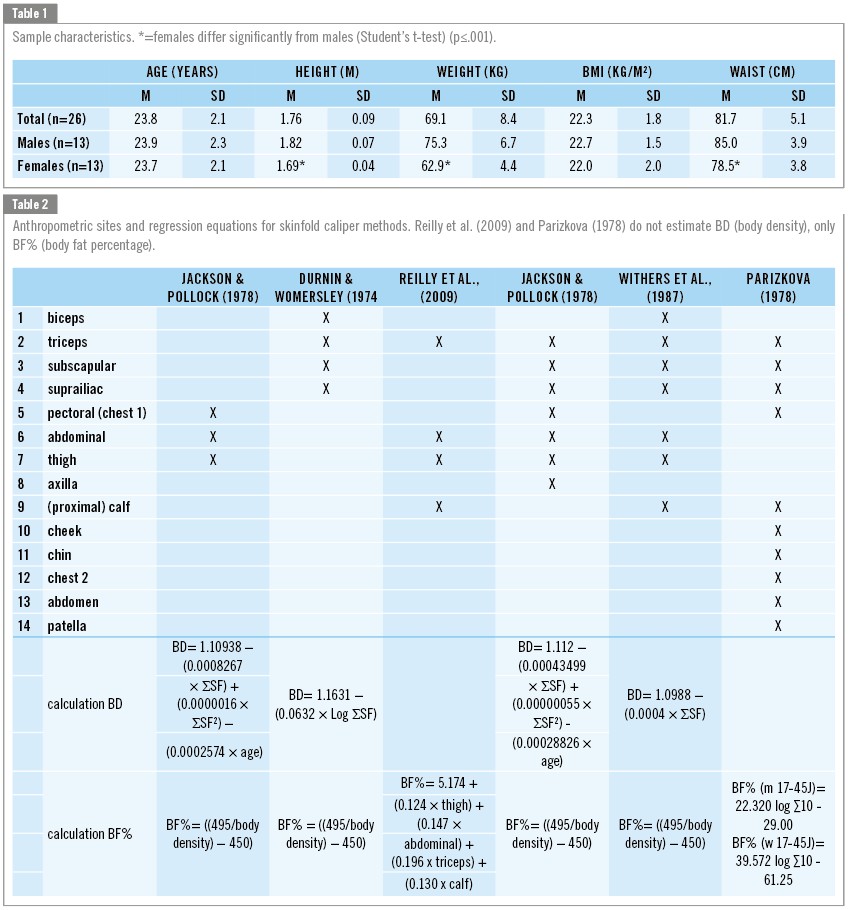
In a cross-sectional study, 26 healthy, normal-weight collegiate athletes (50% males, age 21–29 years, BMI 19.3–24.9 kg/m2) were recruited from a university setting (table 1). Inclusion criteria comprised a minimum activity level of four training sessions per week (~10h), good general health and age between 18 and 30 years. Exclusion criteria included acute illness or injury, high-intensity exercise on the test day, medication affecting body composition or fluid balance and contraindications for ADP measurements.
All participants provided written informed consent prior to participation. The study procedures were covered by an ethics approval (MSH-2023/272).
Procedures
All measurements were conducted in a standardized laboratory environment by the same experienced investigator. Participants followed standardized pre-test conditions, including fasting, empty bladder, abstaining from alcohol and exercise and controlled fluid intake (no drinking for at least 30 minutes before measurements).
Body height (stadiometer), body mass (digital scale) and waist circumference (tape measure) were assessed prior to BC measurements, which were performed in a fixed order: CAL, followed by ADP and BIA, as previously described (21, 24).
Body Composition Assessment
BC was assessed by means of three methods (figure 1). ADP (BODPOD GS-X, Cosmed, Italy) was used as a reference method to estimate body density and derive BF%, FM and FFM. BIA measurements were conducted using a multifrequency, segmental system with standardized electrode placement to estimate BC parameters and body water compartments (mBCA 515/514, Seca, Germany). In contrast to BIA, which is estimating body water distribution and FFM body compartments based on the tissues’ electrical impedance and reactance, ADP estimates BF% using the Siri equation based on body density calculated from body weight and body volume measurements corrected for the thoracic gas volume. FM is calculated by BF% and the according body weight, and FFM is subsequently calculated from body weight minus FM. Skinfold thickness (Harpenden caliper) was measured at standardized anatomical sites by always the same investigator from a professional Sports Medicine Center in the morning hours between 9 and 11 o’clock using established protocols (15). Despite the examiner was not ISAK (International Society for the Advancement of Kinanthropometry) certified, he was well educated and qualified for the precise finding of landmark locations and caliper handling by our research team with decades of clinical and scientific experience in BC analyses. Detailed methodological information was reported recently (21, 24).
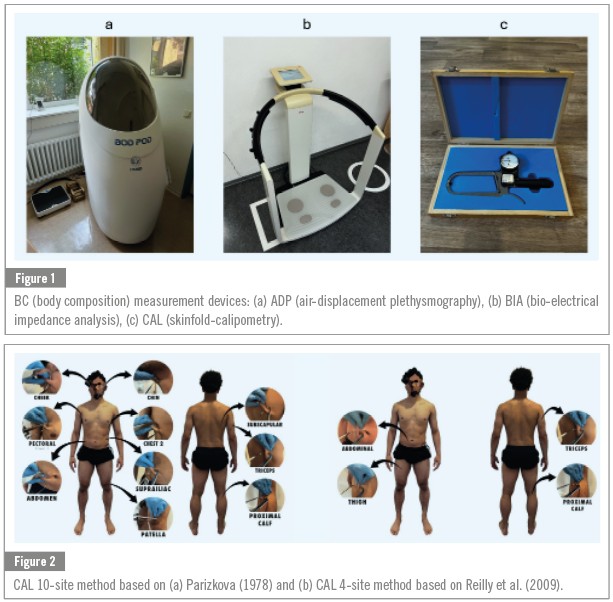
Six CAL methods were applied, including 3-, 4-, 7- and 10-site approaches based on Jackson and Pollock, Durnim and Womersley, Reilly, Withers and Parizkova. BC parameters were calculated using established regression equations (table 2, figure 2). For further methodological details, see previous publications (4, 12).
Statistical Analysis
Data are presented as mean ± standard deviation (SD). Normal distribution was assessed using the Shapiro-Wilk test. Differences between sexes were analyzed using independent t-tests. Method-related differences were examined using repeated-measures ANOVA (one-way and two-way with sex as a factor). In case of significance, the two-way ANOVA interaction effect (device x sex) indicated that sex affected the device/method specific effects. In cases of violated sphericity, Greenhouse-Geisser correction was applied. Post-hoc comparisons were conducted using Bonferroni adjustment. Bland-Altman analyses were performed to assess agreement between methods, including bias and limits-of-agreement (LoA). Statistical significance was set at p≤.05.
Results
Participants characteristics are presented in table 1. No significant differences between male and female participants were observed for age or BMI (p>.05). Sex-specific differences in height and weight are addressed in the legend of table 1 (*).
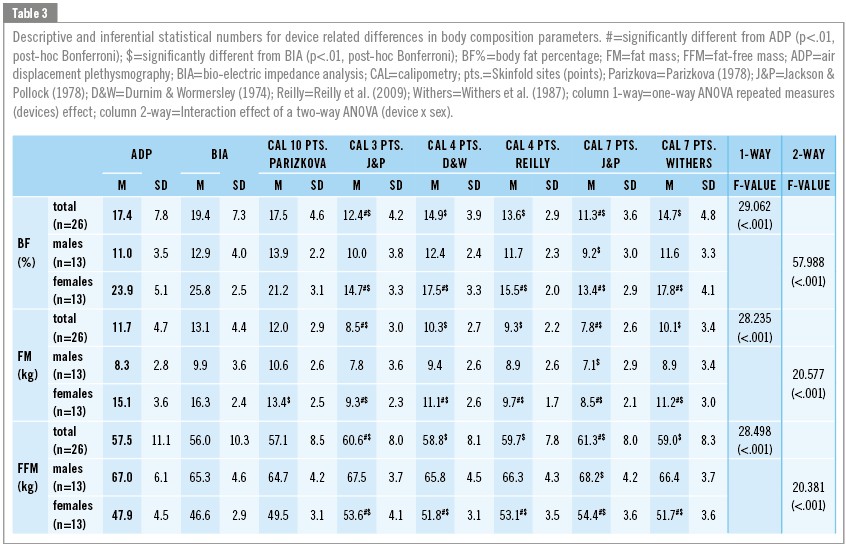
Table 3 describes BC parameters for the advanced laboratory devices (ADP, BIA) and the investigated CAL approaches (mean±SD). Differences between the methods are reported as F- and p-values of a 1-way ANOVA (table 3), while F- and p-values of the interaction effect of a 2-way ANOVA indicated any significant effects of sex on the aforementioned method-specific ANOVA effect (table 3).
Looking at the total sample – males and females together – we found significant differences between the ADP, BIA and our 6 CAL method estimates for BF%, FM and FFM as indicated by the 1-way ANOVA (all p<.001) (table 3, last but one column). Post-hoc analyses revealed that these significances were due to pair-wise comparisons between several CAL methods and the laboratory devices ADP or BIA (see table 3, # and $ indices). Despite higher ADP means for FFM and lower ADP means for BF% and FM compared to BIA measures, post-hoc Bonferroni pair-wise comparisons did not indicate significant differences between ADP and BIA neither for BF%, nor for FM or FFM (table 3). Except for the 10-site CAL method by Parizkova, pair-wise comparisons revealed significant differences for all 3-, 4- and 7-site CAL approaches compared to ADP or BIA (table 3, # or $ indicating p<.01).
Considering probable sex-specific effects, 2-way ANOVAs revealed significant interaction effects (p<.001) underpinning that the statistically significant effect for any device-specific differences of BF%, FM and FFM measures depended on sex (table 3, last column). Further post-hoc analyses of these interaction effects (sex x device) to identify significant differences between all methods for both sexes led to numerous pair-wise Bonferroni adjusted comparisons (Supplement). Summed up – comparable to the total sample – for females, only the Parizkova 10-site method was not significantly different from ADP or BIA while all 3-, 4- and 7-site methods differed significantly (table 3, # or $ indicating p<.01). For males, the post-hoc analyses revealed significant differences only for the comparison of the 7-site Jackson and Pollock method with BIA, but not with ADP measures (table 3, $ indicating p<.01).
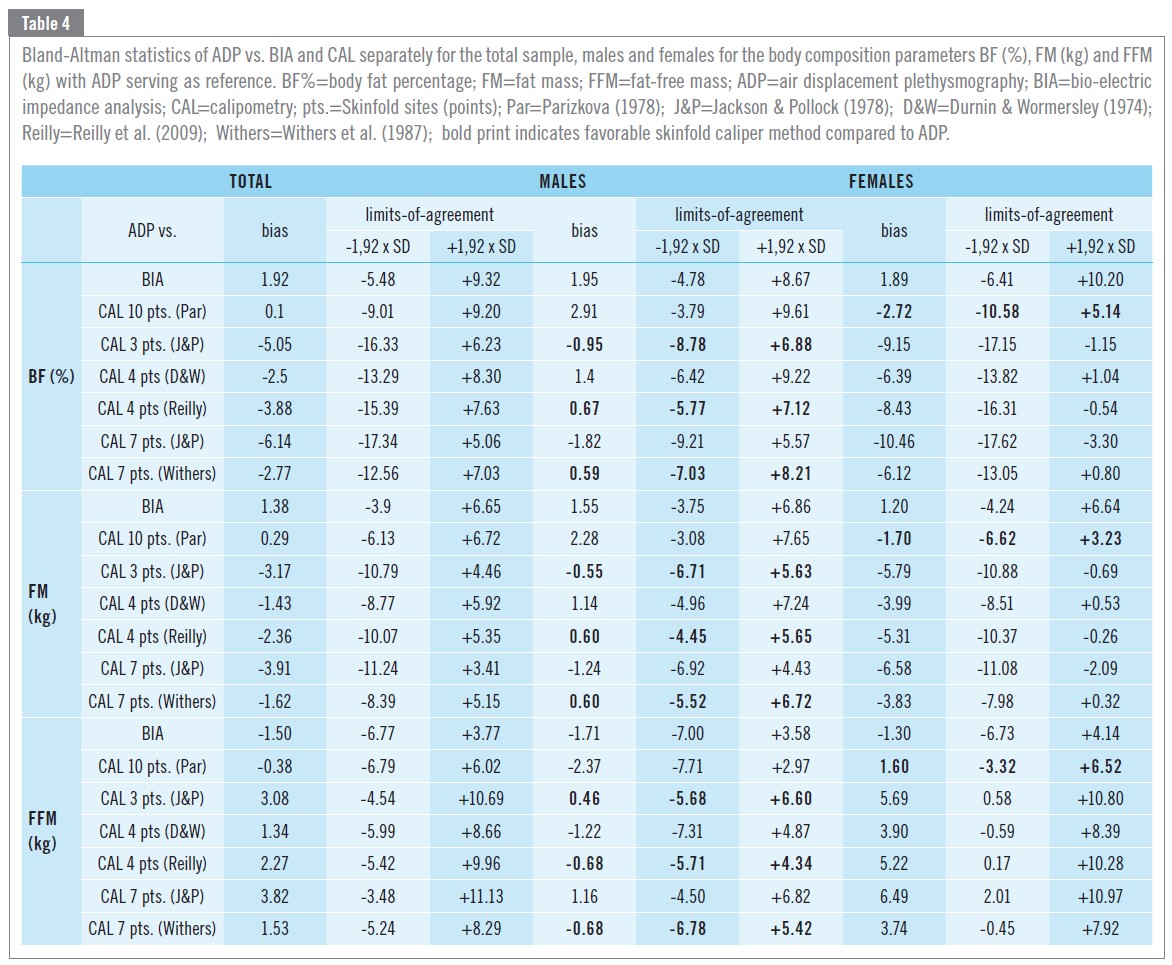
Thus, apart from significance testing, Bland-Altman analyses revealing the systematic bias and the according limits-of-agreement are needed to investigate in detail, which CAL method fits best. Table 4 shows Bland-Altman statistics between ADP – serving as a reference method – being compared with BIA and all 6 CAL methods for BF%, FM and FFM for the total sample as well as for males and females alone.
Referring to the total sample, the 3-site methods showed the largest deviations from ADP. In contrast, multi-site methods (7- and 10-site) demonstrated closer agreement with the reference method ADP (table 4). In males, the 3-site method (Jackson & Pollock), the 4-site method (Reilly et al.) and the 7-site method (Withers) showed the smallest bias of less than 1% or 1 kg, respectively (table 4, males’ bold numbers). If the limit-of-agreement was considered as additional criterion, the Reilly et al. 4-site method demonstrated the narrowest limits-of-agreement corridor relative to ADP across all parameters. In females, the 10-site method (Parizkova) demonstrated the closest agreement (table 4, females’ bold numbers). All other CAL methods (3-, 4-, 7-site) showed a larger bias and broader limits-of-agreement (table 4).
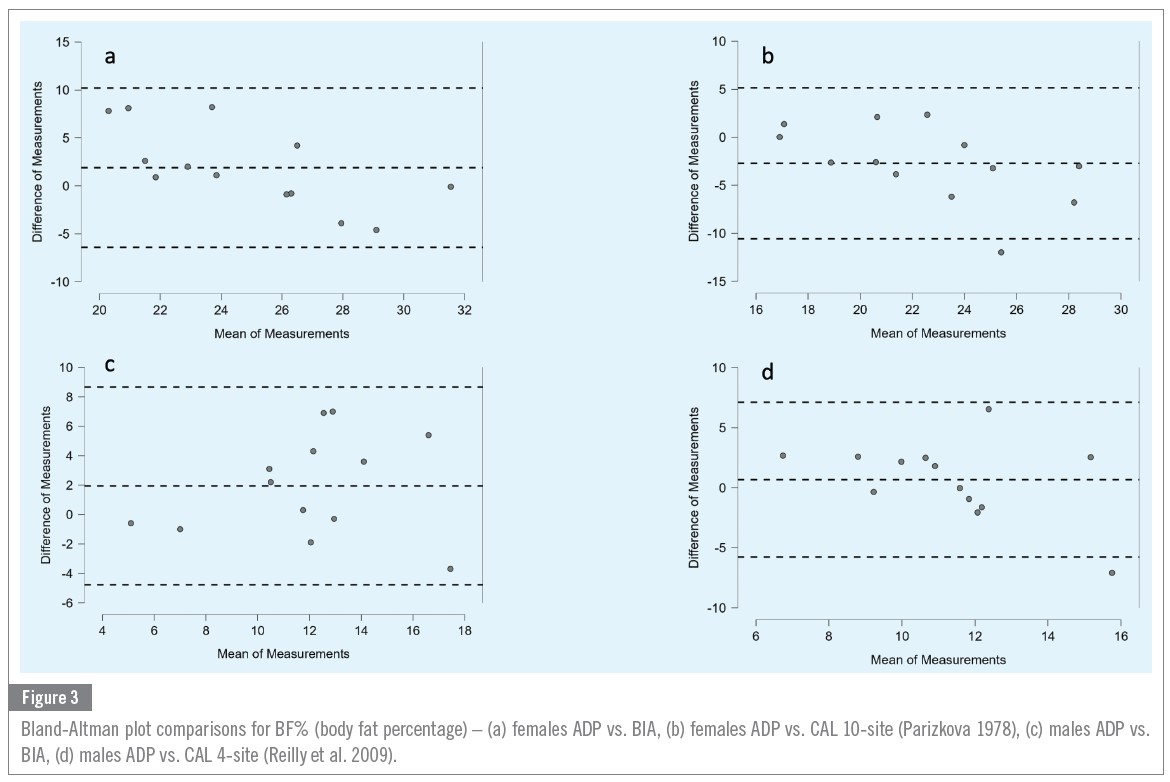
Figure 3 illustrates the bias and the width of the corresponding limits-of-agreement corridor along with the notable individuals’ variability for BF% as an example between ADP – serving as reference – and BIA for females (a) and males (c), as well as for the females 10-site Parizkova (b) and the males 4-site Reilly et al. (d) results.
Discussion
The aim of this study was to compare different skinfold-based methods with laboratory-based methods, especially ADP in order to identify the most suitable approach for body composition assessment in young, normal-weight collegiate athletes in the field or their training environment.
As a side effect, we found no statistically significant differences between the laboratory methods ADP and the 8-electrode, multi-segmental and multifrequency BIA device (table 3), although BIA tended to overestimate BF% (about +2%) and FM (about +1.5 kg) compared to ADP, and underestimated FFM (about -1.5 kg), respectively (table 4). This basic finding was in line with the literature. Compared to ADP, but without using anthropometric CAL methods, as an example Hartmann Nunes et al. (7) reported comparable FM overestimations and FFM underestimations of a BIA device in Rugby athletes (table 3 and 4). Somehow contradictory to our results (table 3), Ostojic (18) investigated a 7-site CAL anthropometric approach and did not find significantly differing BF% estimates compared to their specific BIA device (single 50 kHz, foot-to-foot) in a large sample of male athletes.
In contrast, we found anthropometric skinfold CAL approaches partly differing significantly from both ADP or BIA. Moreover, significant interaction effects revealed that these differences depended also on sex. Thus, the various anthropometric BC assessments showed to be differently suitable to estimate BC either for males or females (table 3). Pairwise comparisons identified the 10-sites CAL method (Parizkova) was most suitable for females (table 3), although BF% and FM were underestimated markedly (about -3%, or -2 kg), and FFM was overestimated by about 1.5 kg, respectively (table 4). Within females, there were more significant differences even between the CAL methods (Supplement), as described earlier (26). Showing deviations (bias) of in average less than 1% or 1 kg, respectively, the 4-sites CAL method (Reilly) fitted best the ADP reference BC parameters BF%, FM and FFM in our sample of younger male collegiate athletes (table 4). But interindividual variability – see the range between the limits-of-agreement (table 4) – must be considered for all those obtained results as illustrated (e.g. Fig. 3a–d).
Overall, there is a large body of literature reporting differences between BC assessment approaches, but when athletic populations and anthropometric skinfold measurements are focused, there are limited findings. A narrative overview by Kasper and colleagues emphasized the valuable role of CAL, but without distinguishing between differing multiple site methods or equations (12). An older systematic review underpinned the favorable suitability of CAL compared to BIA for BC monitoring in athletes due to specific equations for different sports modalities (3), while a younger review comparing ADP, BIA and CAL concluded that field methods like BIA and CAL require further validation due to the lack of reliable reference methods in this specific athletic population, but CAL equations often outperformed BIA devices (20).
Differing in the choice of the reference method, but somehow similar to our research question, Jagim et al. (11) compared skinfold methods with a 3-compartment model (underwater weighing and total body water) revealing that for males, the Evans 3-site equation performed optimally with a mean difference of 1.8 kg FM, which was larger than our result for the bias between ADP and the 4-sites Riley approach (table 4). For females, Jagim et al. (11) found that more sites (Evans 7-site method) performed better than less sites (e.g. Jackson & Pollock 3-site equations), which may be interpreted as comparable to our results emphasizing the 10-site method (Parizkova) outperforming methods using less measurement sites (table 3). Using a 4-compartment reference method, Ploeg et al. (19) found best-performing 3-site skinfold methods, but only in combination with further parameters, e.g. age, waist girth and femur breadth.
Without comparing different anthropometric CAL methods, some further original papers underpinned a better BF% agreement for CAL approaches with ADP (-0.5 BF%, or 0.3 BF%) than for BIA devices (-1.5 BF%, or 1.9 BF%), respectively, in collegiate female athletes (8, 22). These findings were somehow in contrast to our results for females with BIA being slightly better outperforming the best skinfold equation (table 4).
With DXA serving as the reference method, two papers investigated disabled athletes representing a very special population. In wheel-chair athletes, ADP, BIA and CAL underestimated BF% with a newly developed 7-site CAL method showing to be best predictive for wheel-chair athletes (6). Similarly, in a sample of partly amputated Paralympians, beside ADP and BIA assessments several CAL methods and equations underestimated BF% compared to DXA, while the Durnim and Wormersley 4-site method overestimated BF% compared to ADP of about 4% in males and 0.5% in females (23).
Similarly, Tornero-Aguilera et al. (25) investigated BF% with DXA as the reference method and compared the results with a multi-frequency BIA device comparable to ours and an 8-site CAL method in a large sample of male and female football players using a football specific BF% calculation equation. The underestimated BF% by means of this specific CAL method was about 3% BF closer to DXA than the BIA estimate in both males and females, probably allowing for indirect comparisons with our results.
But to the best of the authors’ knowledge, there are no findings comparing directly different CAL methods with ADP analyses serving as BC estimates reference method. Actually, we identified only two conference paper abstracts, unfortunately reporting too less detailed information for male wrestlers (2) or female collegiate athletes (14). Therefore, our findings may contribute to an extended body of evidence for the selection of skinfold-caliper methods and equations, if ADP serves as the laboratory-based reference. Hereby, for males our findings supported the principle that fewer sites measured with higher precision outperform more sites measured with accumulated error. But this was not true for females in our investigation and earlier (11).
Several limitations must be considered for the present work. The sample size was relatively small and limited to young, normal-weight male and female collegiate athletes not distinguishing specific athletic profiles. Future investigations should differentiate between endurance, strength or power athletes. In addition, ADP was used as the reference method instead of DXA or other advanced methods like quantitative magnetic resonance imaging. However, ADP represents a valid and widely used alternative in sports science laboratory settings likely being similar to the earlier ‘gold standard’ underwater weighing. Finally, skinfold measurements depend on examiner expertise, which may have biased the results despite standardized procedures. Moreover, we compared six widely used skinfold measurement methods with according BC estimation equations, but it must not be overlooked that there are further calipometric alternatives and probably more specific equations.
Conclusion
Our data suggest that there is no “one fits all” solution for the choice of the convenient skin-fold CAL method. 10-sites (Parizkova) showed no significant differences compared to ADP in males and females, but Bland-Altman analyses revealed a deeper insight. Based on our population and the reported skinfold CAL approaches, our data suggest that the 4-site method according to Reilly may be recommended for the BC monitoring of male collegiate athletes, while in females, the 10-site method according to Parizkova provided the closest agreement with ADP as an accessible laboratory-based reference method.
Conflict of Interest
The authors have no conflict of interest.
Funding
No funding.
Ethical Approval and Informed Consent
Study procedures were approved by the ethics committee of the Medical School Hamburg (MSH-2023/272).
Data Availability
Datasets are available from the corresponding author on reasonable request.
Author Contributions / Statement of Author Contribution
Conceptualization: SB, GL, RR, JS; Data curation: SB; Analysis: SB, JS; Investigation: SB; Visualization: SB, JS; Writing – original draft: SB, GL, JS; Writing – review and editing: SB, GL, RR, JS.
Summary Box
What is already known about this subject?
- Expensive laboratory-based 4-compartment BC estimates serve as gold-standard reference methods.
- If DXA serves as the reference method, BF% is systematically underestimated by other estimates such as ADP, BIA and skinfold methods.
- ADP is closely related to underwater-weighing serving as an earlier gold-standard.
- Skinfold calipometry as a field test is a BC-change sensitive alternative, but there are numerous skinfold equations.
What does this study add?
- For male collegiate athletes, the 4 sites skinfold caliper equation referring to Reilly showed the closest relation to ADP serving as a reference method.
- For female collegiate athletes, the 10 sites caliper method referring to Parizkova showed the closest relation to ADP.
- Assessing more sites for skinfold-sum BF% estimates may be favorable for certain populations despite a probable error accumulation along with more skinfold measurements.
- At least in male athletes, calipometry may outperform even multi-segmental and multifrequency 8-electrode BIA devices for comparisons with ADP reference BC values.
References
- Quantification of whole-body and segmental skeletal muscle mass using phase-sensitive 8-electrode medical bioelectrical impedance devices. Eur J Clin Nutr. 2017; 71: 1061-1067.
- A comparison of body composition techniques to determine body fat percentages in high school wrestlers. Med Sci Sports Exerc. 2004; 36: S73.
- Skinfold thickness versus bioelectrical impedance for the evaluation of body composition in athletes: a critical review. Rev Bras Cineantropom Hum. 2009; 11: 334-340.
- Kinanthropometry and exercise physiology laboratory manual: tests, procedures and data (3rd ed.). London, New York: Routledge; 2009.
- Body-composition assessment via air-displacement plethysmography in adults and children: a review. Am J Clin Nutr. 2002; 75: 453-467.
- A comparison of methods for the estimation of body composition in highly trained wheelchair games players. Int J Sports Med. 2016; 37: 799-806.
- Assessing body composition in rugby players: agreement between different methods and association with physical performance. J Sports Med Phys Fitness. 2020; 60: 733-742.
- A comparison of body composition measurement techniques. J Hum Nutr Diet. 2014; 27: 626-631.
- Measurement of subcutaneous fat tissue: reliability and comparison of caliper and ultrasound via systematic body mapping. Sci Rep. 2022; 12: 15798.
- The importance of accurate site location for skinfold measurement. J Sports Sci. 2008; 26: 1333-1340.
- Validation of skinfold equations and alternative methods for the determination of fat-free mass in young athletes. Front Sports Act Living. 2023; 5: 1240252.
- Come back skinfolds, all Is forgiven: A narrative review of the efficacy of common body composition methods in applied sports practice. Nutrients. 2021; 13: 1075.
- Bioelectrical impedance analysis - part I: review of principles and methods. Clin Nutr. 2004; 23: 1226-1243.
- Comparison of various body condition measurements to air displacement plethysmography in female collegiate athletes. Med Sci Sports Exerc. 2019; 51: 287.
- Methodological factors and the prediction of body fat in female athletes. Med Sci Sports Exerc. 1984; 16: 92-96.
- Assessment of Body Composition in Health and Disease Using Bioelectrical Impedance Analysis (BIA) and Dual Energy X-Ray Absorptiometry (DXA): A Critical Overview. Contrast Media Mol Imaging. 2019; 2019: 3548284.
- Evaluation of a new air displacement plethysmograph for measuring human body composition. Med Sci Sports Exerc. 1995; 27: 1686-1691.
- Estimation of body fat in athletes: skinfolds vs bioelectrical impedance. J Sports Med Phys Fitness. 2006; 46: 442-446.
- Use of anthropometric variables to predict relative body fat determined by a four-compartment body composition model. Eur J Clin Nutr. 2003; 57: 1009-1016.
- Body composition analysis methods in adolescent athletes: A systematic review. Sports Med Int Open. 2026; 10: a27515759.
- The female athlete—reliability of body composition analyses during the female menstrual cycle in young women without hormonal contraception. Ger J Exerc Sport Res. 2025; 55: 262-269.
- Assessing various body composition measurements as an appropriate tool for estimating body fat in National Collegiate Athletic Association Division I female collegiate athletes. Am J Sports Sci Med. 2014; 2: 1-5.
- Assessing body composition in paralympians: Accuracy of different measurement methods compared with dual-energy x-ray absorptiometry. J Funct Morphol Kinesiol. 2025; 11: 1.
- Are body composition estimates affected by the menstrual cycle in females with or without hormonal contraception? - A case-control study. Eur J Sport Sci. 2025; 25: e12283.
- Differences in body composition analysis by DEXA, skinfold and BIA methods in young football players. Children (Basel). 2022; 9: 1643.
- A comparative study of methods for prediction of body fat percentual: an approach to the method of Dotson & Davis (1991). Fitness & Performance Journal. 2003; 2: 41-48.
- Reference values for skeletal muscle mass - Current concepts and methodological considerations. Nutrients. 2020; 12: 755.
University of Hamburg
Faculty of Psychology and Human Movement Science, Department of Sports Medicine
Turmweg 2, 20148 Hamburg, Germany
jan.schroeder@uni-hamburg.de
ORCID: 0000-0001-9484-1334