

The Efficiency of Evidence-Based Adjustments to Training Methods During Injury Recovery in Track And Field Athletes
Die Effizienz evidenzbasierter Anpassungen der Trainingsmethoden während der Regenerationsphase nach Verletzungen bei Leichtathleten
Summary
Background/Objective: The study examined the efficiency of evidence-based adjustments to training methods during injury among German track and field athletes between 2022 and 2024.
Methodology: This study was a retrospective survey with standardised performance analysis. Data were collected from 360 athletes via an online questionnaire assessing performance, injury prevalence, and injury-related training adjustments. Performance data from injured and uninjured athletes between 2022-2024 were standardised using the World Athletics Scoring Tables of Athletics (WAST). Differences between injured and uninjured athletes were analysed using the Mann-Whitney-U-Test. All analyses conducted in IBM SPSS Statistics.
Results: No significant performance differences were found between injured and uninjured athletes (2022: Mann-Whitney U (U)=7376.5, Z: -0.58, p: .560); 2023: U: 7876.0, Z: -0.64, p: .520); 2024: U: 6829.5, Z: -1.42, p: .156). In terms of competition performance, sub-training adjustments such as “alternative training” (e.g. 2022: 945.4 points; SD: 143.1) achieved higher scores than other adjustments such as “break” (775.6 points; SD: 266.6).
Conclusion/Outlook: Performance comparisons based on the WAST revealed no significant differences between injured and uninjured athletes, however, this finding should be interpreted cautiously given the retrospective study design. Higher scores observed in athletes using sub-training adjustments, such as “alternative training”, indicate their potential for performance maintenance during injury. Future research should examine training adjustments longitudinally and integrate objective and subjective measures.
Key Words: Training Adaptation, Rehabilitation, Questionnare, Mann-Whitney-U-Test, Sub-Training Adjustment
Introduction
During a season, approximately two-thirds of track and field athletes (T&F-A) suffer injuries during training or competition (8, (9, 10, 19). It is essential to maintain an appropriate level of physical activity following an injury, as prolonged recovery periods and complete inactivity can result in substantial declines in physical performance and overall conditioning (25). Within interprofessional rehabilitation management (e.g. coaches, physiotherapists, and physicians), training adjustments play a crucial role (30). In the present study, training adjustments refer to all modifications of the training process during the injury period, including training breaks, restricted regular training, a combination of training breaks and/or alternative training methods and/or regular training with restrictions (combination of adjustments), and alternative training methods. Alternative training methods represent a specific subtype of training adjustment and include exercise modalities such as cycling, aqua jogging, or adapted strength training that target specific injury-related limitations while maintaining physical activity.
In addition, previous research has shown that training adjustments, particularly through strength, technique, and sprint-specific endurance training, are important determinants of performance development, especially in sprinting (14). Among these, alternative training methods can enable athletes to remain active during injury periods, maintain physical performance, and accelerate the return to regular training (20, 26, 30).
Alternative forms of training, such as cycling, can also improve maximum oxygen uptake (V˙O2max), maximum strength and average strength values, which can be particularly beneficial for runners and sprinters (1). It has been shown that AlterG training (anti-gravity treadmill) can achieve a higher metabolic rate with lower overall stress forces, which is particularly beneficial for endurance athletes (7). In the case of hamstring injuries, which are particularly common in athletics, injury-specific training modifications have been shown to shorten the return-to-training period and reduce re-injury rates (30). Similarly, Saeterbakken et al. (2022) found in their study that core muscle training improves physical fitness and sport-specific performance.
The positive effects of training adjustments during injury recovery have been demonstrated in previous research (1, 7, 14, 30, 36). However, it remains unclear whether injured track and field athletes (T&F-A) maintain performance levels comparable to their uninjured counterparts. Therefore, the aim of the present study was to examine whether performance outcomes differ between injured and uninjured athletes following a competitive season. The null hypothesis was defined as follows: H₀: No significant difference in performance outcomes exists between injured and uninjured female and male T&F-A.
Materials and Methods
Study Design and Ethical Committee
This retrospective survey study with standardised performance analysis was approved by the Ethics Committee of the German Sport University Cologne prior to data collection. Participation was voluntary, and all participants provided informed consent prior to participation. Prior to the completion of the questionnaire, participants were required to confirm that they had read the study information and agreed to the data protection regulations.
Participants
Participants were recruited via online distribution of the questionnaire (e.g. athletics websites, social media, and email lists of the German Athletics Federation) (11). The inclusion criteria were athletes who had competed in official track and field events between 2022 and 2024 and who were at least 20 years old at the time of data collection (birth year ≤ 2004), in order to control for age-related performance differences associated with pubertal development (4). The exclusion criteria were incomplete or missing data.
A priori power analysis was conducted using the G*Power software (version 3.1.9.7) to determine the minimum sample size required for the planned inferential statistical analyses (11).
Definitions
A sports injury was defined as “a physical complaint or observable damage to body tissue caused by energy transfer during athletics training or competition, regardless of medical attention or impact on performance” (39).
Athletes who reported being injured in the respective years (2022-2024) but still participated in competitions were classified as injured athletes.
The WAST provide a standardized, cross-disciplinary performance evaluation by converting results from different events into a common points scale (38). This allows performances across disciplines to be directly compared and statistically analysed.
Performance in athletics is based on objective performance metrics such as competition results and rankings. By applying a contextual framework and analysing these metrics using specific constructs, a performance outcome is generated that enables a standardized and meaningful evaluation of athletic performance (32).
Evidence-based adjustments were operationalised as the alignment of reported training modifications with established sports science recommendations and were considered as a potential explanatory factor; however, no specific statistical analysis of their effects was performed. The term refers to the specific training and rehabilitation modalities included within the adjustment categories (e.g. aqua jogging, cycling, modified strength training, or temporary training cessation), rather than to the categories themselves.
In the questionnaire, athletes indicated how they adapted their training during injury, with response options classified into five categories: 1) alternative training, 2) combination of adjustments, 3) training break, 4) regular training with restrictions, and 5) no change. These categories were used to cluster the different methods athletes employed during injury.
Alternative training comprised aquajogging (5), cycling (17, 22), stability training (34, 41), stretching/yoga/pilates (3, 37), modified strength and running training (2, 24), modified jumping (16, 21), gymnastics (23, 35).
Regular training with restrictions referred to the continuation of regular training while modifying aspects such as training volume, intensity, frequency, or specific training content due to injury. (28).
Temporary training break was included as one of the reported injury-management strategies, as short periods of unloading or rest may be indicated for specific injuries and phases of rehabilitation. However, current sports medicine recommendations generally favour an individualized and progressive return to activity rather than prolonged complete rest (18, 28).
Data Collection
The questionnaire was developed using the online platform Umfrageonline.com. It was pre-tested with ten participants to ensure clarity, technical functionality, and comprehensibility of the questions. Following the pre-test, minor revisions, including spelling corrections and more precise wording of selected questions, were implemented before the questionnaire was published online on various websites and distributed to squad athletes via the German Athletics Association’s email mailing list. The survey collected data on gender, year of birth, athletics discipline, competition performances from 2022 to 2024, injury occurrence during the same period, and training adjustments during injury phases.
Statistical Analysis
Injured athletes were asked to report the training adjustments implemented during their injury periods. However, due to insufficient subgroup sizes, the different types of training adjustments were not analysed statistically. Nevertheless, they may be relevant for the interpretation of the results.
Once the sample size determined by the power analysis had been reached, the data collected from the questionnaire were evaluated. For this purpose, the collected data were presented descriptively, and selected data were evaluated statistically. The dataset was specifically structured to enable a comparison between injured and uninjured athletes.
The statistical evaluations were performed using G-Power tests (G*Power, version 3.1.9.7) and the statistical software IBM SPSS Statistics 30.Ink (11, 15). Two groups were created: injured (group 1) and uninjured athletes (group 2). Mean performance differences were compared separately for the years 2022 to 2024, as athletes could be injured in one year but not in another, resulting in changing group membership across years. A combined analysis would therefore have led to ambiguous group allocation and violated the assumption of independent observations. To test the null hypothesis, the data for the respective test subject cohort (injured versus uninjured) was first tested for normal distribution using the Kolmogorov-Smirnov test. The hypothesis of normal distribution was rejected (p<0.05), confirming the suitability of the test. Accordingly, a Mann-Whitney U test was then performed. The Z-value indicates the direction and magnitude of the difference between injured and uninjured groups.
Descriptive statistics for each group are presented as means and standard deviations (SD). Because the data were not assumed to be normally distributed, group comparisons between injured and uninjured athletes were performed using the Mann–Whitney U test. To ensure consistency with the non-parametric analysis, median and interquartile range (IQR) values for each group are additionally reported alongside the Mann-Whitney test statistics (U, Z, and p values).
Results
Participant characteristics and injury prevalence: Of the 379 complete responses received, 360 datasets met the inclusion criteria and were included in the final analysis (men: n=171, 47.5%; women: n=189, 52.5%; age 30±11.8 years). Of these, 92 competed in the U23 category, 198 in the senior (adult) category, and 70 in masters categories (>35 years). In terms of disciplines, 110 athletes were sprinters, 72 jumpers, 68 distance runners, 55 throwers, and 55 combined event athletes. A total of 53 participants were national squad athletes, while 307 had no squad status. A total of 292 out of 360 athletes (79.4%) who participated between 2022 and 2024 stated that they had been injured at least once or were injured at the time of the survey. The required sample size of 105 participants per group (injured vs. uninjured; total n=210) was exceeded in each analysed year, based on the respective annual subsamples (2022: n=257; 2023: n=258; 2024: n=248). However, in 2022, the required subgroup size of 105 individuals was not achieved, as the group of injured individuals comprised 97 people. A post-hoc power analysis was conducted to evaluate the statistical power of the sample (2022) given this distribution. The analysis yielded a power of 97.2 per cent at a significance level of alpha=0.05, a total sample size of 257 and an assumed effect size of d=0.5.
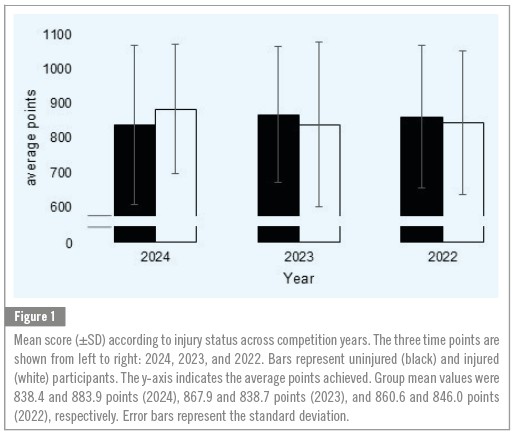
Performance comparison between injured and uninjured athletes: The mean value from the WAST (2025 Revised Edition) for 2022 indicates a discrepancy of 1.7% between injured and uninjured athletes (mean: 846.0 points, SD=208.1 vs. 860.6 points, SD=207.0; Mann-Whitney U=7376.5, Z=-0.58, p=.560, median: 860 points, IQR: 267 vs. median: 896 points IQR 275). The mean difference in 2023 was 3.4% between injured and uninjured athletes (mean: 838.7 points, SD=239.1 vs. 867.9 points, SD=196.7; Mann–Whitney U=7876.0, Z=-0.64, p=.520, median: 869 points, IQR: 293 vs. median: 895 points IQR 299). Furthermore, a difference of 5.4% between injured and uninjured athletes was determined in 2024 (883.9 points, SD=186.8 vs. 838.4 points, SD=230.5; Mann–Whitney U=6829.5, Z=-1.42, p=.156, median: 902 points, IQR: 280 vs. median: 865 points IQR 320). Although descriptive differences were found between injured and uninjured athletes (see figure 1), the analyses for the years 2022 to 2024 showed no statistically significant differences in performance values.
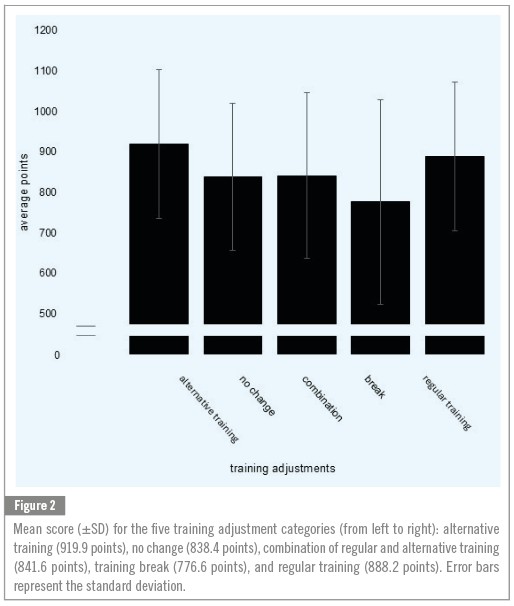
Descriptive analysis of training adjustments: The following figure (figure 2) shows a descriptive comparison of the mean performance values of the different training adaptations over the entire survey period from 2022 to 2024. A comparison of the mean values of the different training adjustments over the entire survey period from 2022 to 2024 shows that “alternative training” has the highest mean score with 919.9 points (SD: 183.9). The second-highest score was achieved with the “regular training with restrictions” method (888.2 points; SD: 184.2). In the categories ”No change” and “Combination of adjustments”, 838.4 (SD: 181.9) and 841.6 (SD: 204.0) points were achieved. The lowest score was achieved with a break (776.6 points; SD: 253.2).
Discussion
Main Findings
The main finding of the present study is that no significant differences in performance were observed between injured and uninjured track and field athletes across the analysed seasons, despite a high prevalence of injuries. Injuries are a recurring phenomenon that plays a significant role not only in competitions but also in the preparation phase for the upcoming season (6, 9, 10, 19). Given the high prevalence of injuries in an athletics season, achieving individual performance peaks and the continuity of the competition season can be jeopardised (26, 31). During a season, about two-thirds of all athletes suffer at least one injury (9, 10, 19). Our results are consistent with the aforementioned studies.
Performance Comparison
The mean scores of injured and uninjured athletes show a relatively similar development in performance level over the observed years (differences in performance: 1.8%; 3.4%; 5.4%), suggesting that training adjustments have less of an impact on the performance of injured athletes than long breaks (12). The results show that injured and uninjured athletes do not have statistically significant differences in their performance in the respective years 2024, 2023 and 2022.
Role of Alternative Training Methods
The importance of the sub-training adjustment “alternative training” options during the injury phase of T&F-A was investigated. A substantial proportion of athletes reported engaging in “alternative training” or “combinations of adjustments” (2024: 37% and 46%; 2023: 24% and 49%; 2022: 26% and 37%), indicating that these represent predominant strategies during injury periods. While training adjustments were documented descriptively, their specific impact was not analysed statistically, as subgroup sizes were too small to allow for meaningful comparisons. These patterns could be one possible explanation for the maintained performance levels observed in injured athletes; however, this assumption cannot be confirmed based on the present analyses.
Injuries are a recurring phenomenon that plays a significant role not only in competitions but also in the preparation phase for the upcoming season (6, 9, 10, 19). This results in a considerable need for action to optimise training strategies during the injury phase in order to return to regular training or competitive sport (return to sport) as quickly as possible (30). The results show that injured and uninjured athletes do not have statistically significant differences in their performance in the respective years 2024, 2023 and 2022. This could be due, among other things, to the subgroup of training adaptation “alternative training” in the group of injured athletes. “Alternative training” is one way of adjusting training during the injury period. Compared to other training adjustments, such as “break”, “alternative training” has higher mean values (WAST) and it may be posited that this could have a beneficial effect on the mean overall scores of all athletes in the injured group. Although no specific statistical analysis of the influence of “alternative training” was performed due to the small group size, the higher mean values in the injured group compared to the other training adjustment options suggest that this training may have potentially contributed to maintaining the performance of the injured athletes. One possible explanation for the comparable performance between injured and uninjured athletes could be due to intensified monitoring or participation in specific training programs during the injury period, which aim to return athletes to regular training as quickly as possible (1, 7, 14, 30, 36). Various previous study results support this assumption (5, 26). It has been shown that joint-friendly forms of training that are part of “alternative training”, such as cycling or aqua jogging, can help injured athletes maintain their performance levels. In addition, it has been shown that active recovery can promote blood circulation and tissue healing (33, 40).
Conclusion and Key Takeaway
In conclusion, no significant performance differences were found between injured and uninjured track and field athletes. Overall, the findings are primarily descriptive and do not allow causal conclusions regarding the role of training adjustments in maintaining performance during injury periods. In particular, the descriptive results indicate higher mean performance values for “alternative training” and for the combination of break and/or alternative training and/or regular training with restrictions, suggesting a potentially relevant role of these approaches, which requires further investigation. However, due to the retrospective design and other limitations, these findings should be interpreted with caution. Further research is needed to confirm these results and to better understand the effectiveness of different rehabilitation strategies.
Conflict of Interest
The authors have no conflict of interest.
Funding
None
Ethical Approval and Informed Consent
This retrospective survey study was approved by the Ethics Committee of the German Sport University Cologne prior to data collection. Participation was voluntary, and all participants provided informed consent before completing the online questionnaire. Participants confirmed that they had read the study information and agreed to the applicable data protection regulations.
Data Availability
The datasets generated and analysed during the current study are available from the corresponding author upon reasonable request, subject to applicable data protection regulations.
Author Contributions / Statement of Author Contributions
The authors contributed to the study conception and design, data collection, statistical analysis, interpretation of the results, and manuscript preparation. All authors reviewed and approved the final version of the manuscript.
Acknowledgments
Ethical approval for the study was granted by the responsible Ethics Committee (Ethics Application No. 163/2024). The committee raised no objections to the proposed research project.
Summary Box
The study used the World Athletic Scoring Table to analyse the sporting performance of injured and uninjured German track and field athletes between 2022 and 2024, and found no significant differences.
While adjustments to training, such as alternative methods, led to better competition results, these were not analysed statistically and should therefore be interpreted with caution.
References
- The effect of bicycle training program on aerobic and anaerobic performance. Turkish Journal of Sport and Exercise. 2020; 22: 19-23.
- The effect of strength training on performance in endurance athletes. Sports Med. 2014; 44: 845-865.
- Acute effects of muscle stretching on physical performance, range of motion, and injury incidence in healthy active individuals: a systematic review. Appl Physiol Nutr Metab. 2016; 41: 1-11.
- Timing of puberty in boys and girls: A population-based study. Paediatr Perinat Epidemiol. 2019; 33: 70-78.
- Recommendations for hamstring injury prevention in elite football: translating research into practice. Br J Sports Med. 2019; 53: 449-456.
- Relationships between performance and injury occurrence in athletics (track and field): A pilot study on 8 national-level athletes from sprints, jumps and combined events followed during at least five consecutive seasons. Front Sports Act Living. 2022; 4: 852062.
- Anti-Gravity treadmill training for prevention and rehabilitation of running injuries. Clinical Care of the Runner: Elsevier. 2020: 113-130.
- Injuries in athletics (track and field): A narrative review presenting the current problem of injuries. Dtsch Z Sportmed. 2024; 75: 132-141.
- Having an injury complaint during the four weeks before an international athletics (‘track and field’) championship more than doubles the risk of sustaining an injury during the respective championship: a cohort study on 1095 athletes during 7 international championships. J Sci Med Sport. 2022; 25: 986-994.
- Prevalence, incidence and characteristics of musculoskeletal injuries in Athletics (track and field): a systematic review and meta-analysis. Br J Sports Med. 2026; 60: 450-464.
- Statistical power analyses using G*Power 3.1: tests for correlation and regression analyses. Behav Res Methods. 2009; 41: 1149-1160.
- Resistance exercise training improves disuse-induced skeletal muscle atrophy in humans: a meta-analysis of randomized controlled trials. BMC Musculoskelet Disord. 2025; 26: 134.
- Recall bias can be a threat to retrospective and prospective research designs. The Internet Journal of Epidemiology. 2006; 3: 4.
- The training and development of elite sprint performance: an integration of scientific and best practice literature. Sports Med Open. 2019; 5: 44.
- Ink. IBM SPSS Statistics Version 30.0.0., 2024.
- Effect of plyometric training on sand versus grass on muscle soreness and jumping and sprinting ability in soccer players. Br J Sports Med. 2008; 42: 42-46.
- Increase in the proportion of fast-twitch muscle fibres by sprint training in males. Acta Physiol Scand. 1990; 140: 359-363.
- A systematic review of early rehabilitation methods following a rupture of the Achilles tendon. Physiotherapy. 2012; 98: 24-32.
- Epidemiology of injuries in track and field athletes: a cross-sectional study of specific injuries based on time loss and reduction in sporting level. Phys Sportsmed. 2022; 50: 20-29.
- Return to work following an aquafitness and muscle strengthening program for the low back injured. Arch Phys Med Rehabil. 1994; 75: 1247-1255.
- Correlations between horizontal jump and sprint acceleration and maximal speed performance: a systematic review and meta-analysis. PeerJ. 2023; 11: e14650.
- Performance and fibre characteristics of human skeletal muscle during short sprint training and detraining on a cycle ergometer. Eur J Appl Physiol Occup Physiol. 1997; 75: 491-498.
- A Systematic Review of Dynamic, Kinematic, and Muscle Activity during Gymnastic Still Rings Elements. Sports (Basel). 2023; 11: 50.
- Improved Maximum Strength, Vertical Jump and Sprint Performance after 8 Weeks of Jump Squat Training with Individualized Loads. J Sports Sci Med. 2016; 15: 492-500.
- Auswirkungen von Bewegung auf die Gesundheit. Gesundheitswesen. 2020; 82: S184-S195. doi:10.1055/a-1217-0549
- Injury. In J. Taylor & G. Wilson (Eds.), Applying sport psychology: Four perspectives. Human Kinetics. 2005; 187–206.
- Health benefits of cycling: a systematic review. Scand J Med Sci Sports. 2011; 21: 496-509.
- The Injury/Illness Performance Project (IIPP): A Novel Epidemiological Approach for Recording the Consequences of Sports Injuries and Illnesses. J Sports Med (Hindawi Publ Corp). 2013; 2013: 523974.
- Effect of practice distribution and experience on the performance and retention of a discrete sport skill. Percept Mot Skills. 2013; 116: 750-760.
- A 4-year study of hamstring injury outcomes in elite track and field using the British Athletics rehabilitation approach. Br J Sports Med. 2022; 56: 257-263.
- Performance success or failure is influenced by weeks lost to injury and illness in elite Australian track and field athletes: A 5-year prospective study. J Sci Med Sport. 2016; 19: 778-783.
- What Is Performance? A Scoping Review of Performance Outcomes as Study Endpoints in Athletics. Sports (Basel). 2019; 7: 66.
- Angewandte Sportphysiotherapie: Untere Extremität. Springer Berlin Heidelberg; 2020.
- Core training and performance: a systematic review with meta-analysis. Biol Sport. 2023; 40: 975-992.
- Electromyographic Analysis of the Support Scale in Gymnastics and Its Related Preconditioning Strengthening Exercises. J Strength Cond Res. 2025; 39: 680-686.
- The effects of trunk muscle training on physical fitness and sport-specific performance in young and adult athletes: A systematic review and meta-analysis. Sports Med. 2022; 52: 1599-1622.
- Dehnen versus Krafttraining – Beweglichkeit verbessern. physiopraxis. 2021; 19: 28-31.
- Scoring tables of athletics: tables de cotation d’athletisme, 2025. [Accessed October 7, 2026].
- Injury and illness definitions and data collection procedures for use in epidemiological studies in Athletics (track and field): consensus statement. Br J Sports Med. 2014; 48: 483-490.
- Sehnenmanagement in Praxis und Klinik am Beispiel der Achillessehnentendopathie. In: Jerosch J, Linke C, eds. Patientenzentrierte Medizin in Orthopädie und Unfallchirurgie: Lösungen für Patientenorientierung, Qualität und Wirtschaftlichkeit. Springer; 2016: 363-376.
- Effect of gymnastics on balance ability in children aged three to six years. Front Psychol. 2025; 16: 1549741.
German Sport University Cologne
Institute for Movement and Neuroscience
Am Sportpark Müngersdorf
50933 Köln, Germany
kai.kazmirek@stud.dshs-koeln.de